
Shared Wisdom, with Dr. Alex Pentland
- Posted by Action Catalyst
- On December 16, 2025
- 0 Comments
- AI, artificial intelligence, author, Business, computer science, cybersecurity, data, science, tech, technology
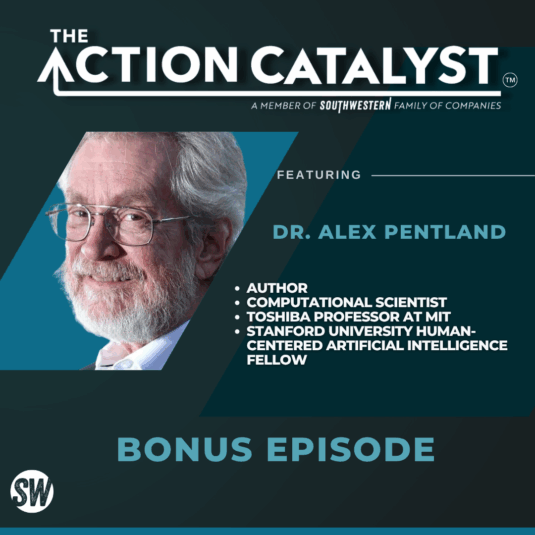
Alex “Sandy” Pentland, a Professor at MIT, a Stanford University Fellow, and one of the most cited computational scientists in the world, dives into the misunderstood issues and opportunities around artificial intelligence, including alignment, human centricity, how different nations are handling the new tech, and the application you can put to work in your business straight away that he calls “a little bit of genius”.
Episode sponsored by:

About Dr. Pentland:
Professor Alex ‘Sandy’ Pentland has helped create and direct the MIT Media Lab and the Media Lab Asia in India, and is a HAI Fellow at Stanford. He is one of the most-cited computational scientists in the world, and Forbes declared him one of the “7 most powerful data scientists in the world” along with Google founders and the Chief Technical Officer of the United States. He co-led the World Economic Forum discussion in Davos that led to the EU privacy regulation GDPR, and was one of the UN Secretary General‘s “Data Revolutionaries” helping to forge the transparency and accountability mechanisms in the UN’s Sustainable Development Goals. He has received numerous awards and distinctions such as MIT’s Toshiba endowed chair, election to the U.S. Academy of Engineering, the McKinsey Award from Harvard Business Review, the 40th Anniversary of the Internet from DARPA, and the Brandeis Award for work in privacy. Recent invited keynotes include annual meetings of OECD, G20, World Bank, and JP Morgan.
He is a member of advisory boards for the UN Secretary General, the UN Foundation, Consumers Union, and formerly the OECD, American Bar Association, Google, AT&T, and Nissan. He is a member of the U.S. National Academy of Engineering and council member within the World Economic Forum.
Companies co-founded or incubated by Pentland’s lab include the largest rural health care service delivery system in the world , the news and advertising arm of Alibaba , the identity authentication technology that powers India’s digital identity system Aadahar, and rural service outlets for India’s largest payment solutions provider .
More recent spin-off companies include Ginger.io (mental health services), CogitoCorp.com (AI coaching for interaction management), Wise Systems (delivery planning and optimization), Sila Money (stable bank and coin), Akoya (secure, privacy-preserving financial interactions), and Prosperia (Fairness and bias mitigation for social services throughout Latin America), and Array Insights (federated medical data analytics).
Over the years Sandy has advised more than 80 PhD students. Almost half are now tenured faculty at leading institutions, with another one-quarter leading industry research groups and a final quarter founders of their own companies. Together Sandy and his students have pioneered computational social science, organizational engineering, wearable computing (Google Glass), image understanding, and modern biometrics. His most recent books are Building the New Economy and Trusted Data, both published by MIT Press, Social Physics, published by Penguin Press, Honest Signals, published by MIT Press, and Shared Wisdom by MIT Press.
Interesting experiences include dining with British Royalty and the President of India, staging fashion shows in Paris, Tokyo, and New York, and developing a method for counting beavers from space.
The Action Catalyst is presented by the Southwestern Family of Companies. With each episode, the podcast features some of the nation’s top thought leaders and experts, sharing meaningful tips and advice. Learn more at TheActionCatalyst.com, subscribe below or wherever you listen to podcasts, and be sure to leave a rating and review!
LISTEN:
SUBSCRIBE TO OUR RSS FEED: https://feeds.captivate.fm/the-action-catalyst/
SUBSCRIBE ELSEWHERE: https://the-action-catalyst.captivate.fm/listen
__________________________________________________________________________
(Transcribed using A.I. / May include errors):
Host
Professor Alex Pentland is a Toshiba professor at MIT, a Stanford University human centered artificial intelligence fellow, and importantly, one of the most cited computational scientists in the world. And Sandy, it is delightful to have you with us on the program. Thank you for making the time.
Dr. Alex Pentland
Well, I’m glad to be here. I think these things that you guys are talking about are really the where the rubber hits the road. It’s the important stuff.
Host
Let’s start with a little bit of table setting for our audience. Just tell our listeners first what exactly is data science?
Dr. Alex Pentland
You know, it sounds scary, but we all know about the census. So in around 1840 a couple of guys said, hey, you know, we ought to know how many people live in each city in order to figure out, you know what to do. And so they created the census and and so it allowed the government and and businesses to do a better job, because now they knew things about the situation. Well. Now we have lots of things in the census. We have other sort of surveys, and private people do it too, right? And all that gives you not it’s not personal data those sorts of things. They’re data about communities, and it gives you a better sense of what’s going on. You can tell what social programs work and which ones don’t. There’s small things that communities can do that have outside effects, and then there’s things that are very expensive that they do do that seem to have no effect at all. So that’s the sort of stuff that is. Is the data science I like. There’s also the surveillance capitalism stuff, which is companies trying just, you know, get everything about you so they can sell you more stuff that, I don’t like.
Host
Before we get into some of the current work, there’s one other thing that you’re widely credited for, I’d love for you to address for our audience, which is that you’re one of a small handful credited with the concept behind and the popularization of the idea of the living laboratory.
Dr. Alex Pentland
A Living Lab is an experiment. And what a community will do is they say, look, things are not going for. Say, our kids education, just to pick one. What we’d like to do is we’d like to have additional sort of surveys and things, and then we will try new policies. We’ll say, Well, what about this? And they’ll try it on, you know, maybe half of the town, and not on the other half of the town. And they’ll say, Well, is it really doing anything? So it’s sort of evidence based change, but it lets you tell what’s working and what’s not working for your community. That’s a living lab.
Host
AI is the focus of your work these days, something you address in your book, Shared Wisdom: Cultural Evolution in the Age of AI, and it’s out now. You speak of the need to build technology and systems that align with human nature. Can you speak a little of that? Why it’s important to have that alignment before innovation?
Dr. Alex Pentland
Yeah, so in one sense, I think this whole problem is miscast. So you know, if you look over history, you see things like the enlightenment and other sorts of places where there was a lot of cultural change, which is, incidentally, something we need, because we have a lot of global challenges and local challenges to face. So we need to, you know, figure out a better way to live that doesn’t, you know, takes care of some of those problems. And the obvious thing to do, from a tech point of view, is you build something that gives you the answer, but that’s wrong, because humans are the ones that live in this world, and we have to understand what’s happening. And when you build something, it’s it’s like, this is abstraction. It sort of lacks the human element to it, and also it’s static, so it’s backward looking, like all this AI stuff, right? It’s all what people said five years ago, you know, 10 years ago. So they can’t keep up with current context. They don’t know how it feels to be a human. So it’s really important to have AI and humans work together, where the humans can provide the context, the perspective the AI can help us. And if you look at the places where we’ve been really, really successful, it helps us know what other people are thinking. It helps us have conversations that are productive conversations, and it helps us sort of reflect on ourselves, to understand ourselves better. And those are the three themes in the book. And so that avoids the alignment by leaving the alignment with the people. It’s only when you try to replace people that you want to have things that are doing what we want and doing what we want. Well, I don’t know about you, but I have a hard time knowing what I want. I mean, I could see ads, I hear what happens on, you know, streaming TV, etc. But it’s usually only when you get into it that you realize, hey, this is not fun, or Wow, this is a lot better. Than I thought it would be. Having things in line with that when we don’t even know, it seems a little bit unlikely.
Host
If AI is ultimately training on human created material, why isn’t the output more human centric when all of the input is?
Dr. Alex Pentland
There’s two things here. One is, you know, what it’s training on is just what people say on the internet. It’s not even what they say in private, and it doesn’t have all of the feeling and experience of actually being in a place. So it’s just saying, Oh, this is what people say. And, you know, you and I do this all the time. Also, it’s like, if someone comes up and says, Hey, what about X, right? You can give a paragraph of answer. You may know almost nothing about it, but you’ve heard things, and you know that’s what AIs are. They’re sort of like the common conversation. Don’t live your life according to what you hear. You know, in that sort of banter, because some of it’s right, but some of it’s not right, and in particular, it’s not necessarily right for you. But let me give you an alternate so I was on a panel with the Chief Technical officers of a couple of the really big companies. Each of them had already done one thing. They’d taken all of the manuals and newsletters and, you know, reporting stuff that in their company, and stuck it in one of these AIs, and they built a separate AI for every single person. This is actually really easy to do. And so instead of having the manual that nobody reads and the newsletter that maybe you scan, but you know, who has the time, yeah, it’s still a common conversation. It’s not like deep, you know, insight or something, but now you’re much more tuned in through this little it’s like a smart librarian, AI, than you were before. So you’re part of the culture better, you know what’s going on. You can be much more appropriate. It’s a really, really sort of simple to do and be a little bit of genius.
Host
You know, technology and AI are both things that very much exist, kind of without borders. But as an advisor to the Abu Dhabi Investment Authority lab, having worked with the EU and the UN Secretary General’s office, you know, you’ve seen how different countries and different governments deal with the challenges and the opportunities that are caused by new technology. So the technology is somewhat without borders. What we do with it very much comes down to the governing body. How are other countries addressing AI compared to the way the United States is? Are they doing something that we should be doing, or is there something that we should all be doing together that we’re really not yet?
Dr. Alex Pentland
Yeah, well, different countries have different strategies, right? I’m helping Abu Dhabi because they’re looking at, how are we going to be alive, how are we going to be as a country 40 years from now, when there’s no more oil, right? Or the oils unreliable ways. And they think that probably being in data centers and things like that is not a bad bet for that 40 tier time horizon. So they’re making open source things that they’re giving away so that they can begin to provide infrastructure for other countries. China has a different strategy, which people mistake all the time in the US venture capital is trying to do these frontier models and billions of dollars, China says, Yeah, okay, we can do some of that. But actually what we’re interested in doing is AI that helps order, you know, parts for this thing, or ship this. There all these very concrete processes that make the world go, make the government go, make the markets go, make people’s lives easier. And so they’re trying to develop efficient, small ais that do these sorts of things. Now, why are they doing that? Well, first of all, it’s going to make money at every step. But second of all, they end up being sort of their systems are now the dominant systems in the world if they can get everybody else to use it. So that’s their game. We’re not trying to get everybody onto our systems. We just assume it’s going to naturally happen. But I think we’re wrong. I think we need to think about what the rest of the world needs in a very practical sense, and that is the sort of place to sort of function is making human life, human trade, human companies, human governments, better. That’s not what the VCs want. The venture capitalists want these things that are like complete brainiacs, because they feel like there’ll be a few companies that supply all of the AI, all of the advice, all of the answers to everyone. And so it’s exciting for us is that now some of these open source AIS will run on a smartphone. You don’t need that data center. It’s right there, right? It’s also cheap. Cheap enough to do this where, you know, they talk about billions and billions of dollars for the frontier. I mean, I see people like in universities building full blown AIS, you know, and it’s a couple graduate students, you know, when they that takes them a year. I even see things that are much faster than that, building on some of these open source things that are, you know, fairly cheap, right? So, so there’s the possibility of doing that, but I’ll tell you, having worked in in Africa and worked in India and places like that, they don’t necessarily need the brainiac thing. They do need something that speaks their own language, that reflects their own culture. Those are called Sovereign AIS, and they need something that will help them live better. So you know, if you ask me, What am I most proud of that came out of my lab? It was a system. It’s a simple little AI system, and it helps nurses take care of people in most poor parts of the world, the nurses go home to home to home to home, village to village, and so the little thing that we built over the years now serves 400 million people to help them be healthy, and takes, gives advice and help to one out of every 30 births in the whole world. It’s a simple thing. It’s a not for profit, but you know, you can really make the babies healthier using these sorts of things, because what you’re doing is very practical stuff. They’re not rocket science. They’re fairly standard things that people have agreed to really work on average. And a lot of the world just doesn’t have access to that sort of information. And increasingly they do, where a little bit of advice goes a long way right. And those are the sorts of things that these little intelligences can do. So personally owned, personally serving you. We call that loyal agents. I think that’s the way it’s going to play out, much more practical than these frontier models.
Host
You know, for people who have concerns, who are a little alarmist over AI and where it could go, one of the, I guess, cold comforts to them has been that AI is quite expensive to produce and requires a lot of resources. That’s not necessarily true anymore, as we’re discussing. Is there any type of concern over the fact that it might be easier for bad actors to enter the AI space as the things necessary to do so become less prohibitive?
Dr. Alex Pentland
Oh yeah. Again, I think people in the US Canada are a little misguided. They’re worried about the Uber intelligence that will control us all, long before that happens, bad guys are going to get a hold of reasonable sort of AIS, like the AIS that exist today and are free and open, and they’re going to be using it, and the famous one is deep fakes. But also, you know, if you want to make armies of bots to be able to do things, if you want to be able to find security holes, if you want to have all sorts of things, a bad guy with those sorts of tools can now be much more productive than they were before. So I expect to see, and we’re beginning to see much more in the way of AI assisted crime, AI assisted disruption. And so, you know, we have to do things about that. We have to be much more on our guard than we used to. And that’s going to actually take AI, because you have to watch, like the whole world, to sort of see where attacks are happening and things like that. I’ve done work with companies like MasterCard, for instance, particularly in the Indo Pacific, where there’s all these sort of small countries that are a little bit different, and there’s data privacy rules, which means you can’t move things out of the country very easily or at all. What they do is they use AI to watch the traffic, not the content, the traffic patterns. And you sometimes see these things which are coordinated activity that ought not be there, right? Because if they’re really just individual people doing things, you know, okay, but if they’re all doing the same thing at the same time, it’s suspicious. Could be something, but it’s worth looking at. And I know MasterCard in particular, said they improved their accuracy at detecting fraud by 300% when they first plugged in what are now sort of last generation AI models. So, so it’s this battle, just like it’s always been for you know, ever, for centuries, of the good guys versus the bad guys versus the people in the middle who are just trying to get along. And fortunately for us, there’s a sort of obvious value in having anti fraud, in having, you know, security things and so forth, and AI is going to help all those get a lot better. At the same time, it’s. Going to give the bad guys more tools, and let’s just hope that the good guys keep up with the bad guys. What is encouraging to me are two things. One is, you know, you get companies like Intuit, which I happen to have a relationship with. My son works there, right? Not that, you know, I know much about what they do, but what they are interested in doing is, they’re interested in giving small business tool owners tools to help them manage payroll, help them manage, you know, payments, etc, etc, etc. So, so they’re giving the two AI tools to the small business owners with, you know, sort of a nice interface that you don’t have to think about, because who has the time to think about this stuff, right? And I think that there’s a lot of companies that are pivoting to help their products help small business owners more than they have in the past. So you’ll see those tools getting better. And then the other thing that goes along with that is consumer organizations that you see in every city, right? It’s just basically a club where small business center get together and they trade tips and what about this and what about that? And what they’re doing is this shared wisdom that I talk about in the book. They’re trading stories about what works and what doesn’t, what’s a rip off, and they’re working together to find the best products, the best the things that are worth it and how to actually use them. And that’s, of course, exactly what you need to do. And what I expect to see is, I expect to see that, you know, these sorts of communities begin developing their own AIS so that they can pool their knowledge more efficiently and be aware of what’s coming without having to, like, do a lot of stuff or organize. You know, look, if you’re trying to keep your business alive, you don’t have time to do all that stuff. In China, they have something called WeChat, and everybody uses it. You use it for buying, you use it for teleconference, you use it for work. There’s nothing like that in Western countries, social networks are just social networks. Amazon is just Amazon. But just recently open AI announced the chat GPT, which has 750 million users, can now buy things for you. You can say, chat, GPT, can you buy me a flower holder for blah, blah, blah, right? You know, like, give it a picture or something like that. That begins to look like WeChat in China, because now you’ve got transactions. You’ve got cash moving around. You have people buying and selling. Obviously, they’ll make a little tiny fraction out of that, a couple percent in China, the company that makes that little, tiny percent is one of the most valuable companies in the world. Suddenly, you have this almost billion people buying and selling everything through WeChat. And that means that, for instance, if you’re a small company, you have to have an interface to that. Now, they started with Etsy, which is great. You know, family of small businesses, artisans. Now you can buy and sell things from Etsy, wonderful. But that shows the sort of thing that’s going to happen. And if you think about it, it’s a completely different way of doing business, because it’s not about advertising anymore. The AI is looking at the product specs. The AI is looking at what other people are saying about it, right? And then it’s giving recommendations to you, and in some cases, just buying the thing. Okay? So it changes the advertising community economy just completely it means that small things, cheap things, things you buy regularly advertising will no longer be a significant force that’s amazing. And at the high end, like you’re buying a car or house or something like that, the AIS will end up being a role that are like, like, financial advisors, no. So this is a house, but it maybe has these problems in the markets this way, it is, like, giving you all this context, hopefully correctly. And that’s also a little different than it’s been, because previously it’s all been advertising, local knowledge. It’s just a very non transparent type of market where there’s high fees. Nobody knows why you’re paying the fees, but you have to, and so that’s going to change a lot too.
Host
Why have we seen AI become so people pleasy? Why is AI so quick to admit when it has made a mistake? Why was it wrong in the first place? Where’s that incongruence coming from?
Dr. Alex Pentland
Well, current bots, current AIs, are trained on all that social media, right? And they’re trained to be sort of, you remember what I said about the training? It’s sort of like if I ask you something and you just. Give me an answer off the top of your head. That’s what they’re trained on. So they’ll just give you, it’s like, you know, you’re at a party, and you say to somebody, Hey, what do you think about all that EV stuff, right? And they’ll just, they’ll say something, but they’re not committed to it, and it’s not really informed. It’s just things that they’ve they’ve heard, and that’s what these AIs are providing. So that’s not too bad. It’s engaging. They’re trained to be friendly. That’s how they’re set up, right? But what you really want is, you want something, if it’s helping you, right? You want something like, say, we’ll give you why it did that. Maybe refer you to the original documents. That’s some. Some of the ones that are meant for business are that way. I think the more general ones ought to be that way too. And it ought to be something that it can defend its position in that sense, right? So it ought to be like, you know, if you had an executive assistant, right, and you said, Could you do that overall, right? And they would come back with this, this and that, and you would expect them to actually do something that is in your best interest, not their best interest. You would expect them to be evidence based, for instance, right? You would expect them to be able to say why they thought this was true, and if you pointed out that they were wrong, that they would reconsider it. And they’re sort of not there yet, the AIS, aren’t they’re working on, right? I mean, that’s those are exactly the frontiers your question is a great one. Those are the things that current AI doesn’t do very well. I could point out another thing it doesn’t do very well is it doesn’t understand you and your motivations very well. It doesn’t understand the society you live in or the communities that you speak to, it doesn’t know your listeners, for instance, right and what they’re concerned about, and it can’t really get answers to a lot of things that are quote, unquote right answers, until it does understand the human side of the equation. But the human side of the equation, where are you going to get data to train that? And it changes very, very quickly. A former student of mine did the analytics engine for Twitter. He said, You know that you could get things that would analyze tweets as being our, you know, as being friendly or not friendly, those sorts of distinctions, but it would only work for a couple months, because the way people talk changes dramatically over just a couple of months. So it needs to really be up to date. It needs to be something that’s part of the discussion, to be able to be sensitive to the terms and twists of humans and communities.
Host
There’s so much more in the book. Where can listeners find the book. Where can they connect with you?
Dr. Alex Pentland
So the book is on Amazon. It’s on Barnes and Noble. To get in touch with me, I think I would look at first couple websites to begin with. I would look at this deliberation IO, which is about how groups of people can talk about it’s free, it’s open. The software is there. There’s experiments and papers. And schools are using it. Mayors are using it, other sorts of people and companies are beginning to use it, and they find it fairly easy to use, and it really improves the quality of the conversations that people have with themselves. And the other one to look at is loyalagents.org, just to sort of understand, you know, what it is that we’d like to have these AIs do, and what standards we ought to hold them to, to be able to really say that they serve us and not just, you know, another persuasion engine. So those are two things. And you know, my email is out there, but I get a million emails a day, and I’m sorry.
Host
Well, Professor Pentland, thank you so much for making the time. We’ve really enjoyed this, and we know our audience is going to get a lot out of it. Thank you.
Dr. Alex Pentland
Oh, my pleasure. Thank you for for having me. Good talking.
0 Comments