
Leading With Purpose, with Dave Mortensen – Episode 497 of The Action Catalyst Podcast
- Posted by Action Catalyst
- On January 20, 2026
- 0 Comments
- Business, fitness, health, leadership, partnership, passion, purpose, success, talent
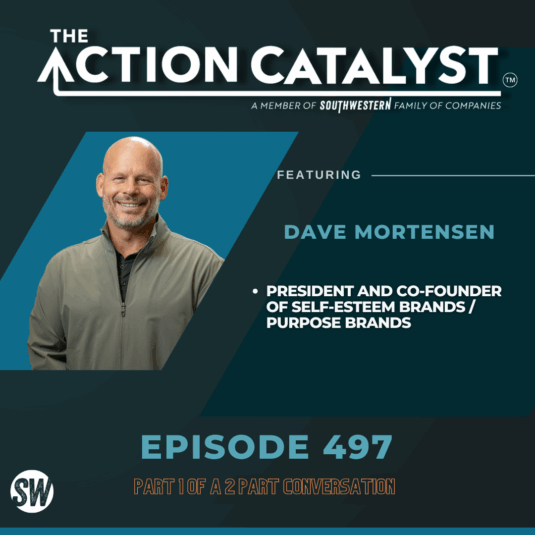
Dave Mortensen, President and Co-Founder of Self-Esteem Brands / Purpose Brands, recounts the improbable meeting between himself and his business partner of over 30 years, and shares why 80% to 90% of any great idea isn’t about the idea itself, the secret to truly great partnerships, and 4 Ps of executing their business, doing vs leading, identifying passion and talent, and why the fitness industry is like the McDonald’s ball pit.
About Dave:
From cleaning exercise equipment to selling memberships to co-founding the world’s fastest-growing fitness club franchise, Dave Mortensen has done just about everything you can do in the fitness industry. That wide-ranging experience has helped him become one of the world’s leading experts on “Making Healthy Happen.” His heartfelt practice of emotional intelligence has earned Dave a reputation, amongst his co-workers and throughout the entire fitness industry, as a thoughtful and generous leader. And it’s just part of the reason he was named an “Entrepreneur of the Year” by Ernst & Young.
As the President and Co-founder of Self Esteem Brands, Dave leads a global collection of franchises intent upon improving the health and wellness of millions of people worldwide.
In the early days of Anytime Fitness, Mortensen helped spur the company’s growth by overseeing the development and implementation of its integrated security, surveillance, usage-tracking and reciprocity systems. These days, he’s heavily involved in Anytime Fitness’ evolution from a gym that emphasizes simple convenience to one that offers round-the-clock coaching services, utilizing the latest technology to provide members with support, nutritional information, and a wide array of new fitness training programs. Mortensen also continues to play an important role in leading the expansion of Anytime Fitness worldwide, frequently travelling to consult with master franchisees all over the globe.
The first Anytime Fitness gym opened its doors in Cambridge, MN in May of 2002. In the years since, Anytime Fitness has quickly become an international powerhouse — with nearly 7,000 gyms located in all 50 states and nearly 40 countries on all seven continents, serving nearly 4 million members.
Under Mortensen’s leadership, Anytime Fitness has earned numerous industry accolades, including “One of America’s Most Promising Companies,” “Top Global Franchise,” “Fastest-Growing Fitness Club,” a “Top Franchise for Minorities,” and “The Best Place to Work in Minnesota” — four years in a row.
In addition to Anytime Fitness, Self Esteem Brands serves as the parent company to three other rapidly-growing franchises: Waxing the City – dedicated to providing the finest waxing experience imaginable; The Bar Method – a popular, low-impact fitness franchise with more than 100 studios across 30 states and Canada; Basecamp Fitness – a high-intensity, class-based fitness concept, and most recently Orange Theory, full-body strength training and cardio.
Learn more at SEBrands.com and PurposeBrands.com.
The Action Catalyst is presented by the Southwestern Family of Companies. With each episode, the podcast features some of the nation’s top thought leaders and experts, sharing meaningful tips and advice. Learn more at TheActionCatalyst.com, subscribe below or wherever you listen to podcasts, and be sure to leave a rating and review!
LISTEN:
SUBSCRIBE TO OUR RSS FEED: https://feeds.captivate.fm/the-action-catalyst/
SUBSCRIBE ELSEWHERE: https://the-action-catalyst.captivate.fm/listen
__________________________________________________________________________
(Transcribed using A.I. / May include errors):
Adam Outland
Today’s guest is Dave Mortensen, the President and co founder of Self Esteem Brands, now Purpose Brands, which includes wellness and fitness brands like Anytime Fitness, Orange Theory, The Bar Method and more. Co founded alongside Chuck Runyon, another Action Catalyst guest in Episode 220. You know, it’s great getting both sides of a partnership that like the one you guys had, and how you’ve grown what you’ve built over. How many years has it been now? Like, how many years ago was it….
Dave Mortensen
May of 2002 is when we started Anytime. But Chuck and I have been business partners for 35 plus years.
Adam Outland
35 plus years.
Dave Mortensen
Yeah, if you met Chuck and you now, you’ll meet me, you’ll go, Wow, can these guys be any different? So we are. It’s, it’s funny, we’ve been 35 plus years, but yet, in any business scenario, we’ll probably land in the same spot, but we come at it at a completely different direction.
Adam Outland
You guys met through the work, just working at gyms?
Dave Mortensen
That’s kind of a it’s kind of a funny story. So I literally came out of college, dropped out of college, knew I wanted to be in the fitness industry. That was my passion. Chuck was doing it because he got free basketball. Okay, so let’s be clear on the difference between the two of us. I was a little bit more intentional in coming into this industry. I wanted to be in it. Chuck was in it because he liked to play basketball, and he got a free he could play anytime for free. Right during that period of time, I actually got recruited by this chain of clubs he was already working at to go manage one of their clubs. And Chuck and I met, and shortly thereafter, about a year later, we started our consulting firm, and the kind of story was written after that. What makes Chuck and I work is that we will challenge each other every day like there isn’t a day of Chuck has an idea, it is my job to tell him that’s a bad idea, and if I have an idea, he’s going to tell me it’s a bad idea, not in the intention to break down my idea, but to strengthen it. What Chuck and I have learned really early, we have zero egos on whose idea we’re going to go with. We’ll typically pick the idea that the person that’s probably most passionate about it, and whatever that may be and has has, can articulate what they’re trying to accomplish with it. Now that isn’t the secret. The secret is, once we choose an idea, no matter if it’s Chuck’s or it’s mine. Now what is the role of the person? So if it’s Chuck’s idea, what is my job? And almost everyone, I won’t put you on the spot, because everyone says the same thing, support the idea, and that’s not the answer. The answer is actually lead the lead the idea to success. So if it is Chuck’s idea, then it’s my job to go make it work. In the essence, we both have to lead it to success. Because 9080, to 90% of any great idea, it has nothing to do with the idea in itself. It has to do with the way you execute it. Rarely will chuck and I ever, and I don’t know if there’s a day we’ve ever looked at an idea that’s failed and looked at each other and said, told you so there is no told you so there is, man, we screwed that up. What do we learn and how do we improve it for the next time.
Adam Outland
Reminds me this adage that I heard a long time ago is that you you don’t focus on always making right decisions. You focus on making decisions and then making them right.
Dave Mortensen
Very, very good quote, and very, very true and what? So we just never get really caught up or enamored with ourselves. I think Chuck and I don’t spend a lot of time in our in the accolades of what we’ve done, because that just creates complacency and laziness, and we just have very little tolerance for that.
Adam Outland
Similar set of skills? Or do you find that you guys have…
Dave Mortensen
Completely different. Chuck is an innovator. He will challenge a status quo every day of the week. And he makes good great. He does. He just Chuck is a person, you put him in a flourishing market, he’s going to make it even better. That’s what he’s really good at. I am the guy to look at something that is not working and dive in deep and figure it out and fix it so and bring it to that good to get it to great. Chuck is typically going to stay above the fray. I’m going to be in the deep of the fray and where we balance each other. There’s days I got to look at Chuck and say, Hey buddy, get out of the clouds a little bit, and let’s get get to work here. We got to we got to dive into some of the work we’re doing, versus create new stuff to do, and times where he’ll be the guy to look at me and say, Dave, get out of the way of the team and allow them to continue to do what they’re doing, because you’re scaring the hell out of them.
Adam Outland
When I read your your bio and background, and I was looking at it did almost made me feel like you’re this, this, like business integrator, where you can you’re in it like you dive in and you have maybe, like, a little bit more capability of staying in the details for longer periods of time when it comes to the team.
Dave Mortensen
But yeah, Chuck is the first three innings. I’m the second three innings, and then we hire really smart people to finish the last three innings.
Adam Outland
I love that. So Anytime was was the first baby that you guys had, and then, when did you guys acquire your your next franchise?
Dave Mortensen
You know, there’s a lot of different things we did. So look at 2008 2008 and nine is when we made one of our first major, pivotal decisions. When you think about pivoting, we had a third partner, and at that time, Anytime Fitness probably had about we were probably about 600 clubs open at that time, and we knew we were onto something special. But Chuck and I, we both looked at each other and wanted to reinvest back into that business, because we knew we were a part of something that was bigger than ourselves and our third partner, albeit, was in it for one reason, he wanted to make money get out and go enjoy life. So we’ve found a way to make that happen. Now, to make that happen, believe it or not, Chuck and I took a if you know anything about Oh 809, that was the financial crisis at the time. So Chuck had to buy him out. Had to take on a loan for $26 million right at 16% interest. So imagine taking a 16% interest loan on anything. It’s like credit card loans, right? But we did. We didn’t have to be in it that long. We were probably in that loan for about a year and a half, and then we refinanced, and the stories written from there. But I’d be a big bet today in our lives, no matter what, but it was a crazy bet. But we we one thing, we didn’t lack confidence, and we’re super competitive, and we wanted to win. And we we built a winning team so we were able to accomplish that through that work. But that’s where the predecessor of going. Okay, what do we beyond just Anytime Fitness? Who do we want to be? And that’s where self esteem brands came to life. That is where we really built our pillars around our 4p of people, purpose, profits and play, which is truly our intellectual property today, on the way we deliver and execute our businesses. And that’s where we bought our first brand, and said we wanted to be not only a fitness brand, but a franchise vehicle. We wanted to be able to provide franchising in multiple multiple facets, and build out capabilities. And that’s where we acquired wax in the city. And then, you know, the story’s been written since then with multiple brands.
Adam Outland
Dave, you know, none of us are static, but you know, people who grow businesses from you know, one or two to 1000s and millions of members tend to have to grow a lot more than the average person to do it. I’m so interested in the Dave I’d be sitting across from in 2003 2004 versus the Dave I’m sitting in front of now. I mean, what are some of the iterations that you personally went through in personal growth?
Dave Mortensen
Yesterday or today? Literally, that is a that is a mindset people need to have, is that you’re always growing and you’re always learning, and you can learn from anybody, anybody in anything. So I’m a human growth is something that is forever going to happen, and it’s something that both Chuck and I just have a mindset. We go at it differently. Chuck is like a just ferocious reader, right? He reads everything. I’m I’m a consumption of human so, you know, I I’m a connector with a lot of different people, and I’ll learn a lot from others in all aspects. And it’s just a it’s just the way we grow and learn. Now, that doesn’t mean I don’t read it. It doesn’t mean he doesn’t create the relationships we both probably do it. It’s just one’s more formal than the other, but we’re both always in a learning mindset. I’ve found I like being around really, really intelligent people in different facets. I don’t care if they’re awkward, they’re weird, whatever. Sometimes those awkward ones have some of the most brilliant things to offer, and learning was something you know early on, I would say the biggest transition for me was from doing to leading. That is that is a really hard transition for leaders, especially founders. Founders are the worst at transitioning from doing in in leading. Leading is where you are more passionate about the success of the people around you than you are passionate about the work that you’re doing, and that most founders can’t get past. Chuck and I are people, people, first type of mindset, people, so it was easy for us to make that transition and then just learning how to do that over the years and become better at it, because that someday you realize, as most CEOs, if they do it right, cannot get hired at their own company for doing anything else but being the CEO, because you become capability experts in every aspect of the business. I’m never going to be the CMO by by means. So every one of these roles, you’re going to bring capacity leaders around you that are experts, really, really smart people, and get them to play in the sandbox together.
Adam Outland
I love that. Do you remember the first time you hit like a proverbial wall?
Dave Mortensen
My strength and my weakness is I can probably dive into anything and figure it out and and that strength and a weakness, the weakness in that is that I was taking on things that were not ready, or we weren’t developing as fast as the organization was. So I was trying to solve problems that were going to take me a little bit more time to learn and figure out. And the in the in the business was ahead of it, right? And when you start to live in behind your business and start to figure things out that are not within your capability. Wheel, this is where I think the greatest gift the most leaders top down, biggest weakness they have is they don’t ask for help and they don’t look to find capability leaders or capabilities in general that can come in and help you solve the problems, because you’re trying to solve it yourself. It’s like you’re almost in bed. Your ego gets in a way, because you’re embarrassed, you don’t understand it, or you you haven’t figured it out yet. And that actually put an anchor onto the business. And when you put an anchor on a boat and try and go down, down the way of the water, you know what happens? That anchor only gets heavier. It picks up weeds, it gets stuck on a rock, and you become the you become the stalling point to your business. So there were areas of the business I needed to let go and allow others, or get rid of, and allow others be able to, with better capabilities, be able to lead that space of the business. So I could focus on the major things of our business that I can have better control of.
Adam Outland
I’ve heard, you know, from a number of people that are great leaders, a great recruiter, which you’ve kind of alluded to in the few stories that you just shared. Right? You found talented people. What does that mindset look like, you know, over the course of your career? I mean, if you you go into a conference and you’re eyeballing people for talent. Are you? Where are you sourcing some of these great people that you found and surrounded yourself?
Dave Mortensen
That’s a great question. Easy answer for me. One My biggest advice for people in business, especially early business, when you find someone great, make a place for them. Find find a place to bring them into the organ. A lot of times we get caught up in in going, Okay, this is what I need, and that’s important. You got to know your capability. But when you see talent, there’s talent there, don’t hesitate to bring that talent into the organization. The other thing is, watch what the word talent means. Talent with people is, I’ll say this, when you look at like the high you look at the grid right, you look at the four grid, and you want, you want everyone in the upper right, right. You want everyone in the upper right, in your upper right or upper left, however you want to look at it. One of the things that we look are high talent, high culture people, right? The biggest mistake most organizations do is they bring in high talent that don’t match your culture. That is the biggest mistake you can make, because you know what high talent low culture is in an organization cancer because they’re so highly talented. You You know that talent, you see that talent, but they don’t fit within your ethos of who you are. And the one thing that Chuck and I have always known, and we literally have documented, is what we look for in people, things like for us, we need people who are competitive, right? We want people who are highly competitive. We want people who are highly passionate, passionate about what they do. I know if I’m not passionate about it, no matter how great of an idea it is, I’m probably not going to execute it that well, people who are self aware, especially in leadership, self awareness, we’ve heard this many times, but there are so many people that are on our side. I can tell you every gap I have, and probably even more and what. And I’m interested to learn more about those gaps, so having people understand their gaps in life are very, very important. If they’re constantly trying to mask them, they’re not improving. If you’re spending more time trying to hide your weaknesses or hide anything, well, guess what? Then you’re going to have a lot of gaps. Selfless. We need people who are selfless. If you are going to build a large organization, you can’t have. I people in the room and Chuck and I have zero tolerance. We don’t like titles, right? I’m not a big title guy, and I don’t like I people in the room. What? But what is important is leaders in a room that are intrigued to hear the voice of everybody. I will say having a voice is very, very important. Last but not least, believe it or not, for checking out, we need people checking out, we need people with a sense of humor. Yeah, we need our fun to be around, because I don’t need a bunch of dry nuts in our organization to be very candid with you, because they just don’t last that long for us, we want a sense of humor, and if you take yourself too serious, we always say, take the. Business as serious as can be, but don’t take yourself too serious, and those are the elements that we look for when we bring people on. I think the weakness when I say this a lot of times in podcasts, is to say you need to know who you are as a leader and surround yourself with people who have similar cultural beliefs. Because if you have a broken culture, the talent’s not going to go anywhere.
Adam Outland
Well said, I mean, in the cultural reference piece, it’s great, you can have cultural identifiers, but still find people with a variety of different strengths. I mean, they can be introverted, but still meet all the criteria you just shared, right in terms of, like, sourcing too, because it’s always in people’s mind, man, we like, you know, throwing up LinkedIn job descriptions. Like, if you’ve kind of itemized some of your top leaders today, where did some of those folks come from? Like, did you have a headhunter and a recruiter? Were you out there wheeling and dealing and shaking hands…
Dave Mortensen
A little bit of everywhere? You know, we’ve got recruiters. We’ve had wins and failures in those we’ve had, you know, just networking, you know, because we are a high cultural organization, and people hear about us, they’re going to reach out to us, always telling our teams, we’re always hiring, you know, I think that’s important. We’re always hiring for great talent. So if you know, someone introduce us. So a lot of it’s been things like that. But you know, just having an intriguedness to always be looking for quality is really, really important and and when you have an open door policy like we do, I mean, if you read the the plaque that had been in front of my office door for years, it’s simply just ask you have to have that open door policy all the time, and that’s what’s the differentiator from a good leader, is they need to make sure they’re open to great talent.
Adam Outland
One of the ways to make sure someone’s a cultural fit is to develop them from within. Was that something that you you all did as well, where you’ve taken people in your organization and grad feel like Chuck or someone in your company, told me a couple examples.
Dave Mortensen
I’m a firm believer, go to dinner with them. Sometimes go to dinner with their family, depending on the level of person you’re bringing into the organization, because you’ll learn a lot from the their environment, and you let them lead that. So hey, we’d like to go to dinner with you, but go ahead and why don’t you set it up. We’ll go ahead and buy the dinner, but you tell us where we’re going, where they choose, how they choose, it all of those things make them make a matter. I’ll take a little nugget we’ve done for years, and I can say this now, because we’re not in the office every day anymore, right? But a nugget we used to do is when we bring in a high level leader, we’d leave every person that was coming in for an interview in front of our executive assistant, and I’ll tell you why it’s intriguing how people treat others versus how they’ll treat you. And I’m very much a person that needs to know that they’re going to treat up the chain equally as they do down the chain. And you wouldn’t believe how many times they would treat our executive assistant completely different when we weren’t in the room, and the ones who shined the most were the ones that were and she had a great gut for people as well. So when you start to lean on your teams and ask them, What did they think of these individuals, they’ll align you with the cultural fit really quick.
Adam Outland
So acquisitions can be a real challenge because you’re assimilating cultures, and they’re often quite separate. I mean, they may share values, but you’re still different. Founder different. You know, you guys acquired Orange Theory this year, which I think on that track the original owner had already sold to private equity, right? This would be the second?
Dave Mortensen
Yeah.
Adam Outland
How do you tackle you’ve done it a number of times now, cultural mergers of that size?
Dave Mortensen
They’re all different depending on the scale and the size. Cultural alignment is really, really important, because at the end of the day, this is something people always talk about with businesses. I don’t care the business, there’s holes in the business. There’s always going to be gaps. What? What big mistake organizations will do is when they bring on or they merge or they acquire, doesn’t matter how it is. It should be equally treated the same. Doesn’t matter who’s the bigger one, who’s the smaller one, one. They should be treated equally when the merger happens, because the IP that they have, the intellectual property they’re bringing the table. The thing that made you passionate about it, if you’re not passionate about uncovering the the values that you got, you acquired, or you purchased, what you partnered with, and all you’re doing is looking for their gaps, you’ll never see its opportunity. And that is a big mistake. A lot of people do because they look to see where the holes are so they it’s all come almost telling you how smart I am. You know what? Oh, geez. You know the way they do their strategy. They don’t even have US budget or strategy. Well, you know what? They did something, right? Because they’re pretty darn big, so we should probably understand how they got there, not necessarily a process in which they did it in. Yes. Once you can show each other’s values, and you’ve earned that trust of those values, then you can start uncovering areas of opportunity to improve together. But if you don’t do it together, there’s going to be an us versus them mentality, and we want to we want to fix things too quickly, rather than really get interested in learning what we’ve we’ve got involved in.
Adam Outland
If you’re able to answer, what was that about Orange Theory that said this is the right fit?
Dave Mortensen
A lot of different things with Orange Theory. Technology, I would say was, when we looked at this was a this was truly a merger. So this wasn’t an acquisition. This was a merger of two, two equals coming together. And what, what areas could we complement each other? Because there were obviously areas that we had overlaps, and there’s going to be like they had strongness. We had strongness. But one of the things that was really strong on their side was technology. In the advancement of technology into fitness is something that we really wanted to do, right? It’s an area that we did okay, but we wanted to we did it really well operationally, you know, an example like our doors opening operational, our doors open every time, right? That’s kind of an important technology, right? So we wanted to get closer to the consumer with technology, because we knew this thing right here was a differentiator in people’s lives, and how are we going to win the war of the phone in health and wellness? We knew their partnership would help us get there for us to them, it was our global breath and expansion. So because we had such a massive network globally, in 40 plus countries, with true penetration and saturation in these markets, we just had a an awareness of how to grow globally. That was real value. And there was a lot of little ones, but those were probably, if I would say, if you would ask them, what attracted them most to us would have been that, and we would have set their technology.
Adam Outland
Yeah, and I see, I mean, on paper, it seems like that such a good fit from those two components overlapping. Where does the brand go from here, Dave?
Dave Mortensen
Yeah, 7000 facilities in 50 countries, and we continue to grow with the largest fitness platform, but we really want to be the largest personal care platform. So imagine not just fitness, but anything in the personal care space. We want human high touch businesses, is what we really want, and we want to utilize technology to ignite the relationships to the consumer, because we know those interfaces really, really are challenging right now, everyone’s looking to figure out, how do I take technology and replace human touch? We don’t want to replace the human touch. We actually want to ignite it, and we want to be a part of businesses that have high level human touch in relational and make it easier for them to be even better at it, and have them focus on the things they actually like to do and utilize technologies to be able to enhance it.
Adam Outland
That’s a fantastic mission. It’s kind of like artificial intelligence and all these tracking software. It’s there’s a component where people feel it can pull them away from community, but if leveraged correctly, you can just add value to those.
Dave Mortensen
Yeah. I want AI to teach us more about how we can be better at who we are with humans, and how we can make it easier for our people to know who they should be talking to, right? So a lot of times we in the fitness industry are really good. I use the McDonald’s theory all the time. You remember the McDonald’s ball pit? Yeah, where you put your kids in. Everyone loves it, but that’s what the fitness industry has been for. You know, centuries where you jump into the ball pit and you get all these people think of every one of those balls as members of your club. And we’re really good at grabbing the ones on the top and giving them love and showing them care. And we had these great stories about them, and we loved it, right? Throw them back and forth, everything else and make it great. But what we had the problem was, is on the bottom of that ball pit, there were a lot of balls getting stepped on, crunched, old, stuffed in a corner and ignored, and that was we were losing them out of the bottom of the bucket. So imagine if we no longer have a ball pit we’re jumping in. It’s more like a ball Hopper, where AI teaches us who to talk to, when to talk to them, and how to talk to them. So it gets shot to us in a way that says this person needs this kind of personal care and touch, and that’s where AI is going to be an enhancement to the fitness industry is really managing the behavior of our customers better, so we can meet their needs where they are at any point in time in the journey.
Adam Outland
Yeah, and what I’m hearing in that is, you know, there’s, there’s always a retention issue that you want to address as any kind of gym or location, right, where the people who stop coming, or maybe they’re just, they go through a phase, you know, they become disconnected, and that, those are your operations. Opportunities that if you engage them appropriately, early enough, and you catch it before they it’s been three weeks since they’ve shown out, there’s an opportunity to keep them engaged and help them meet their goals.
Dave Mortensen
Everyone gets enamored with the new thing coming in the fitness industry. Whatever may be GOP ones, is a big conversation the fitness industry. How do we ignite and balance that relationship with people on on, you know, weight loss medication. There’s ways to do that as well. Or it’s the new workout, you know, the new exercise, the new piece of equipment, whatever it is. But I’ll tell you, fitness has figured out how to get people in shape for a very, very long time. What we have not done is figured a way to deepen the relationships with customers to help them in their journey through the hard times. And that’s that’s the next level of fitness is really being able to meet them 100 and you know, 68 days out of a hours out of a week, right? We only are going to see them two to three times. Now, we can ignite our touch points with our customers throughout the week, depending on their their wellness journey, we’re going to have a better success ratio of helping them succeed in their weight loss or their weight gain or whatever fitness goals they have.
Adam Outland
What do you think of the when you think the word accountability? How does that fit into your belief ecosystem with your customers, your culture?
Dave Mortensen
Accountability is is essential, and that’s part of holding yourself accountable. Number one, but holding others accountable, from a consumer lens wise, it’s really helping them hold themselves accountable. And what are the tools and resources they need to be able to hold accountable to their fitness journey. One of the things AI taught us, and I always like Sharon, is, let’s say someone’s coming in two days a week at a health club, and they start to come three or four times a week. What does that mean to you?
Adam Outland
They’re they’re increasing their accountability. They’re getting some joy. They’re getting something in return for their their effort, right? So they’re coming more.
Dave Mortensen
You know what the truth is? That means they’re going to cancel. Let me tell you why. And this is what AI taught us. If I’m coming two days a week, I start coming three or four days a week. What do I want? I want more. And what is more more? I want more results. Now, consumers don’t call you and say, I’m going to start coming three or four days a week. They just start coming three or four days a week. And if we don’t meet them at that point in their journey, what happens is they start coming, but they haven’t changed the way they’re going to exercise or change the way they’re going to consume their fitness and wellness, and they start to work twice as hard to see very little result. So then when they and that creates frustration, and within that frustration, they go from four down to zero really quick. Is it our opportunity to meet them in those those pivotal moments and those pivotal changes in their wellness journey to help them succeed in it, and that’s what we’re learning to do and get better each and every day.
Adam Outland
Stay tuned. We’ll conclude this interview with Dave Mortensen in Episode 498 of The Action Catalyst.
0 Comments