Innovation at the Edges: An Action Catalyst Panel
- Posted by Action Catalyst
- On December 30, 2025
- 0 Comments
- AI, Business, cybersecurity, leadership, security, southwestern consulting, Southwestern Family of Companies, success, tech, technology
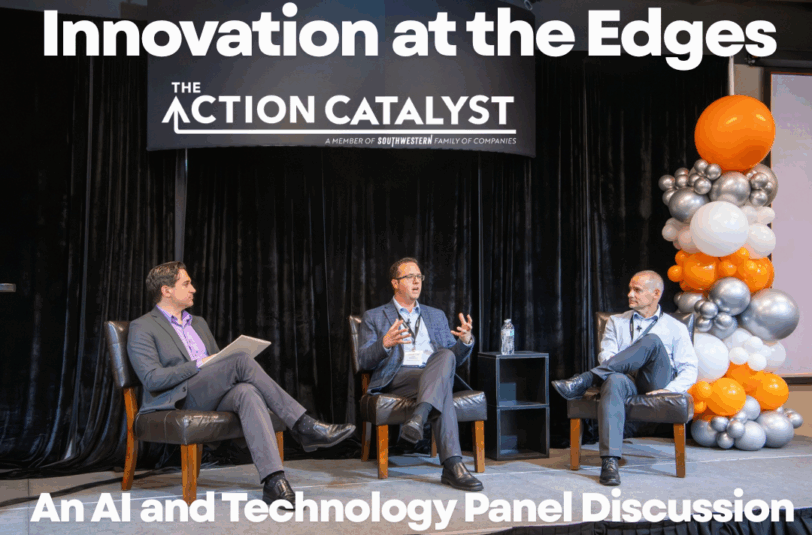
Vice President of Information Technology for the Southwestern Family of Companies, Ed Solima, and Training and Development Manager for Southwestern Consulting, Chad Rothermich, examine recent changes in AI and other tech, and offer an in-depth use case as well as some guiding principles for vetting potential tools and vendors, engaging stakeholders in your operation, integrating into existing systems, and even using AI to learn about AI.
About Ed:
Ed Solima is a seasoned executive with over three decades of experience in the IT sector. Born and raised in Ontario, Canada, Ed Solima moved to Texas in his teens where he eventually attended Austin State University, receiving a degree in Computer Science. His first and only professional job has been at Southwestern, hired in 1990 as a computer programmer working on their mainframe. He now heads up the IT department as the Vice-President of Information Technology. Ed is also a martial artist, with a blue belt in Krav Maga.
With a strong foundation in computer science and mathematics, he has honed his skills in account management, business development, and strategic planning. Ed’s leadership style emphasizes team building and effective time management, fostering a culture of innovation and excellence within his organization. His tenure at Southwestern Family of Companies reflects his commitment to long-term growth and stability in the tech industry. Outside of his professional life, Ed is passionate about mentoring the next generation of leaders in technology, showcasing his dedication to leadership development. His extensive experience in various functional areas equips him to navigate complex business challenges with ease. Ed’s insights into marketing strategy and direct sales further enhance his strategic approach to business operations, making him a valuable asset in any executive role.
Learn more at Southwestern.com.
About Chad:
As the Training and Development Manager as well as a professional Sales and Leadership Coach for Southwestern Consulting, Chad’s passion for investing in people has been the driving theme of his diverse career. He spent six years with Southwestern Advantage as a salesman, sales manager, and recruiter. During this time, he cultivated key sales principles and discovered his passion for teaching people and helping them reach their personal and professional goals.
As a coach, Chad excels at motivating and encouraging people by not only inspiring them to set and believe in big goals but also to break down monumental tasks into achievable actions.
Chad holds a bachelor’s degree in Biological Sciences from the University of Missouri, Columbia. He started his sales career selling educational materials door to door. Some of his key accomplishments include:
- Consistently finishing in the Top 5% of producers at Southwestern Advantage and in the construction, insurance, automotive, and agricultural industries.
- #1 producer with over $2.8M in service-contract sales in a single year.
- Leading the top-producing team three years in a row.
In his spare time, he is a passionate outdoorsman who enjoys activities such as fly fishing, hiking, camping, and mountain biking. In both his personal and professional lives, Chad’s passion is to serve his church, friends, family, and people in general—whether he’s known them for years or they’ve just met.
Learn more at SouthwesternConsulting.com.
The Action Catalyst is presented by the Southwestern Family of Companies. With each episode, the podcast features some of the nation’s top thought leaders and experts, sharing meaningful tips and advice. Learn more at TheActionCatalyst.com, subscribe below or wherever you listen to podcasts, and be sure to leave a rating and review!
LISTEN:
SUBSCRIBE TO OUR RSS FEED: https://feeds.captivate.fm/the-action-catalyst/
SUBSCRIBE ELSEWHERE: https://the-action-catalyst.captivate.fm/listen
__________________________________________________________________________
(Transcribed using A.I. / May include errors):
Emcee
Our next discussion is going to dive into the very timely topic of AI. So to tackle that topic, we welcome a 36 year Southwestern veteran, the Vice President of Information Technology. Please welcome Ed Solima. Joining him will be a training and development manager for Southwestern Consulting as well as an elite level coach, Chad Rothermich. Ed, what has fundamentally shifted in the AI landscape overall?
Ed Solima
Yeah, if you look at the speed at which AI technology is advancing, it’s just remarkable. When you look at the AI models that have been coming out, they’re getting smarter. They’re getting more complex. The tasks that they can complete are just mind boggling. You’ve got companies like open AI that just came out with GPT five. Anthropic came out with Claude four. You had Elon Musk it into the race with his X AI company, and the one I use, which is grok. So the new players, more advanced models. If you look back to years, generative, AI was all about text, so the interface was mostly a text based one. But now the newer models, they’re creating very realistic images, audio, video. I don’t know if anyone’s seen the Bigfoot vlogs that are online, hilarious, but, man, it looks so good, all created with AI video editor. So yeah, the world is changing. Just in the past year, I’d say, if you look at just 2025 the big change in AI has been agentic AI. So now you’ve got AI agents that are running autonomously, which allows them to do things like be your customer service agent, plan your vacation and book your travel for you. And then the big one this year, I think, has been a real focus for AI companies been coding. So being able to write code autonomously, you saw companies like cursor that went from no revenue to half a billion dollars. So the the hype over AI is not really hype. It’s really being used. There’s a lot of people that are moving into the AI space. You’ve got tech companies like Microsoft and Oracle just spending billions of dollars to build AI data centers to keep up with the need for AI. So I don’t see it stopping. It’s exciting times, especially if you’re in IT. Who knows what we’re going to see two years from now?
Emcee
You mentioned, you know, AI is, in particular, a very fast moving and ever evolving tool. We don’t want that speed, though, to create a false sense of urgency that keeps us from making choices that are pragmatic and sustainable. How do we maintain a long term focus on the problem that we are trying to solve and not be short sighted or being quick to choose a solution that’s merely sufficient, rather than truly what we need in the long term.
Ed Solima
Yeah, when I think about that, there’s a lot of companies that jumped in early on AI with AI projects, and they’re looking now to see where the ROI is on those investments. I think some people got in maybe a little early or didn’t have the right approach. There was a MIT study that came out early this year, and the headline was, 95% of enterprise AI projects failed to find business value. That’s a pretty startling percentage. So if you dig deeper into the study, it wasn’t really the technology that was the problem. It was how companies were approaching the use of AI. So three things that the study pointed out was number one, they were focused on sales and marketing use cases. The employees were resistant to AI or didn’t get adequate training. And then there was no definitive like business objective that was outlined when they started the project. So take the inverse of that. The ones that were successful, they had very narrow defined business needs that they were trying to accomplish for the AI initiative. They did adequate training and also spoke to some of the fears that employees have around AI, which is, is AI gonna take my job, or is it here to help me? And then they focused on the back office automation, which we’re seeing a lot of value in the market right now, of back office and where AI can help, especially in time intensive, very repetitive tasks, AI does great with that.
Emcee
You’ve mentioned before that, when evaluating AI, considering AI, the first consideration really isn’t even the tech one, it’s that you need to identify the business need, what the problem is you’re solving, and why won’t a more conventional or a different tool do Why must it be AI to solve this problem?
Ed Solima
Yeah, I think always start with the business need. Not I’ve got a shiny tool. What do I do with it? It’s what’s the business need you’re trying to solve? And then look at the market to see, does AI fit into the picture here to solve my problem, I always start with the need. And then look at the tools. Southwestern consulting, we have a challenge with coaching calls, and Chad’s going to go into the process of looking at that business need, and how do we, how did we get to the end of selecting an AI tool?
Emcee
Yeah, so Chad, we’ll come over to you now. Let’s, let’s spotlight that example looking at the the recent vendor selection process that you’ve gone through at Southwestern Consulting, what was the problem that you were looking to solve? Why was AI the answer, and what was your methodology as you moved through that process?
Chad Rothermich
Sure, absolutely, so the the issues that we had were kind of threefold. So we had these repetitive processes that were taking a lot of time for our salespeople and coaches specifically getting prepared for coaching calls, getting prepared for sales calls. Then afterwards, how do we notate all of that? Like, how do we get all these notes and we got to put them in a CRM? So it was very, it’s very manual, friction involving process. So what if we could streamline that? Another issue we were facing is, are salespeople and coaches not ramping up in their skill sets fast enough? So how can we help to improve their knowledge, their abilities faster? Get more reps in, get better guidance, and then the third one being simply not really having clear insights into our product itself. So in our audit process, we we, you know, you look at the math, and we were really auditing point 5% of our coaching calls. So that obviously doesn’t give you very much clarity into what’s really happening. So what is happening? What do our clients need more of? And a lot of that was being driven by intuition, which, if you have the right people, their intuitions are usually pretty good, but that’s not necessarily enough or enough data behind that. So that was really we had to identify what is the need. And really we had tried a number of conventional tools that just hadn’t been able to like, to really solve any of those problems. We’d we’d really like improved, but they still inmate. So what options are out there now in that AI space? So once we’d identified that, we really looked at who are the right people to help us investigate that, which I will come to later. So who are the right people to have involved in not just the discovery process and decision making, but in even testing it? So once we knew we had the right folks, then we had to do, we had to want to, we did want to look at what tools, what AI tools we had most readily available to us, and typically freer, Free is better, right? So we did a whole lot of work looking into chat, GPT and copilot. We tested that extensively on the operational side. Had the right folks to test that, and in the sales and coaching side, and it just wasn’t going to get us where we needed to be. It was still really manual, really intensive, a lot of training time just for us to even get up to speed to understand it. So once we realized, okay, those tools aren’t going to work, we needed to do our own research. And a lot of that research was really looking at what don’t we know, and that research was really in service of getting us the right questions to ask. So like, not just what’s out there, but how have people been using it? What questions do we need to ask of vendors when we start researching? And then once we were researched, once we had that, that stack of questions, it was really time to just go do discovery. So we lots of meetings, lots of vendors, and it is a space that is rapidly evolving. So there were many of these discovery calls we’d set up and realize quickly, within 10 minutes, like, Oh, this is in no way gonna work. And then there were some that we went really far down the process of vetting now and then, once we were doing those discoveries, we wanted to actually narrow that field so we could do really good proof of concepts. So not just the idea that they have, not just their PowerPoint of what it could do, but can you show us what you can do in a limited scope with our real data, so that we can kind of see if you can put your money where your mouth is, essentially.
Emcee
You mentioned a few things I kind of want to pick at there, I believe. How do you make sure, and you alluded to this a bit in your answer, how do you make sure that you have the right people in place on your team to evaluate those tech needs, those problems that you need to solve for and then what’s the right way to bring in other stakeholders who might be involved but might not be the principal decision makers, people like legal departments. It other shared services. What’s the right way to get those people in place, keep the right people in the loop?
Ed Solima
Well, from an IT perspective, there’s a bunch of things that we want to ensure. Anytime we work with any vendor that’s going to access our intellectual property. First and foremost, security. We’re going to make sure that the data is going to be encrypted. We want to know where the data is going to reside when it’s at rest. We want to know what kind of access controls there are. We want to make sure that they’re conforming to GDPR, CCPA, any other related privacy laws. What we don’t want to happen it was an email I got last week from CloudFlare, which happens to be a vendor that we use as a CDN, but they had to admit that their sales force and since got hacked by a threat actor who had got in through a back door from a third party AI tool that they were using for customer service called drift, so just a word of warning Anytime you open a door to your data with a third party tool, you’re potentially opening a door to a threat actor. So it is there to make sure there’s not those holes. The other thing it can do is look at things like scalability. Ask the questions, can you handle 100 users? How about 100,000 users? Or looking at the licensing cost, especially in AI, because there’s a lot of a hidden costs, sometimes on Compute usage fees and things like that. So we’re there to help, just to make sure that the business is making the most informed decision.
Chad Rothermich
And then people wise, really, it’s twofold. It’s those who are going to be making the decisions and betting and vetting that out and then those who are actually going to test it. So I really wanted to put a lot of focus on like the user and use case and the work set. So in looking at the team that we put together, we needed people who understood our sales process and the delivery of our coaching, as well as the like training of those skill sets, like, what do our clients need? Like, who understands our actual clients needs, their requests, their wishes, and then implementation, like, what is that going to look like? Because I am not an IT person. I’m just a problem solver, and then I’ll hit a wall and be like, I need a nerd. Please. Somebody help. And so we had a good, strong team that could fill the gaps that each of us had, and could ask the questions that maybe we did not ask. But even from the test side, when we tested things, just even the chat, GPT and copilot, we wanted to have not just coaches and sales people, but who’s recruiting. Like, how could this be used in recruiting? How could this be used in team leading, and how could this be used in client experience? So we wanted to make sure that we had a good group of people who could test this in different ways. So even in bringing forth some of those to the operations folks, it was like asking the questions of, how, what are some of your frustrations in what you and then thinking, How could AI help that? What are some of the issues that you solve? What are some of the things that you know if, if we could just minimize some of the friction there, it would benefit you. And so there were people who we would have given a license to that we realized, oh, there’s actually no need there at all. So getting the right group of testers involved in that. But as far as like the when to bring folks in, I think you just have to recognize that you you have to be willing to accept what you don’t know, right? I don’t know a ton of legal situations and GDPR and looking at automatic recording, what are the implications of that across different states and across the pond. So learning those roadblocks and the potential landmines before you step on them is better.
Emcee
Ed, you had mentioned receiving an email from a vendor indicating that there was not a problem with them, but that there was a problem with a third party tool that they were using when you’re bringing new tech into place for your company, what are some considerations you need to make for integrating that new tech in with the existing tech? Because in this case, for example, it wasn’t Cloudflare there was the issue. It was the third party add on that was integrated later on. What are some best practices around making sure that integrating into your existing technology is seamless?
Ed Solima
Yeah, I think integrations can sometimes be a an afterthought, and really needs to be on the forefront anytime we’re discussing bringing on a new vendor that may touch your data. So anytime data flows to and from a new technology to your existing systems, you really need to be careful. It can be either a deal killer if the integration isn’t there, or it could be a money pit if it’s going to cost a lot in order to integrate, even vendors who say, Oh yeah, we have native integration. They may not have native integration with custom fields. Or there you have a may you may have a unique use case that’s not handled so you. Integration very important to talk about up front.
Emcee
You guys had both mentioned testing as well, and that’s critical, not only testing potential new products for ourselves, but also putting potential vendors to the test. As you had mentioned, seeing what can you do for us? What can you show us before we make a real commitment? What is a reasonable ask from a potential vendor. Of course, we want more always, right? What’s a reasonable ask?
Chad Rothermich
Well, how do you find out what’s unreasonable you ask? What’s the best way to answer an objection in advance? Right? So I think bringing up their concerns that they would have on their end first, and your intent. So we asked a lot for our POCs, and we would call out, Hey, we do not. You might think we’re crazy for asking this. You might think we’re wildly unreasonable, and we do want to be reasonable, and we have an idea of what you’re talking about, but we also need to see it, to see if this is something that will work for us, and also something that our people would actually use, like, where’s the benefit of that? So we also recognize, gosh, that that’s probably going to have a cost to you. So we don’t want to be wildly out of scope here. But what could it look like for you to show us with our real data what you can do? So when you open up conversations like that, we found that there were vendors who typically would charge for those who waived that, there were those who still were like, Okay, well, we are still going to charge for that, and it would be so exorbitant they’d price themselves out of even testing. That’s where Breen and like legal was really big with that, because we are giving them our true data. We are giving them actual recordings of calls with real life clients, and so we need that to be protected. So are you willing to sign this NDA like, what are your protection method methods with our data? Where do you find the boundary line? Well, you have to, kind of push it a little bit. You kind of have to ask. But what we universally found was, if you address their concerns, like the things on their ends, because they’re a business too, and your intent that usually forwards that dialog.
Emcee
Speaking again to this particular case study that we’re talking about with Consulting, was there anything that you didn’t know, that you didn’t know, that you needed to learn first before you could really even properly evaluate what was necessary?
Chad Rothermich
Yes, there was a lot we didn’t know. So there’s a lot to learn. Two big things, the questions and the curiosity you have in asking some of the in those discovery meetings, some of the possible vendors that you talk to, such as some of my favorites were like, what questions have we not asked you that we should be asking you, what benefits have other clients and other use cases gotten out of this? What mistakes have you seen others make in trying to implement this? You know? What successes have you seen that you didn’t expect with your own product. So just being able to learn what even these other companies had learned, the we had lots to learn, just in general, about using AI, which I’m sure all of you can relate to, just in your own playing around with what is Cronk, Gemini, chat, GPT, you name it. But one of the cool things that I think we discovered as we went down those rabbit holes is that you can actually use AI to learn AI like, you can’t use Excel to learn Excel, right? You can’t use Word docs to learn Word docs. But if we asked really thoughtfully constructed questions of AI, you could be like, what are some of the best ways that I can use this in this use case? Describe those things out right? These are things we’re trying to accomplish in our business model. What ways could potentially AI help us with that? You can actually use AI as a teammate, as opposed to a lot of people use it as Google. If you treat it like you’re having a conversation with an informed person, it can actually teach you what it can do. So asking the really thoughtful questions and leaning into what you don’t know and trying to get that from your vendors, and then asking AI to help you learn AI.
Emcee
For either of you. Perhaps you, Ed. You know, this specific process that you guys just went through took over a year to go through. I think maybe a lot of people might not have a frame of reference for if a year is reasonable or not. You know, what is a realistic timeline in the current tech environment with the explosion of AI options? Does that mean that it should be a faster choice because options are plentiful, or does it mean it’s just more options to wade through and it should be a longer process. What kind of is a reasonable timeline?
Ed Solima
I think for this particular project, it was reasonable only because when we started it back last year, conversational intelligence was an emerging technology. It was pretty brand new. There were vendors coming online every month. It seemed so. Choices that we started with were different than the choices once we got near the end of the project, we even had some vendors that got pretty far in the process, and then they went bankrupt. So it was pretty new, new tech. So I we took some pauses along the way, which I think were very beneficial for the project, and ultimately helped us select the best possible project or product. What do you think, Chad?
Chad Rothermich
Yeah, I’d start off with, we did not intend this process to take a year, like we didn’t set out with a goal of, we’re going to take a year and really steep in this stuff. So my encouragement would be hold it with an open hand. Like, know what problems you’re trying to solve and the character traits, if you would, of the company and the partner that you want to work with. And we were really dedicated to those tenants, and it can be very tempting to want to speed that along. So I think there is in our experience with this one, it does. It actually doesn’t go faster. There’s more to wade through. There’s more to understand, and there’s always new people using it in new ways. So you can also go the other direction, where it’s like now, I’m making this take two years, and I’ve waited too long. So how do you marry those two things together? Right? There’s the tech, you know, Silicone Valley, principle of move fast and break things, right? And then the idea of, like, how do we make sure we have something stable, trustworthy, et cetera, I think as long as you’re asking yourself that question throughout that whole process, you will find the right timeline. So we kept on being like, we don’t want to find something perfect, because that will take far too long, right? And we don’t want to just make a quick, quick selection on this. I’d say a really big piece of this too is that we did get pretty far along with several folks. And the temptation came up where it’s like, well, this is good enough. Like it. Well, it’s just, we’ll, we’ll move forward with one of these. And you know, if we have to change in a year, no worries. In a previous career in industrial manufacturing management, it was very interesting to see in real metrics the costs of change management and change fatigue in your people. So that is a real thing for your sales people, for your operations people, when we are constantly putting new tech in front of them, there is a learning curve, like productivity will dip before it improves. There is distraction, there is confusion, and in a manufacturing process, you can literally see that dollar amount on a daily basis because of what we’ve produced. It’s harder, I think, in some of our businesses. So I resist that temptation to be like, you know, it’s good enough, and if we have to change, well, yeah, but if you already saying, like, yeah, maybe we’ll have to change later, you might have the wrong vendor. And thankfully, we didn’t fall we didn’t fall into that boat, because we came up with a perfect partner in level AI who outperformed what we were hoping for. They are very much collaborative. So had we not and they actually were the last entrant. Literally we were, we were like, we’re not adding another one. We’re not, we’re not doing this. And lo and behold, they are our ideal partner.
Emcee
So a question to kind of put a button on this particular topic, and then we do have a few questions from the audience as well. So this particular example is only now being implemented. Will you be able to report back to us and what the outcomes are. And how are you guys, you know? How will you go about evaluating the success of those outcomes? Are you looking what specific kind of metrics are you looking at to know?
Chad Rothermich
From the business side, it’s pretty easy, because we did a great job of identifying our problem. We we have feedback from our coaches as to what’s slowing them down. We have we have audit scores from our coaches to tell where the product is, so we can monitor those and the the improvement of that. We have the feedback of our clients and what they’re looking for, so we can fill that void. So we are going to be able to have real metrics coming out of this as to the improvement of our coaching product, the improvement of our sales process. So when we started with the the issues, and we were able to kind of rank those, it’s going to be really easy to tell if this was the right solution or the right direction as we go forward.
Emcee
Really good question from the audience we’ve got. Ed This is specifically for you, can agentic AI actually help with cyber security?
Ed Solima
Oh, it absolutely can. And actually, that’s one of the big use cases of agentic AI, where it can autonomously look at all of your audit logs constantly, and it can be trained on patterns, so when it sees something unusual, it can trigger that up. So yeah, we will definitely be leaning into AI and Agent tech AI in order to bolster our security. And the reverse is true too the threat actors when AI came up the. The the number of threats increased by 1000 fold, because it’s so easy now for threat actors to initiate attacks. So we’re going to need AI to combat that.
Chad Rothermich
And I, I personally think also that that responsibility starts with us as business leaders, to ask, because if we don’t ask, we we won’t know it’s our responsibility to ask those questions so that we can find those opportunities
Emcee
For both of you, this is a little more fun. What are some AI tools that you’ve used personally or professionally that have impressed you? The most recently could be something you use outside of work, but what is an AI tool that’s really blown you away lately?
Ed Solima
Blown me away, as far as day to day. Like I am a heavy Microsoft copilot user, like I can’t imagine a day going by where I’m not in copilot at least 3040, times. So I use it to help with email, read documents, summarize meetings like, if I jump into teams and I’ve missed a big, long thread, I’m not going to read through all that. I’m going to ask teams to summarize what I’ve missed. So I save significant amount of time every week with Microsoft copilot. I just find that is should be embedded in everybody’s daily use as a time saver, because I can’t imagine going back to not having it.
Chad Rothermich
I mean, I do play with all of them. I think they each have their own use. Copilot is awesome in helping to really analyze some of that data too, because I don’t know how to do all the formulas in coding in Excel, but you can ask it to and Wow, can that save you some time, and I will have to pull that up on my bookmarks bar here. But there’s this awesome AI tool that you can give it any topic you want in the style of music, and will write your song for you. So, you know, I’m saying it’s really highly entertaining. I use that at least a couple times.
Emcee
Very good, I have to admit, we we use that to create a really goofy theme song for The Action Catalyst podcast as well. We did it’s just it’s hard not to spend my whole day doing that. Last question, this one might throw you a little bit. What’s something you’ve significantly changed your mind about recently, technology wise, workflow wise, what’s something that you had a very strong belief previously that you’ve come around to a different way of thinking about.
Ed Solima
Yeah, the first thing that comes to mind for me is igenic coding. So on the development side, I was always very resistant to there’s no way we’re going to just turn over coding to an AI bot to do it. But as I’ve gotten more into it, we now use Microsoft GitHub copilot for our development group, and we’ve just started on the cusp of it, we’re using it to help explain code to suggest code changes. But the next step, as we get further down, is to turn it into agent coding, which is now, rather than writing code faster, it’s about delegating AI agents to go out, check the code out, make the coding changes, write a test plan, and then present it back to the developer for approval. That’s a whole mind shift of doing development work, I would say, a year ago, I wouldn’t really have bought into that, but the more I’ve researched into it, the more podcasts I’ve listened to, and just seeing where the technology is going, I think that’s going to be a transformational change that’s going to happen. Super excited about it.
Chad Rothermich
I’d say just in content creation, as far as a written word. Now this is we’re also having the correct measures in place, the right enterprise level data protection, but I’ve been helping to build up an agent with our modules, our content, with transcripts of speeches from our global summits, to capture our voice and our context. And really, it’s an amazing tool for, like, sparking ideas. Like, literally, it’s almost like it’ll create some and I’ll be a copy editor, then I’ll create something, and it’ll copy edit me, and you can arrive at a wealth of content at a ridiculous speed that’s really good, and save a ton of time and money in the process, and that it’s shocked me. It’s really helpful.
Emcee
Well, we’re glad to have both of you keeping open minds and open ears when it comes to the latest advancements. Ed and Chad, thank you. Big round of applause for them.
0 Comments