
The Accidental Network, with Rouzbeh Yassini-Fard
- Posted by Action Catalyst
- On September 23, 2025
- 0 Comments
- author, Business, entrepreneur, founder, internet, inventor, leadership, success, tech, technology
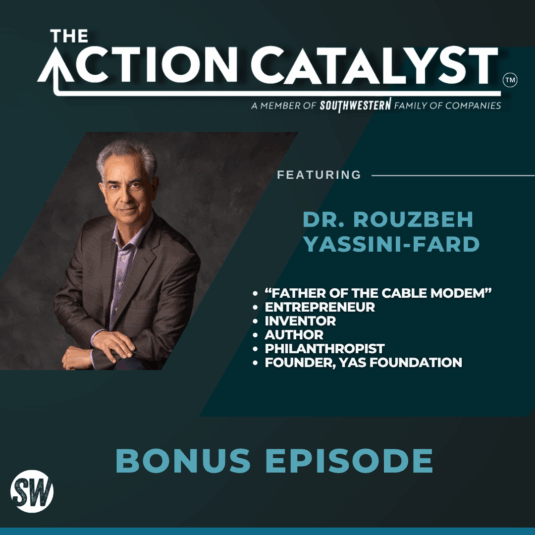
Rouzbeh Yassini-Fard, the tech entrepreneur known as the “father of the cable modem“, explains the two experiences he brought together to create the revolutionary device, what things like broadband and cable modems REALLY are, why he gave it all away free of royalties, and the role of homemade Persian food in making it all possible.
About Rouzbeh:
Rouzbeh Yassini-Fard is a technology entrepreneur and philanthropist whose Massachusetts-based organization, YAS Foundation, supports innovation and creativity addressing medical technology, telecommunications advocacy, educational scholarship and cultural collaboration.
Dr. Yassini is widely known as the “father of the cable modem,” tracing to the breakthrough achievements around high-speed data technology pioneered by LANcity, a company Yassini founded in 1988. LANcity was the developer of key technologies including a Media Access Control software solution which Yassini contributed on a royalty-free basis to the global cable telecommunications industry.
In 2024, Yassini was inducted into the Syndeo Institute’s Cable Hall of Fame, joining numerous notable industry luminaries and trailblazers. The same year, he was selected to receive an Emmy Award for Technology and Engineering from the National Academy of Television Arts & Sciences.
Earlier, Yassini served as an executive advisor to CableLabs, providing guidance and support for the non-profit organization’s Data over Cable Services Interface Specification (DOCSIS) program and a separate device interoperability initiative that paved the way for the scaled deployment of cable modems, a pillar of today’s worldwide, multi-trillion-dollar broadband sector.
As Founder and CEO of YAS Ventures LLC, Dr. Yassini was instrumental in the creation of multiple start-up companies that were acquired or successfully staged initial public stock offerings. In total, the firm has been an investor in 13 start-up companies from 1997-2017. He has been an advisor and/or consultant for Cablevision Systems Corp., Cisco Systems, Comcast Corp., Cox Communications, Liberty Global and Rogers Cable systems regarding technologies and solutions tied to high-speed broadband communications. He has also served as a member of the board of directors for LANcity (acquired by Bay Networks in 1996); Broadband Access Systems (acquired by ADC in 2000), TrueChat (acquired by Terayon in 2001), Entropic Communications (initial public offering in 2007), IRYStec (acquired by Faurecia in 2020), and Visteon Corporation (2015-2020).
Yassini also is Executive Director of the University of New Hampshire Broadband Center of Excellence, an interdisciplinary initiative devoted to the advancement of broadband Internet technology and services. Yassini holds an Honorary Ph.D. in Science and a B.S. in Electrical Engineering from West Virginia University; an Honorary Ph.D. from Merrimack College; and an equivalent MBA from General Electric’s Financial Management Program. Dr. Yassini is a member of the Lane Department Academy and the West Virginia University Academy of Distinguished Alumni.
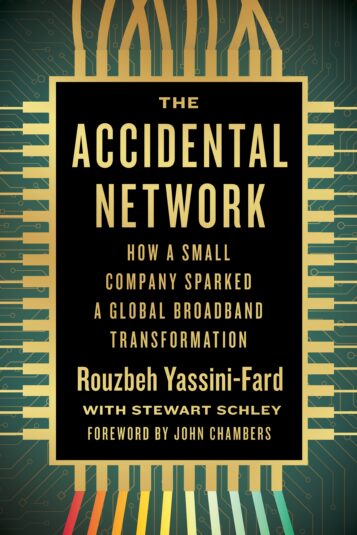
Dr. Yassini is the author of The Accidental Network: How a Small Company Sparked a Global Broadband Transformation. He has also authored Planet Broadband (Cisco Press, 2004), a humanized look at broadband technology and its contributions to society. He resides in Massachusetts.
Learn more at Yas.com.
The Action Catalyst is presented by the Southwestern Family of Companies. With each episode, the podcast features some of the nation’s top thought leaders and experts, sharing meaningful tips and advice. Learn more at TheActionCatalyst.com, subscribe below or wherever you listen to podcasts, and be sure to leave a rating and review!
LISTEN:
SUBSCRIBE TO OUR RSS FEED: https://feeds.captivate.fm/the-action-catalyst/
SUBSCRIBE ELSEWHERE: https://the-action-catalyst.captivate.fm/listen
__________________________________________________________________________
(Transcribed using A.I. / May include errors):
Host
Rouzbeh Yassini-Fard, known as the “father of the cable modem”, is a tech entrepreneur, a philanthropist who supports innovation and creativity, and his book, The Accidental Network, tells the story of how his startup, LAN City, defied the odds, rewired an entire industry and helped give birth to broadband that we take for granted now. So Rouzbeh, thank you so much for joining us. Can’t wait to dive in.
Rouzbeh Yassini-Fard
Thank you so much. Yes.
Host
You’re widely known as the father of the cable modem, but what exactly are we talking about when we say that? What specifically is the cable modem and its function and what existed before that?
Rouzbeh Yassini-Fard
Thank you so much for your question. If you go back by early 1980s your audiences would remember beeps and the burps of when you connect your phone modem. In order to have computer connectivity, that was the methodology we used from a remote location to get to the computer as such, you had to have a phone line and a phone modem and a dial in numbers. The AOL methodology was a very good model. So up to know that computer connectivity was we are the phone modems. The reason I was called the father of the cable modem by CD magazine, which is Communication Engineering and Design Magazine 1999 was because of the vision I came up with earlier in my careers in 1987 by then, I was lucky enough to have two solid experience, one about the televisions and cable television working with General Electric understanding how TV signal works and how people receive their favorite programming on TV. And the other one was the computer networking to see how the corporates are connecting people who come to a place called workplace together. And by 1987 I asked myself, Why shouldn’t we have one cable instead of two separate cables, in order to be able to have people connected from the home, why should we come to the place called the workplace connected to the our computer to a network? At that time, of course, was a funny matter. Everybody was laughing at it and and the idea was that there is no such a device, there is no such a cable that can work both for the data networking and TV signal. And I said, Well, based on my background, the cable TV does a very good job with the TV distribution as well as the data networking for the computer works very well. I bet you we can make the data voice and video works over coax, which was the media the cable TV was using that idea of a 1987 led to the innovation and creation of the cable modems by 1996 on the four different stages, and then become to be global standard by 1999 so I got the label of the father of the cable modem for babysitting an idea from 1987 to 1999 with my team of the excellent engineering group to be able to develop such a product that now allows you to Be on the network all the time from a place like your home and with your everyday communication.
Host
And we understand that some good, homemade Persian food had a hand in making that all happen.
Rouzbeh Yassini-Fard
You’re so kind to remember that part of the book. Yes, indeed, before Silicon Valley was Silicon Valley and companies providing food for the employees, and we already had that in a place in our little company called land city, thanks to mom, was able to get some good Persian cook tomorrow into the office all the times and the people would naturally stay to work from first shift to the second shift and sometimes to the third shift. In order to meet the deadline we had. We were a small group of entrepreneurs that believe in our vision, and nobody else believe what we can accomplish the dream that we have. So the Persian Foods was a touch on that.
Host
When people hear the term broadband, that’s something that we’re very used to hearing nowadays, so much to the point where it’s just kind of always been there. A lot of people might not really know what that refers to. Can you just explain kind of what broadband is, what that really means.
Rouzbeh Yassini-Fard
Think about your life this way, everything you do in a given day is ambient and works by itself. So you don’t do anything specifically to turn your computers on, to connect your computer to other devices or so on. Broadband is always on. Highest speed connectivity always on. Basically means, when you turn your computer on and you’re working with that, you’re automatically connected to the entire network of the computing devices and sources in the world. So a broadband is a digital highway that is always on, always connected, always available, all the resources at higher speed where you would not differentiate. Oh, can I receive this content? Can I receive that video? Can I receive this type of a file? In fact, the reality tells you that with the broadband and always on, you are part of the ingredients of the data networking around the globe, and you have access to anything, anytime, anywhere, that is your life. Now think about yourself this morning. You got up this morning, you probably touch broadband four or five different way, without even knowing you were touching it, or you had to do a special connection. You might have talked with your parents. You might have been able to do your banking. You might watch a video video. You might have seen some news, or, more importantly, you might have an interactive meeting with number of the people all those are using now broadband infrastructure without even knowing it.
Host
Obviously now, it’s like you said, in everything. When these technological innovations were first made back in the 80s and 90s, how did that creation impact consumers, the economy and Silicon Valley at that time? What was kind of the immediate impact closer to the beginning?
Rouzbeh Yassini-Fard
So let’s take them, one at a time. This is a very excellent question, because impact humanity at its best. How did it impact consumers? Consumer as the word indicated to be consumed, receiving at home, but only consuming information. They were never producer. They never could create. You’re creating these podcasts from your place, so you are not a producer. Doctors can look at the x ray. A variety of the teaching can be done in that nature. So what broadband did the consumer made the consumer to be producer at the same time, not just consuming information, but you also could contribute and be able to provide number of influencers in social media and so on so forth. That’s one. Now let’s look at the Silicon Valley. Almost every corporation in Silicon Valley, or, for that matter, Austin, Texas or Boston, needed to have a always on broadband infrastructures in order their social media networking or the services that they provide to work all the way from our friend in Ubers, all the way from our friends in the Facebooks and so on so forth, to the Netflix those companies would have not been able to really take advantage of the dial up and provide the type of services they do. So the Silicon Valley got its life by having an information highway, which was empowered by the broadband Now let’s bring those Silicon Valley companies and the producer together. All of a sudden, we have built this global economy now as a result, because now you have a toolbox. Your toolbox is beautiful, software services made by all the corporation innovators around the world and Silicon Valley and other places, then you have the producer and consumers now taking advantage of this toolbox, and as a result, everything comes together. And now you have a global economy. You also have a global infrastructures where companies and countries are talking together daily, where the languages are translated live for the people at the same time. A good examples on this one, if you really consider going back about 30 years ago, 40 years ago, we could not even imagine to be able to learn and distribute the knowledge within the second globally, the individual would come to the Western countries, educated, get some listen, and then 20 years later, they go back the home country to be able to contribute something. Now you’ll instantly be able to do that. Here in the Mass General, for example, we can see the doctors who get an X rays at the night time because of an accident, and the professional might not be able to look at that x ray. But back in Australia, is a daytime and that doctor can look at that x ray and provide comments and a feedback to the emergency room in a Mass General that what that are. So we really have seven by 24 global economy all in power now because of it.
Host
You say something really interesting in the book, which is that you say along the way here, an entire industry lost and then rediscovered its purpose and its momentum. What do you mean by that?
Rouzbeh Yassini-Fard
I’m glad that you’re bringing that up. Cable infrastructure was all known for TV distribution only before that basically means get the video content and bring us to the living rooms of the people and appear. And the TV was positioned for one way communication. You sit in your sofa, you have your potato chips in your hand, and you watch programming and TV that was it. We used to call them couch potato, if you remember. So what happened is this, that the power of the cable TV, the infrastructure they put in a place, was so powerful, but only being marginally used. And as the video become to be less important, and time goes on, you will find out that cable industry, because of regulation from one side and the cost on the other side was becoming to be irrelevant to the people, just to be a distribution of their TV programming. So at that time, when we injected the data delivery through the cable infrastructure, it actually gave the cable industry the Second Life, where it became to be instead of a TV programming distributor, a telecommunication pipe. In fact, in 2022 the revenue that cable Industries was receiving from high speed data on a broadband was more than the revenue they were getting from distribution of the video signal. So what had happened was the transformation of cable industry from being video only system to a telecommunication system where you really don’t mind if it’s a voice, if it’s a data, if it’s a video, everything was coming together very nicely to be able to provide that contents to the consumer. So consumer now is extremely happy because they have one pipe, and that pipes deliver to them the contents, the video, their voice, their data, they do their banking, watch the any programming they want at any given time, and also do the health cares, do education and do more that we have never been enabled to do. So that’s the transformation we saw from cable industry becoming to be a telecommunication pipe.
Host
Now, typically, when we think of companies that launch big ideas, big products, there’s often private investment, there’s venture capital, there’s corporate interests. In your case, government entities actually played a big role. Can you explain how?
Rouzbeh Yassini-Fard
I’m glad that you bring in this one up, because the standard venture based companies are created based on external financing from VCs known as the venture capitalists, and they invest in the company to go on, we were so early with our technology in order to be able to provide the broadband that most venture capitalists didn’t want to take that risk. A, because they didn’t believe in cable industry. B, they never believed that we could actually put data over a cable system. What happened, which most American don’t really appreciate, the government has done a very nice job to be able to be moving some of this technology well in advance, it happens in the middle of the Mississippi River. There is this place called Rock Island. Arsenal. Is actually a little island in the Mississippi River where they do for their military works. And they had chosen in early 80s to use the cable TV as infrastructures for their computer connectivity, voice connectivity and data connectivity. So we were able to actually work with them and provide our technology to them and and make sure the connectivity between the mainframe computer at that times, as well as the personal computers and others to work for the global services they had to provide that private company, Mined Land city and that public infrastructure, rocketland, military, working together over the cable TV infrastructure, help us to mature the product, bring the cost of the product down and also be able to add the network management and tools that is necessary to have a larger scale. 100,000,002 100,000,300 million customers working together. So I love the private, public relationship that we had at the time. And the government really should be credited with the taxpayer money that they actually were much earlier than anybody else to use the cable infrastructure as a telecommunication pipe. And my land city company happened to be the beneficiary of that type of a private public company. And I’m very proud of that, because that really shows to us, America, that private company, public company, working together, we can actually do better thing for humanity. Guess what? Today, everybody’s using broadband for all the good things they are doing because of that type of relationship that we had in early, late 1980s.
Host
And speaking of that, usually after creating groundbreaking technology, people profit off of it, or people, you know, really hold the technology close. You decided to distribute it to the broader industry free of royalties.
Rouzbeh Yassini-Fard
You know, there are time in your belief that you think what you innovate sometimes has far better value if it’s distributed globally for everybody to utilize. And I still remember that moment very effectively. That why we decided to be able to do that, because we felt a technology that we had brought from $18,000 per cable modem to less than a $30 per cable modems. It really better serve the entire globe than for somebody trying to make money into it. We decided that if we make our technology global standard, everybody will be connected faster, cheaper and seamlessly, and all the connection will work exactly the same, where the interoperability and connectivity among all the peoples around the world would become to be seamless, but really made perfect sense for that technology to be gifted to the cable industry with the royalty free and then becomes to be global standard, because that’s how we got 4 billion people around the globe connected. Now, if I would have not distributed my technology royalty free, would that happen, of course, but it would have taken much longer time, and would have taken a lot more efforts to be able to do so. So we expedited the process and and if you go backward to year 2020, with the unfortunate co Ed solution problem that we face. Think about that. What was the role that broadband played? Everybody was connected from any part of the world. So our foresight really worked very well. And when a natural disaster like covid showed up, the broadband was our rescue factors for the global humanity, global economic and global connectivity. So I really felt very good then, and I still feel even better now, because you shouldn’t measure yourself by the number of the zeros in your bank, but you should measure yourself with how many humans are now, using that technology effectively.
Host
You mention two secret superpowers for success, which are determination and diligence…
Rouzbeh Yassini-Fard
Yeah. So I’d like to take a step back on this one and think about it. How many people told us this would never work? How many people told us there’s no way you can bring this half a size refrigerator device to a small size that can fit in the people’s home? There were people who said, There’s no way you can put a cable infrastructures in middle of that. In fact, some people were referring in the universities to the cable system as a sewer pipe that a good thing goes in it and bad things comes out of it. So the two awards that you are referring to was really the field behind my team, we believed in one thing, should the data over cable TV work yes or no? And we have accepted it should Yes. So we kept peeling the onion, layer by layer, solving their problem, solving the issue, technically, marketing wise, business wise, and we were able to really accomplish our goal. If you didn’t have that determination, we would have given up the ideas and the hope that these vision we had back in 87 would ever work. So in summary, they were really the guiding factor for us to stay in the track and keep on going and keep on going until we get to the objective that we had, which was really a ubiquitous cable modem connectivity, now called broadband services everywhere at any given time.
Host
You know, for a lot of entrepreneurs, after having a great and groundbreaking success like yours, it’s difficult for them to maintain momentum. How do you keep yourself motivated and constantly innovating?
Rouzbeh Yassini-Fard
My motivation has always been the stuff that I’m innovating. Does it help humanity? Most venture capitalists and venture companies and founders like to say, can I make money? I have never been motivated with the money yet. I’m a good capitalist at the same time, if I really work hard and create something, I think it should be a rewards on that, because that’s the best system we have in the world, and works very productivity, productive for everybody. So my innovation has always been around whatever I innovate, it needs to help the humanity, and it needs to make the planet Earth’s a better place than what we found it before as such, that has been my way of the growing my company, online city, and all the other companies that I have founded after that. But the other side of the issue also is on the startup company. Is that how well can you really focus on. New technology and new innovation always try to focus on existing problem. Means find a problem that needs a solution, where go design something and innovate something, then try to see what fits in in order to do that. So the combination of focusing on solving a problem and also focusing on making sure what I’m doing helps humanity has been the guiding factors for me, and has helped me tremendously in my last 20 plus years to be able to innovate more company after we did the cable modem technology, what am I working now? I really believe the elder is that staying at home with the loved one have a far better chance to enjoy life and the sunset of their life becomes to be a more powerful by being near their loved one and their home, and be able to have the children, the grandchildren surround them. So using the broadband infrastructures, working with a number of medical doctors, I’m working around the technology to be able to see how we can provide the quality of a life and the details of the healthcare information that elders can share with their doctors and nurses outside to be able to monitor them just as they were in the hospital or just as they were in the nursing home. This allows the elders to stay home longer live betters, have better quality of life, and then we will be able to monitor them effectively and openly and dynamically to be able to provide them a better assistance and a better input. For example, with the using the technology, you could almost predict the mobility of elder person at home is the mobility of that person requires to do something different for them. So we will be able to manage that, and before the person falls down and break a legs or arm, you could actually prevent those elements of happening. So healthcare at home for elderly is my next passion that I’m pursuing right now, and I think that’s a very good way of to be able to appreciate our elderlies, to be around the grandchildren and enjoy the life at the environments that they have at home.
Host
You know, our audience is made up of entrepreneurs and inventors and small business owners, and they’re all listening to you talk about motivation and impact and determination. If they’re stuck in a rut or if they’re working on their first big thing, what would be a piece of advice you would give to them, something they can do today, literally today, what’s the next step they should make? Where should they start?
Rouzbeh Yassini-Fard
You know, that’s very interesting, because it impacts every one of us. So I think the number one for any entrepreneurs today that can make an impact for them is to make sure they believe in what they are developing, first internally, if they believe in that number one, then make sure that it fits in a problem that exists. And if it fits in a problem and they believe on it, then they should make sure to work in environments to be able to prove to their consumers or their customer base that this thing does do something good for them, and if they focus on those three elements, you will see that the product will start doing the talking versus a PowerPoint presentation or some marketing advertising, about it. So my my advice to them is make sure as fast as you can let the product does the talking for you, and let the product speak on the value and the benefit that bring for the consumer, that will do a great job for any entrepreneur to be able to move forward faster.
Host
That’s very good advice. So where can our listeners get a copy of the book? And where can they connect with you?
Rouzbeh Yassini-Fard
Of course. So the amazon.com. Just look for The Accidental Network in Amazon, and they should be able to get the book through that distribution system. There’s other wide distribution as well, like a Walmart that you can also get the book order through their website. And most importantly about the book is the book really does two good things. From One Hand says how we believe in ourselves and how we transform industry to become to be the broadband pillar of the society, and the other one says how small group of the people are able to make that change without external financing, which I think it brings to value to the entrepreneurs and the industry, that as long as you believe in your vision and your technology, keep on going and deliver what the product should do and the best is yet to come.
Host
Fantastic. Well, look Rouzbeh. Thank you so much for making some time for us today. We’ve really learned a lot.
Rouzbeh Yassini-Fard
Thank you so much. I really appreciate the time you have given me. Thank you so much.
0 Comments