
Wired for Progress, with Ken Coleman – Episode 502 of The Action Catalyst Podcast
- Posted by Action Catalyst
- On April 21, 2026
- 0 Comments
- AI, author, Business, career, coaching, education, leadership, mindset, parenting, soft skills, success, technology
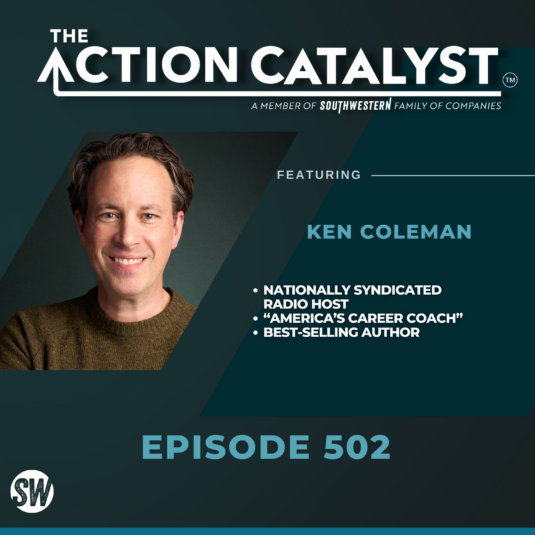
“America’s Career Coach” and author Ken Coleman discusses parenting, curiosity, and the evolving workplace in the age of AI, emphasizing the value of human connection, soft skills, and relationships, and reflecting on challenges facing younger generations—especially diminished curiosity and difficulty asking good questions—while advocating for major reforms to the U.S. education system to focus more on critical thinking, creativity, experiential learning, and reduced standardized testing. Coleman also explores the importance of overcoming limiting personal narratives, building self‑awareness, and embracing mitigated risk in career development, and shares insights on coaching, the role of technology in gathering data, his own personal growth and reading habits, and the lifelong tension between progress, patience, and controlling what one can control.
About Ken:
Ken Coleman is “America’s Career Coach”, the #1 national bestselling author of The Proximity Principle and From Paycheck to Purpose, and host of both The Ramsey Show, as well as Front Row Seat.
Ken’s early 30s were rocked by an identity crisis. Since the age of 16, he had planned a political future that would have him running for office, but that dream slowly died—leaving him confused and lacking confidence about his professional direction. After some deep soul searching and life mapping, he decided to get on the path to broadcasting. He didn’t have a degree. He didn’t have any experience. His head told him it was too late and too risky to start over and completely change direction, but his heart kept pulling toward the vision he couldn’t stop thinking about.
Thankfully, he decided to pursue broadcasting. He signed up for a six-week broadcast school with people 10 years younger than him, and covered high school football games on a country station at 11 p.m. on Friday nights, worked for free several hours a week at a sports-talk station in Atlanta, and fought through imposter syndrome and humbling moments to gain as much experience as possible. Ken took on public speaking gigs, introduced mimes and balloon artists at a community event…anything.
Through strategic connections he made along the way, he got an emcee role for a national leadership conference that gave him the opportunity to interview well-known athletes, leaders, authors and celebrities. One of the notable guests he interviewed was Dave Ramsey, which eventually led to their friendship and Ken joining the team at Ramsey Solutions. After three years of serving in multiple hosting roles, Ken got the chance to use all the career strategies he’d learned along the way to write three bestsellers and host a nationally syndicated radio show, The Ramsey Show, the second-largest syndicated talk radio show in America, fulfilling the dream of broadcasting, to encourage and equip people to be who they were born to be.
At this point in his journey, Ken has had the opportunity to interview three presidents, heads of state, some of the top names in sports and entertainment, and a host of other leaders. Between interviewing leaders and coaching over 10,000 people who are working to level up their careers, he has gained a unique perspective on how you can get better, move up, and lead well.
Learn more at RamseySolutions.com/Ken-Coleman.
The Action Catalyst is presented by the Southwestern Family of Companies. With each episode, the podcast features some of the nation’s top thought leaders and experts, sharing meaningful tips and advice. Learn more at TheActionCatalyst.com, subscribe below or wherever you listen to podcasts, and be sure to leave a rating and review!
LISTEN:
SUBSCRIBE TO OUR RSS FEED: https://feeds.captivate.fm/the-action-catalyst/
SUBSCRIBE ELSEWHERE: https://the-action-catalyst.captivate.fm/listen
__________________________________________________________________________
(Transcribed using A.I. / May include errors):
Adam Outland
Today’s guest is Ken Coleman, a nationally syndicated radio host often referred to as America’s career coach, as well as a number one best selling author since 2014 he served at Ramsey solutions, where he offers expert advice to help 1000s of people every day discover what they were meant to do and how to land that dream job. He’s been the long standing co host of the Ramsey show, and most recently has helmed his own show front row seat. And he’s previously joined the action catalyst in 2019 and again in 2022 now making him the only guest to have been featured on the show three times.
Ken Coleman
Is that right? Wow. Well, I’m honored by that.
Adam Outland
Ken, you know, one of the things they say to us coaches is, it’s hard to be a prophet in your own land, right?
Ken Coleman
Yeah, right. Isn’t that the truth?
Adam Outland
Yeah. And I was curious, for you, I mean, you know you’re, you’re right in this period, or pretty close to this period with your own kids about their career journey. Do you stay like super hands off when it comes to that with your own kids?
Ken Coleman
I’m not super hands off, but I’m not, I’m not in any way trying to manipulate. I’m super supportive. Cheerleader. Is probably my vibe. How can I help? Sometimes they want my help. Sometimes they don’t. If I offer to help with a connection and a relationship that benefits them. They’ve been quick to say yes to that. So that’s good.
Adam Outland
Yeah, you slip The Proximity Principle in their bag and just say, read this and then come ask me…
Ken Coleman
Yeah, I wish. They would roll their eyes and pick the book up and probably throw it at me. To them, it’s just, you know, it’s just my job. My favorite thing is when one of their friends will be over at the house, and their friends recognize me from Tiktok. Video that really embarrasses my kids. And you would think it would make them proud, but it embarrasses them. And I think I’m cool for a half second. You know what I mean? Because the kids like, wait a second, you’re his dad. I’ve had that happen two or three times. They’re like, I recognize him from Tiktok, and it just drives my kids crazy. And I always try to get out of the room quickly, because I know my kids are mortified.
Adam Outland
Well, one of the things I was curious about, and this is the generation your your kids are walking into this you wrote a lot of your material, obviously, pre this AI boom. And, you know, I’m kind of curious as you’ve been following the agentic and generative AI and all these innovations. How is this filtering into conversations that you’re having when you’re helping people with career moves? How is this filtering in to conversations you have with your own kids as they design their future and what they’re interested in?
Ken Coleman
Well, I think the overall statement would be, as it relates to professional growth and opportunities in AI, you just need to be aI savvy, but AI is not going to do one on one interviews, the ability to win with people in interviews, the ability to connect with people outside of you know your lane in your lane, to do what has always worked, and that is, it’s not what you know, it’s who you know. Because the what you know is becoming even less important now, because AI knows it, but the who you know is going to always be the difference maker. It’s, it’s the ability to connect with people, the ability to win with people. That’s going to be a premium and and, yes, AI is going to be a massive disrupter. I don’t think it’s going to be the sky is falling predictions that we’re seeing some people who are predictively in AI say all this stuff, but yeah, I think it’s going to change the way we work, but it will not change the way we connect.
Adam Outland
Yeah, I even feel, at times that it may actually do the opposite. Makes the human connection even more special.
Ken Coleman
I agree. I agree. Yeah, it will. It will be a premium. I think there’ll be mass adoption, right? And just like we’re starting to read reports now, of, you know, college kids starting to get, you know, putting their phone away, and, you know, there’s only so much of that you can take. And so I think there’ll be swings back and forth, but the human touch, the touch, the emotional connection, the ability to look someone in the eyes, to read their body language, to be empathetic, to be discerning, what we call soft skills. And soft skills are going to be at an absolute. Premium when so many other skills are essentially farmed out. But focus on becoming the most healthy, likable version of yourself, and you will absolutely rise like a helium balloon.
Adam Outland
This next generation. What aspects do they struggle with the most?
Ken Coleman
Asking good questions, being quick on their feet. You got to be careful when I answer something like this, because the you know, that’s a big question, and my answer could come across very generalist. So I think no matter what generation we’re talking about, take our just current span of life, the greatest generation, all the way down to Gen Z, and whatever generation is behind that, okay, that’s our span right now, and as history moves, it doesn’t make any difference. This answer will be true. There will always be people, no matter what generation or age group they’re in, that are just quick on their feet and are naturally curious, but by and large, what social media and phones have done to this younger generation is remove their curiosity, because everything is just kind of at their fingertips. So they’ve got a ton of what I would call just general information, and information is at their fingertips, but to learn how to dive deep and go deeper, they just don’t know how to do that, because they’re not being taught critical thinking. They’re not being taught how to use a question, how to wield it like a sword. So less and less are they what I would call really curious and know how to ask questions. Ask good questions. That’s a big part of communication, because when one asks, one also must listen, because the asking without the listening is a waste of time. So the better question askers we become, the better listeners we become. That’s the beauty of that. It’s being lost and so that, I think that they’re also they struggle with the ability to to make a good connection with adults. I think birds of a feather flock together. Is true. I think if you throw a bunch of 18 year olds in a room right now, I’d say, yeah, they probably connect pretty well in their way. But when you take them out of that, and they now have to start looking for their first job, and they start having job interviews, this is where I think we see some deficiencies.
Adam Outland
Where did you develop your initial skill at asking great questions? Where did you get your initial reps?
Ken Coleman
I think it was through reading books about history and biographies, even at a young age. I read the book roots, the Alex Haley classic. I read it when I was 11, and my dad was alarmed. He comes home one day and he sees me in the living room. We didn’t have a TV until I was 12, and I had just pulled it off of his bookshelf because it looked interesting to me. And this is an epic story of slavery in America. And just, you know, for whatever reason, I pulled that book off the shelf and it that is a phenomenal book, I mean, just spellbinding to me. And here I am reading about slavery and the horrors of it. And I’m this, you know, 11 year old white kid in suburbia, when you read stuff like that, the reason my dad, I gotta pay that off, he was like, oh, because there’s some pretty heavy stuff in that. But he sat down and talked to me about it. We talked through it. But it is natural for one to read about something in history or read about a historical figure, and it’s like the act of reading, which is learning fuels curiosity. Think about it. And so learning fuels learning. And again, I believe reading is the ultimate tool to open up the mind. And I think it teaches curiosity. It’s like, it’s like kerosene on a fire. And I do think that I’ve just always been a person. I’m just fascinated by how people tick. And I would just say really quickly to your audience that if you don’t feel like you’re particularly curious, don’t, you know, walk around going, Oh, well, Ken, got an extra dosage. No, we all have the same level, but you got to learn how to feed it. And if you feed it and you treat it right, it’ll grow.
Adam Outland
Talk about being a parent again for a second, because this is where I, you know, you can relate to all the dads out there, like, hey, great idea. Would love for my kid to be curious. Awesome. Thanks. Ken, yeah. How are ways that you found to do that?
Ken Coleman
When they were younger, and we did our bedtime routine, you know, going in, getting them in their bed and tucking them in and praying with them, I would always ask them a question, or I would say to them, what questions do you have? What would you love to to know from daddy right, very early on, and I was attempting to model this idea of wonder. Wonder is a wonderful thing. So they would go, where do cows come from? Okay, great. And when you’re tired, you’re laying in bed with them, you got to lean into those things. And so I would just ask them, What would you like to know? And then we would do it at dinner time. We make dinner time about questions.
Adam Outland
Hard to do when you’re tired at the end of the day, but tremendously valuable.
Ken Coleman
Yeah, but I’m going to tell you something, certainly you parents of younger ones, the days are long, but the years are short, you will wish that you could have those exhausting days and nights one more time.
Adam Outland
That’s really fair. Sure. I guess this leads into the question too, what are some of the important parts of our education system in the states that’ll help us as a country? You know, what are we needing to teach our kids more of what do we need to equip, from your perspective, to make sure that we maintain a successful country?
Ken Coleman
Yeah, it’s a really great question. It’s a massive question. I’ll do my best to I have big, big, big, big, big thoughts on this stuff. You know, I think that our education system needs to be overhauled completely. The education system we have now was designed to create factory workers. It’s just that simple. And so it has either intentionally, if you believe in some big subversive conspiracy, or unintentionally, beaten the curiosity out of our kids, because they’ve become test takers, not pathfinders. And so if you want to create Pathfinders, there needs to be creative thinking, critical thinking, learning how to do hard things, learning how to do new things. Sometimes that’s one in the same. It needs to be far more experiential, less class time where our teacher is lecturing, I would remove all homework, completely. Remove homework. These kids need to be kids at night. If you’re doing critical thinking and creative thinking and teaching them how to ask questions, how could I forget to say that if we were just teach people you know how to go from critical thinking and creative thinking to question, asking and learning how to learn, not learning how to memorize. See, all we’re teaching in the American school system is how to memorize. And then now we brought in standardized testing, which was some genius idea by some idiot bureaucrat. It’s bad policy. I don’t care if it’s Republican or Democrat, I’m going to call balls and I call strikes. But if you want to revolutionize American education, you got to remove standardized testing because teachers tell me they’re teaching to the standardized test, they’re not even teaching the topic. And then we need to, again, get out of this overwhelming amount of homework and tests and quizzes all the time. And let’s just teach kids how to think. Let’s teach kids how to do hard things. Let’s teach kids how to ask questions. Let’s teach kids how to relate. I would change the rhythm of how they learn too. You know, five year old boys don’t need to be sitting in class for six hours a day. So there’s lots of thoughts on that, but, but by and large, we are not producing pathfinders. So all they’ve ever known is how to is how to memorize and regurgitate.
Adam Outland
Yeah, that an absence of a desire to take risk.
Ken Coleman
Well, yeah, because we’ve made everything about, we’ve made everything about what’s on the other side of risk, and that it’s always destruction and death. So that’s marketing, if you think about in the 80s and 90s, the explosion of marketing about products, and it was always scare you half to death. So when you remove, when you remove risk in the sake of this is terrifying this could happen. Then what happens is, you raise people who at the very first hint of risk, they melt down because they’ve not been taught how to handle risk, how to assess it, how to move forward through it, when everything is fear, fear, and we must buy this product, or do this thing, or be careful of this thing, then you create super fearful people. That’s what’s going on. There’s risk. Let’s go with, I like to say, mitigated risk, right? So making great decisions in your professional life, taking a chance as an entrepreneur, taking a chance with a big hire, taking a big chance on a product launch. Yeah, you shouldn’t just be like we risky, but using critical thought, creative thought testing, at some point though, we’re going to take a risk. It’s a mitigated risk in that we know that if it fails, the company will not fail. If I fail, I’m not going to be homeless, living under a bridge. If I fail, I’m not going to be in bone crushing debt. That’s mitigated risk, right?
Adam Outland
That’s a good point.
Ken Coleman
It’s going to be okay.
Adam Outland
It’s going to be okay. Do you feel when you’re career coaching someone that’s a big part of your job is unlearning with them stuff they’ve learned, like, risk, right? Like what they’re afraid of in an interview process, like, what do you have to unteach?
Ken Coleman
Usually, narratives and then the behaviors that are attached to the narrative. That’s what I have to unravel. Sometimes, a narrative is I’m not enough. I don’t deserve this thing I’m going after. I’m a complete imposter, because I come from a really poor family, and a bunch of my family members are losers. They’ve never done anything with their life, and here I am on the precipice of like, a really nice ladder and an opportunity to step on a rung of the ladder that completely separates me from everybody in my family as to what they’ve done, and I’m looking at it going, I don’t belong here. I come from this so that’s an example of a narrative that I’m just an imposter, because I come from this stock, and I’m attempting to hang out with this stock, and I got to show them all that past and, you know, explain to them, help them see how that narrative has developed. Helped. Understand what is the narrative like? Just owning what is the voice in your head that you’re really not calling out? So we start with that, and so they get clear on what’s holding them back and the narrative, and then we begin to show them how actions are tied to that narrative. And so if we’re going to change our actions, we got to change our narrative.
Adam Outland
So any exercise that you’d ever suggest for people to catch their own narratives that they have or become aware of them?
Ken Coleman
Yeah, write their feelings down once a day. What am I feeling? Write it down. Be super specific. It’s just write it down. Get it out of your head. We know this is powerful from all the psychology studies on, on writing stuff down. That’s why writing goals down is so powerful. Well, the same thing about doing some reflection and some heart work on yourself and kind of doing a regulation check, you got to get good at it. And the super healthy, super effective people are ones that can do that. And so there are times where I just know I’m I’m out of sorts. I need to slow down long enough to just sit down and write it out. What am I feeling now? I ask myself that and I write it down. Why am I feeling that way? Who’s the cause of that? What’s my role? And you can just ask those questions of yourself, but write the answers down, and it allows you to almost take this third person experience and look at it and go, Okay, and so that’s just awareness. Self Awareness is a superpower. So if I’m aware that I’m angry, and I’m aware that I’m angry at this person or this process, and I’m aware of what my role is in it, what I can do, where’s my ability to do something about it? Where is it not what can I control? What can I not control? If I’m aware of that, it’s gonna make me less abrasive. It’s gonna make me more aware around others, you know, I’m going to go back into that professional environment where it’s causing me frustration, and I’m going to have better perspective. And so knowing what you’re feeling will help you explain what you’re doing. Our thoughts and emotions. Our thoughts and feelings are the direct source for my actions. And so if we go, why am I doing this? Okay, let’s go back. What am I thinking about myself? What am I feeling about my environment, or whatever else? So that’s a really important exercise. Yeah, it’s helpful.
Adam Outland
So just quick turn of topic here, too, with with your work. I’m in the coaching space as well, different sector, but I’m curious. You know, coach to coach. What are you how are you leveraging, or hoping to leverage, some of this technology, some of what’s happening now to enhance your work with people? What are things that you’re looking at in order to to enhance what you’re able to do with others?
Ken Coleman
I’m looking for sources of the big challenges that professionals face in their journey to win. And so I want to see data, you know, I just so technology, in that way, is important because, you know, it’s the ability to do research is so much faster because AI can aggregate, you know, not just case studies and research projects. It can aggregate some of the best stuff ever done studies on human behavior. It can aggregate what American workers are actually saying are there. So there’s just so much information that is now just seconds away. So that’s how I use it, so that as a coach, that knowledge for me allows me to identify stuff, the more I know about what causation looks like, what it is in the in the workspace, and where frustrations and so I go, Okay, here’s what’s going on with leaders and managers. Here’s what’s going on over here with people that are working and and frustrations there. Here’s what’s going on with culture stuff. Here’s what’s going on with burnout. Here’s what’s going on with life balance. Blah, blah, blah, blah, blah, but you’re two of the biggest issues that keep coming up. So the more I can be aware of what’s happening and what is causing it to happen, then as a coach, it’s like going into the room with your growing antenna, you know, like some crazy sea creature that just like, Oh, here’s another touch point. Here’s another touch point. And so because when you’re in coaching, you are reading and you are reacting, that is coaching. I’m reading what’s going on with the person I’m coaching, I am now going to react with more questions, and the more questions I can react with, the more information they get back to me. And all of that knowledge base allows for a coach the more widely read and widely known they are, they know a lot of stuff. They don’t have to be PhD level, but you know a little about a lot. Let’s put it that way. It makes you wildly valuable as a coach, because you see things and hear things and feel things that you may not have caught if you weren’t knowledgeable. So you got to get better at the craft of actual coaching, but you also have to get really good at what inputs are you getting that make you a much more knowledgeable coach, that you see things and hear things you wouldn’t have normally seen. That’s huge.
Adam Outland
You’re saying data, coming back to the data and the aggregating, are you pulling that from institutional case studies? Are you pulling it from your own inventory?
Ken Coleman
All, all of the above, you need to find your AI agent, and if you’re using Claude or chat, GPT, or whatever else is out there. And then there’s books I’ve also coached. I don’t know what the number is approaching 20,000 people live on the air, and I do it every day. I’ll do it today for three hours. So the day in, day out, of practitioning, and you got to help somebody in six to eight minutes. That’s a super intense coaching environment. And so what happens is your processor speeds up by the nature of your job, because we’ve been trained, and we’ve been trial by fire, so but you learn, you learn how to listen and see and hear so much faster, and then you’re in the same lane. So somebody who’s coached 1000 executives is going to be a Jedi compared to somebody that’s coached 200 executives by sheer volume, right?
Adam Outland
What are you reading right now? How are you growing yourself, Ken, like, what are the steps you’re taking to keep your edge?
Ken Coleman
Yeah, well, I read every day, so I’m reading so many things. I literally it could be 21 different books that I’m rotating through, articles that I’m reading, but I am personally diving into a book called three mile an hour God by a Japanese theologian, and it’s pretty heavy read. I’m in a season of life where I am really focused on learning how to wait, because waiting is really hard for me, and I think for a lot of humans, it’s anti to our nature, but it’s so much more spiritual than it is physical. You know, God wired us for progress. Tells us to go work. In Genesis, chapter two says, Go subdue the earth, go work, right? So that’s in us. The Creator himself worked. You know, is still working. So we are wired to work and to do. And thus that makes us creatures of progress. But this idea of waiting is where faith comes in. Hebrews says, Without faith is impossible to please God, right? And and we know, in Isaiah, those who wait on the Lord, in some translations, those who hope so, just just understanding. And again, if you’re not a person of faith, I’m simply saying that we’re wired for progress, and yet we are called to faith, and so learning this patience while persisting is a real, natural tension. And by the way, you could be an atheist and get something out of this, just learning how to wait when you need to wait, wait is an action it’s not a passive verb. It’s an action verb. I’m still getting up and I’m and I’m doing the best that I can today with what I have today. But if I am moving forward and longing for a desired future, then I am hoping and essentially in a waiting game, doing what I can, waiting on the results. And so that’s a book that it’s really heavy, but I love the title, and I just it’s a reminder that God doesn’t move at our pace. Number one. Number two, it’s almost always slower than we want it to be because of our humanness. And so it’s not just a spiritual read. It’s also, I think, a deeply practical read for me, as I’m still dreaming and and all of that and doing. It’s just a reminder to show up and do my best today, and God’s in the details.
Adam Outland
I love that. I did a 10 day silent meditation when I was in my 20s, and it illustrated to me how we all have addiction. The one that’s really transparent is alcohol or some kind of substance abuse. One that’s less transparent is the thoughts that you’re addicted to in your own head, right? And you just keep coming back to and it’s hard to not think. It’s hard to focus on being present, because your brains wants the juice of coming back. And whether it’s a bad memory or happy, it doesn’t matter. Like we get addicted to emotion, to feeling, and to all kinds of things. And I think a little bit about that when you talk about this book, because some of it’s the addiction to wanting results, or the addiction to wanting these things and being patient and creating space helps create more peace in life, right?
Ken Coleman
Yeah, absolutely. I think that’s a very good point, you know, to get to be comfortable with just controlling what you can control. That’s what’s going on with all the stress and burnout in the workplace and all this stuff is that everybody’s trying to control stuff they can’t control, instead of focusing on the things they can control. And when you focus on the things you can’t control, you realize, oh, a I don’t control very much at all. And so now it just kind of goes, well, I can do one of two things with that. I can go life sucks. Why am I here? I wish I had more control. Or we go, huh? Life can be really great if I just do a good job controlling the things I can’t control. These are very different shifts as to which way you can go with that. But I think that what you’re describing what we’re talking about here. It does get us to a place of healthy perspective on Who am I, what’s my role in this grand, cosmic scheme, and what can I actually control as it relates to that role? And just focus on that.
Adam Outland
Yeah, because there’s very few things that you can actually control.
Ken Coleman
Oh, gosh, I gotta tell you, as a parent, that’ll be one of the greatest things as you, as your kids get older, this will be the hardest thing you do, and I sucked at it, and I mean that I’ve apologized deeply to my kids for things that would have created tension and stress as I began to get healthy as they were older, I wish I had gotten so much healthier when they were younger, but just realizing what a control freak most of us are as parents, but I’m calling myself out. And so moments of anger or tension were created because I was not feeling in control. And had I just had proper perspective on control, I wouldn’t have been as intense or made a decision that, you know, whatever. So if I could say to all the parents as your kids start getting agency, and they’re now out driving and they’re away from you, you know, I think back to how little control my parents even tried to exert over me because they couldn’t. There were no cell phones when I was a teenager. I mean, you talk about free range chicken, they couldn’t track me, and they were fine. So, you know, you can teach your kids and you can love your kids, but you cannot control your kids.
Adam Outland
I have to tell you, you know, I picked up a lot of, I used, I used to read a lot of biographies, and still squeeze them in here and there. A lot of business development books I’ve been reading, like parenting books, right? And it is some of the best, most profound leadership advice, right? I mean, you think about how you parent kids with control, and it actually works at work like, you know that John Maxwell, idea of, you know, lead through influence instead of control, works great in the office, just as much as it does as a parent. And I can, I can totally relate to what you’re saying. Let me tie up with this. You know, the question I always ask, and you know, there’s a, there’s a ninth grade version of Ken Coleman who isn’t nearly as developed as you are today. What did that ninth grade boy need to hear?
Ken Coleman
You’re wildly talented and you’re not like your dad, you’re not like your mom. So rest in that and follow your heart. You’re going to be fine. You have enough ability to do whatever your heart desires, and you don’t need everybody’s approval. Just go, be you, be the best version of you, and you’re going to be fine. Your time is coming. That’s what he needed to hear.
Adam Outland
What a great way to end Ken, thanks for giving us your time and your vulnerability and your knowledge. Really, really appreciate it.
Ken Coleman
Well, I’m honored to be with you again. Thank you.
0 Comments