
Tax Strategy, with Carlotta Thompson
- Posted by Action Catalyst
- On April 7, 2026
- 0 Comments
- accounting, AI, Business, CEO, family, finance, IRS, money, real estate, strategy, success, tax
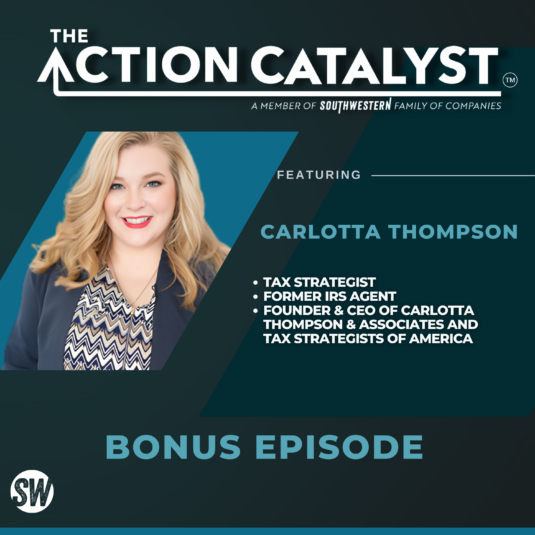
Tax strategist Carlotta Thompson explores her unique early start in tax law, her years as an IRS enrolled agent, and what it taught her about helping business owners legally reduce their tax burden through smarter planning and compliance. Thompson explains how the IRS TRULY operates, and highlights the most common audit triggers, and how tools like cost segregation, opportunity zones, family‑office‑style investing, business acquisitions, and real estate tax strategies can significantly reduce tax liability when implemented correctly, and discusses the limits of AI in accounting, as well as key red flags to watch for when hiring accountants.
About Carlotta:
Carlotta Thompson is the Founder and CEO of Tax Strategists of America. When Carlotta was 14, she remembers becoming enthralled with a booklet on preparing taxes. She decided then that she wanted to work for the IRS, so at 14 years old, she began studying tax law with the dream of working for the Internal Revenue Service (IRS).
Shortly after attaining her dream of working for the IRS as an auditor, Carlotta realized that the IRS isn’t actually in place to help small businesses like she’d thought and it felt like she was working for the wrong side. As an auditor, she saw tons of tax returns with sometimes hundreds of thousands of dollars of missed deductions that were detrimental for the client. Carlotta had a bigger dream and mission to directly help business owners pay the least tax legally possible. She left her government position after seven years to transform her ministry into Carlotta Thompson and Associates, and later, Tax Strategists of America.
Carlotta created her national tax strategy firm to be unique from every other “accounting firm” in the US. Experts in tax strategy, the professionals at her firm create and implement a custom strategy plan for their clients that infuses tax strategy into all elements, including bookkeeping, CFO services, as well as tax preparation.
In her spare time, Carlotta enjoys spending time with her husband and three children.
Learn more at CarlottaThompson.com and TaxStrategistsofAmerica.com.
The Action Catalyst is presented by the Southwestern Family of Companies. With each episode, the podcast features some of the nation’s top thought leaders and experts, sharing meaningful tips and advice. Learn more at TheActionCatalyst.com, subscribe below or wherever you listen to podcasts, and be sure to leave a rating and review!
LISTEN:
SUBSCRIBE TO OUR RSS FEED: https://feeds.captivate.fm/the-action-catalyst/
SUBSCRIBE ELSEWHERE: https://the-action-catalyst.captivate.fm/listen
__________________________________________________________________________
(Transcribed using A.I. / May include errors):
Host
Carlotta Thompson is a tax strategist and the founder and CEO of Tax strategists of America, which help business owners nationwide pay the least amount of taxes legally possible through education and custom tax strategies. So Carlotta, welcome.
Carlotta Thompson
Thank you. Thank you for having me here today.
Host
In the tax world, you’ve got almost a superhero origin story. You began studying tax law at the age of 14. 14!
Carlotta Thompson
Isn’t that crazy? And so a pamphlet came in the mail whenever I was 14 years old, the instruction booklet of how to do taxes. And so I got one in the mail, and I asked my dad what it was, because I had my name on it. And he said, You should read it. And so I read it, and was like, Oh my gosh, this is so cool. And so that’s kind of where my journey began, because my family were business owners, and they were always so scared of the IRS. My dad was a truck driver, and he had a 10 nine on and he had to follow his own taxes, and he was so terrified of the IRS. But whenever I looked at this book, all I saw was like credits and ways to get money back. And so I was always confused of why my dad was so terrified. So I started studying tax law at that point, and I knew that’s what I wanted to do with my life, like I loved it.
Host
So naturally, like any 14 year old, working at the IRS was your dream job.
Carlotta Thompson
Well, I really, you know, at that point, whenever I was 14, my dream was to do taxes. I didn’t decide I wanted to work the IRS till I was about 18. Years till I was 18 or 19, I went to work at a large, big box tax place, and they were doing everybody’s returns incorrectly, and they weren’t helping them strategize. And I was like, the IRS would be so mad if they knew these people were making business owners overpaid taxes. I thought the IRS would like get on to the accountants for not doing their jobs by helping business owners pay less tax. So I was like, I want to go to the IRS, because they’re an education company, because that’s what I thought the IRS was like, they sent me this material when I was 14. Like to help me pay less tax. So surely, if I go there, they’ll get onto the accountants. I was very gullible.
Host
Well, you did end up working at the IRS as an enrolled agent for about eight years. But before we talk about why you left, I think the IRS is often an easy punching bag for a lot of people. But what does the IRS do really well?
Carlotta Thompson
So what the IRS is really good at is IRS doesn’t make any tax laws, right? Congress makes the tax laws, and the IRS interprets what politicians are trying to say, and so they’re a fair organization, right? They’re just wanting to make sure that you have the record keeping, right, that you have what you put on the return, that you’re not doing anything crazy, and that’s really it. They’re not there to, like, give you a large tax bill. Their job is to be fair. A lot of times, when you are dealing with the IRS, there’s a lot of income on your account that’s duplicated, there’s a lot of income that’s not there. There’s no expenses. The IRS doesn’t know any of your expenses. Also, the IRS doesn’t know as much as you think they know. What they’re banking on is us as a nation doing things correctly, and they do that because they’re going to put the fear in you, because if they find you doing something wrong, the penalties are large, right? And so they’re banking on the fact that you’re trying to do things right now, they don’t know when somebody has a lot of income that they’re not reporting, and so they try, and if they catch you, they can go down this rabbit hole of finding that stuff, right? That’s what the auditor’s for. But right now, they don’t have access to all of that stuff, so they just put the fear in everyone, and they’re banking on, you know, compliance, right? They’re making on you complying. In our country, it’s actually worse to file a wrong tax return than to not file at all, and I don’t think people realize that. So filing an incorrect return can actually put you in jail, whereas not filing a return at all, it’s harder for the IRS to convince you. Another thing that they will hit you with too, is if you’re sending letters to the IRS to try to opt out of like paying taxes, well then you get on their radar. Just leave it alone, because there’s no way to opt out of not paying taxes. All you’re doing is bringing attention to yourself. Okay? And the IRS will only usually audit you every set they’ll like. If you’re a non filer, they’re only going to get you every seven years because they can because they can hit you for a tenure. They’re going to hit you in that year seven. So that’s they’re letting those years build up so they can hit you with more money. Like, they’re not going to hit you if you just miss it for two years, because they’re waiting for those to add up so they don’t have to do as much leg work. So people were like, Well, I haven’t filed in five years and I haven’t got a letter for. The IRS, well, that’s because they’re waiting. They’re kind of come. It’s just they’re waiting till they get enough for it to be worth their while.
Host
So after working for the IRS, you know, you started to feel, as you say, like you were maybe working for the wrong side. And in 2018 Carlotta Thompson and Associates was founded, you said that you saw a lot of waste at the IRS, 1000s in expenses that weren’t deducted, usually for one of two pretty common reasons. What are those?
Carlotta Thompson
So there’s a lot of things that get missed on tax returns. The number one reason why things get disallowed on a return is because you don’t keep your records, you don’t keep your mileage record, you don’t keep your receipts, you’re not keeping things, and the IRS is not they’ll let you recreate it, but you have to know what you spent your money on. So if you have a bunch of trips to Walmart or Dollar General or target or places like that, and you don’t know what you bought, the IRS is not going to allow those things. Even if you have a credit card receipt, right? You got to be able to tell them, like, what you spent your money on. So that is the majority of what’s getting disallowed in an audit is you don’t have your mileage logs. You always have to have a mileage log if you use your vehicle for miles. So you need an app, right? Put an app on your phone, let it, let it follow you everywhere. So you know what was actually business. So those are the the biggest problems in an audit is not that you didn’t have the expense, is that you can’t prove the expense. IRS is a company of paper of documentation. They want to know that you every time you have a mill receipt, you have to have the actual receipt for the mill on the mill. You have to have what you purchased, who you are, with the date, why you were there the IRS. You cannot use a credit card receipt for that you have to actually have the receipt. If you travel, you have to actually have the receipt. So those are a few things that are just tips. Like the IRS is all about documentation. So what are things that get missed? Well, on the flip side, a lot of people that work from home or have businesses online, they forget to deduct the things like mileage, or they forget to deduct their home office, or they forget just their regular personal strategies, right? So personal strategies should be like, everybody should be paying their kids if and having their kids work in their business. And so there’s no reason why, if you have a business, your kids not doing something in that business, whether it’s social media or maybe you’re putting them in videos, whatever you can do to have your family involved in your business, renting your home to yourself like these are just like very bottom of the line. Every single business owner should be doing these. So personal strategies and then just regular deductions. And then after you start making, you know, over 40,000 in your business, you should start looking at business strategies, family office style strategies that are higher end. But again, back to tax returns documentation is the most important thing, but I’m going to tell you what gets you audited the quickest is not even anything you actually do. It’s something your accountant does. So when you have a business return, okay, and that’s usually what’s getting audited. W2 earners with kids usually don’t get audited unless they have a business, or they have real estate. So if you just have a w2 and you don’t put a business and you don’t put real estate, you’re usually not going to get audited because the IRS can match all that up W twos, they can match up the kids you have, they can match up. And that’s very easy. So the number one reason why a business gets audited is because the code on your return is incorrect. So whether you do a Schedule C, which is a sole proprietorship, or you do an LLC on S corp or C Corp, the number one reason why the return gets audited is because the NAICS code is incorrect. That is the n, a, i, c, S code. And what that code does is it tells what your return should look like. So it takes everybody with that code and it puts it into a system and it says, Okay, everybody with this code should have 30% of their their expenses in this category, 20% of their expenses in this category, 10% in this category. And so it gives every line a percentage, and if you’re outside of that percentage, then it sends you out for a classifier. And so if your NAICS code is maybe your accountant put your next code in for a lawyer, but really you are a realtor. Your code you’re gonna as a lawyer, you would have no mileage as a realtor, you’d have a ton. And so think about the return difference between a lawyer and a realtor or a hairdresser and a marketing person, right? The returns are just totally different. And when that code is wrong, or if they put like all zeros or all mines in that code, then your return is going to look wrong when it’s compared to everybody else that’s in your same industry. So that’s actually the number one way of getting audited.
Host
We mentioned at the top of the interview in your intro that you specialize in tax strategy. Now, what is tax strategy? How does that differ from what most people might have in mind when they hear those words or think of someone that does what you do?
Carlotta Thompson
Yeah. So a lot of times people think tax deductions are tax strategy. Well, okay, so I could sit with you and I could, you know, come. Up with things that you missed on your return, like you started the business this year, everything that you used in your home office should have been a tax write off, even though it was stuff you had personally in the past that should be a write off. Okay? That’s what a lot of people think is tax strategy. That’s really just tax deductions. Okay, those are things that everyone should be looking at when they’re doing a tax return. So tax strategy are things that take a third party to help you implement. So it’s not something your accountant can do. So think about like if you buy an Airbnb and it needs a cost segregation. Your tax accountant doesn’t do a cost segregation, right? They aren’t qualified. It needs to go to somebody who is an engineer that also does real estate. It’s all about doing what’s best for each situation. And there’s about 120 of those strategies where it takes a third party to do that, and it’s not something you do on your just with your tax return. It’s something that you have to do in advance of your return. So maybe you have a big capital gain, maybe you need an opportunity zone, then that is going to be a strategy. So maybe you’re high w2 earner, and you’re paying a lot of taxes, well, you need what we call family office style strategies. So those strategies are going to be like maybe some solar credits that are from an investment. So family office style strategies are investments that give you back tax deduction. So that might be like film credits or solar credits, or a leveraged charity, or something like that, and they give you credits to go against your other income that you make. And so those kinds of things are what we’re looking at is the overall of the client. We work with clients from 40,000 to 40 million. So when you need a tax strategist, when you’re making about 40,000 in your business after expenses, that’s when you really need to start looking at tax strategy.
Host
For businesses specifically, what can they do to minimize some of what they owe and put themselves in a better position? And what are some considerations for businesses of different sizes? So there would be different considerations between, you know, corporate tax and small businesses. What are a couple things that you usually see people overlook, I suppose?
Carlotta Thompson
Yeah, so we break everything down into four different strategy sections. Okay, so when you’re starting out, your personal strategies are things like renting your home to yourself for 14 days a year. It’s called the Augusta rule. You go out and you get three comparisons from a third party source to figure out what your home would rent for. Then you do the contracts and the invoices and everything to make sure that’s legit. So that would be your home being rented to your business for 14 days a year. Qbi maximization is another one that’s those start off strategies that you’re first doing after you’re making you know around 40,000 in your business. So before 40,000 your biggest strategy is regular deductions, and your entity structuring, knowing how to do it, all of those things that’s leading up to 40. At 40, you’re hitting the personal strategies, which I just said after 40 now we’re hitting business strategy. So business strategies are going to be things like work, opportunity, tax credit, health credit, R and D credits, Cost Segregation credits. So next, after we hit business strategies, then we start telling people, okay, now you’re at a couple 100,000 now we need to start looking at real estate and investing in real estate and doing real estate strategies. So things like I said, like step up and bases up on death opportunity zones, cost segregations, those kinds of things. Next, after we hit real estate strategies, we’re going to move into family office style strategies. And family office style strategies are for those couples that are making over 300,000 if you’re married or over 200,000 if you’re single. And those are going to be more of the investment style strategies by just making sure that you’re hitting all the strategies along the way.
Host
Doing a bit of reading up on you, you advocate for business acquisition, not only as a means to grow wealth, but also as a tax strategy.
Carlotta Thompson
Yeah, so acquisition of businesses or real estate, or what we call a tax acquisition, and it’s actually the fastest way to get to zero. You can either do a tax position in businesses or a tax position in real estate. And so why do we focus on business acquisitions? Well, they usually come with a lot of furniture, friction equipment. The ones we’re looking at, we’re trying to buy something that we can be pretty passive in. Yes, we might have to be active for the first six months, but then we really want something that we can actually turn passive. We’re looking for something that’s going to give us a large tax deduction. We’re looking deduction. We’re looking for something we can exit in five years. So there’s a strategy called the 1202 it’s in the tax code, but essentially, if you sell your business and it is structured correctly after you’ve held it for five years, it’s 100% tax free. This is why private equity companies become so wealthy, because they have this large exclusion for the money they get from selling these large companies. And you think it’s actually a small business, because it’s for companies that are small, but the assets can be up to 75 million. So obviously the that it’s not that small, right? But when we’re thinking us as business owners, we’re like that. It is a small business exception, but 1202, will allow you to not pay taxes when you sell, if it’s structured correctly. So we like to buy businesses and sell them after five years, and that is a 100% tax free exit. Now, who in their right mind wouldn’t want to do that? There’s nothing else like that in the code. So I could sell even a partial piece of my business, and it’d be 100% tax free if it meets the requirements, which is insane for anybody to get tax free money in the US. That just doesn’t happen. But there is a little piece of the code that allows that, which is really cool for business owners.
Host
AI is everywhere now, and surely the tax world is no exemption. Should we have any reservations about ever taking the human element fully out of our tax prep?
Carlotta Thompson
I think for easier returns, like when you don’t have a business, I think it’ll get there. I think it’s going to be able to do easier tax returns, because we’ve always had some AI in our bookkeeping, it just classifies things wrong a lot of times, even, like, you can’t teach it because it’s never going to be able to do reasoning, I guess so. Like, think about this. So for me, when I go to a certain company to buy something, for me, it may be an expense, but for someone else, it may be on the balance sheet, right? That’s a lot of difference, right? Like, one it should be an expense, the other one, it shouldn’t be. And so if you don’t have a human review those books, which is where AI actually started in accounting, then the books are 100% of the time wrong. Like, I’ve never seen a correct set of books where the AI actually did the whole set of books. So you always have to have a human element. But what we do in the accounting world is we use it as a tool. We also see this when we send things out of the country, a lot of times they don’t understand, I guess, their roles, but it’s really hard to get a correct set of books, no matter if you send it to AI or you send it to someone who’s just really being like a machine. So used to, they would send this out of the country for people who didn’t have accounting degrees, and they would just, you know, classify the things. But then when it would come back, nobody asked the client question. So so it doesn’t matter if it’s a human or if it’s a machine, if you don’t ask the correct questions, it’s going to go in the wrong place. That is what I see more and more. When I was an IRS agent, I never saw a set of quote books that was correct ever. And that is insane to me, that there was never a set of books that were correct. You have to ask questions, and that’s the same way with strategy. I see strategists all the time that will say, let me see your tax return, and they’ll try to do strategy from the tax return. That’s never going to be accurate, because you’re never going to know what’s not on the return, just like you’re never going to know what’s not in the book. So if you don’t ask those people questions, so are they ever going to be able to do taxes? Yes, they’ll be able to do easy returns. Are they ever going to be able to do tax strategy? Well, since most humans don’t do tax strategy correctly, it’s going to be even less likelier for a computer to do it correctly, because it all comes down to asking the right questions. It’s going to be hard to take the human element out of it.
Host
You do want to have the human element in it, but choosing the right one is going to be critical. So what are some of the main mistakes that small business owners tend to make when they hire an accountant or when they hire a strategist, what should we be looking for, either as a positive attribute, or what should we be looking for as far as red flags?
Carlotta Thompson
Yeah, so when you’re when you’re looking you want to have somebody that asks you a lot of questions, and that’s very frustrating for a business owner, because they think not getting questions asked to you is good, like your accountant knows everything, but your accountant doesn’t. They’re just guessing. So every time that I have seen bad returns or bad books, is because the accountant doesn’t want to bother the business owner, probably because you’re snarky whenever they ask you questions or like you should already know this, like I always hear business owners say that guys, they don’t know. And so if your accountant’s not asking you a ton of questions, that means that they’re not they’re not doing the best job they can for you, because they don’t know. They can’t guess. They can’t look at what you have and know the answer. I think that is the biggest red flag if you get into a relationship with somebody and they’re not asking a lot of questions. Not asking a lot of questions. Number two, if they are doing tax returns and tax strategy, that’s usually a big red flag, because they don’t have the time to focus on strategy until the tax returns are done, even if they have tax strategy under the same roof, and even if it’s done by a different group in the company. What the CEO is focused on is the tax prep. And a lot of companies try to combine these together, and it does not work, because the whole engine is going towards the January to October deadlines that the IRS has in place. And so if you’ve got a company that’s doing both at. Same place, they’re usually just focused on tax prep and next, your bookkeeper, your tax person, your bookkeeper, should have some kind of communication. Or whenever they do your taxes, they should, there should be some communication between the two. You know, do you always need a bookkeeper? No, you need a tax preparer first. Usually, as long as you can use Excel. Use Excel if you only are doing 20 to 2020, to 30 transactions a month. Keep Excel. Don’t make your life complicated by switching to QuickBooks or zero or something like that, until you absolutely have to, because doing your own bookkeeping and QuickBooks, even though they flaunt is as being really easy. It’s not easy. Hold off on doing that as much as you can. Other flags you should be looking for. Ask them how many reviews are done on their on their tax returns. Any company that does not do a review of the taxes and a review of the bookkeeping should be a company you run from. There’s nobody that’s perfect. There’s always going to be something that could be missed. And so if your company does not have a tax reviewer that reviews every single return that goes out of there, so the prep and the reviewer is separate, do not use them. Same with bookkeeping. If they don’t have somebody reviewing the books that did in the person that did the books and the review of the books, if they’re not two separate people run because there is no human that is perfect, and that is where I see a lot of issues. So that’s my two cents. I would make sure that there’s a reviewer at the company.
Host
Fantastic, Carlotta. Thank you so much for your time.
Carlotta Thompson
Yes, we appreciate you having us on today.
0 Comments