
Perfecting Your Sales Pitch, with John Livesay – Episode 145 of The Action Catalyst Podcast
- Posted by Action Catalyst
- On June 8, 2016
- 0 Comments
- author, Business, confidence, entrepreneur, founder, funding, fundraising, sales pitch, speaker, startup, success
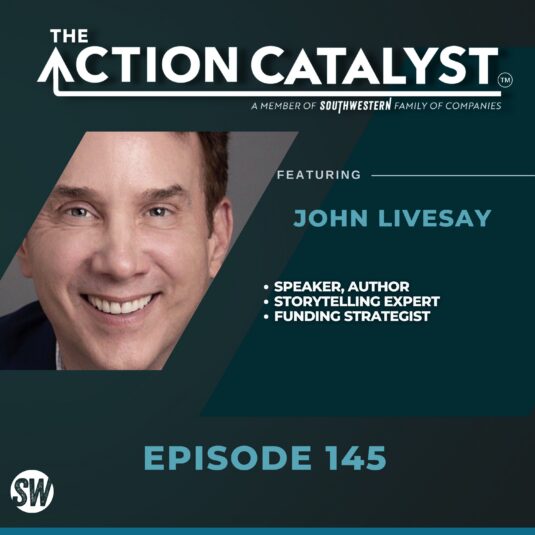
John Livesay, funding strategist and author, reveals expert insights into how entrepreneurs and startup founders can craft compelling investor pitches that win funding, including a shift from feature‑based presentations to emotionally driven storytelling, how to structure a winning pitch, grab attention in the first 90 seconds, demonstrate traction, show empathy for both customers and investors, and position the founder as the “jockey” investors want to back. Livesay also covers practical startup fundraising strategies, including angel investing, venture capital, valuations, and family offices, making this episode a must‑listen for entrepreneurs looking to raise capital and communicate their vision with clarity and confidence.
About John:
John Livesay is a sales keynote speaker and author, and is the Senior Associate at Gensler, where he builds strategy for new business pursuits by working with the marketing team to craft and deliver winning proposals. He also works with the next generation of business builders focused on compelling relationship development through presentation and storytelling skills.
INC magazine calls John Livesay “The Pitch Whisperer”. He is a sales keynote speaker where he shows companies’ sales teams how to turn mundane case studies into compelling case stories so they win more new business.
From John’s award-winning career at Conde Nast, he shares the lessons he learned that turn sales teams into revenue rockstars. His TEDx talk: “Be The Lifeguard of Your Own Life” has over 1,000,000 views. He is the author of four books, including The Sale Is in the Tale.
John is a guest lecturer on how to leverage the power of storytelling in sales at multiple universities including the University of Texas at Austin (UTLA), Franklin University, Pepperdine Graziadio Business school, and the University of Chicago Booth School of Business.
Learn more at JohnLivesay.com.
The Action Catalyst is presented by the Southwestern Family of Companies. With each episode, the podcast features some of the nation’s top thought leaders and experts, sharing meaningful tips and advice. Learn more at TheActionCatalyst.com, subscribe below or wherever you listen to podcasts, and be sure to leave a rating and review!
LISTEN:
SUBSCRIBE TO OUR RSS FEED: https://feeds.captivate.fm/the-action-catalyst/
SUBSCRIBE ELSEWHERE: https://the-action-catalyst.captivate.fm/listen
__________________________________________________________________________
(Transcribed using A.I. / May include errors):
Host
John Livesay is a funding strategist, so this is pretty interesting. So he helps CEOs and kind of entrepreneurs craft a compelling pitch that engages investors in a way that inspires them to join a team, you know, to join a startup and to give money. And so John has a background in sales. For 20 years, he had a career with Conde Nast, one of the top media sales companies, was salesperson of the year for them. But John, welcome to the show.
John Livesay
Thanks for having me.
Host
Tell me a little bit like, how did you get into this pitch world? How’d you get into that?
John Livesay
Well, my last position at Conde Nast was the executive director of corporate sales for all 22 brands, everything from wire to GQ to Vanity Fair. And in addition to packaging, print, digital and video together from big brands like Lexus and guest they asked me to find startups that Conde Nast could use to help monetize the brand. And so I was doing all kinds of research, looking for startups. For example, there’s one called Haul Stars, H, A, U, L, S, T, A, R, S, and they have a shoppable video player, which was helping solve the problem that people were not clicking on static banner ads, and therefore there was no return on investment. So the digital spend was going to go away until I found a solution to bring all stars in and make it a rich media versus a static banner, tell a story, and then people could click on it and buy the clothes that were being in the video and make that come to life. Well, the problem was, when I brought the tech CEO in, was he really did not know how to pitch, and he confused the [email protected] they weren’t sure of the pricing and what problem it was solving. He was talking about how it worked. And I thought, let me work with him and help him fix his pitch. And then I went with the rep from style.com and the CEO to AG jeans, and they said, This is exactly what we need. They did it. We got $30,000 worth of jeans sold in five days. So they were happy. He was off and running, and got other clients. He had proof of concept. And I just realized, if only 1% of pitches get funded, I know why. Now it’s because the people who create these tech startups, they’re left brain people right, and they talk about how something works, and as you probably know and all your listeners, that people buy emotionally from the right side of the brain and then back it up with logic. So you have to grab people’s attention and paint a picture and make it really easy to understand. So that’s what made me decide I’m going to help people craft a pitch so that they can get funded.
Host
So I think the average person you know listening here to the show has probably never pitched an actual investor. A lot of people here probably have seen Shark Tank, right? And so they edit it down, and it’s like this, you know, two minute interaction, right? What do you think, on average, in a realistic scenario, if you are in front of a panel of VC or angel investors or whatever, how much time do you think you are going to have, typically, to get your idea across.
John Livesay
One of our clients, Cole Smith, was able to get in front of an angel group thanks to our connections and coaching, and they gave him 10 minutes to pitch and a 10 minute Q and A. So that’s what’s really important for your listeners to realize, is not only do you have to have a great pitch, but you have to know the answers to the questions, just like they do on Shark Tank, the minute you lose credibility, the answer is no, or the minute you confuse people, the answer is no. And even if you’re given 10 minutes, you only have 90 seconds to grab their attention, to pay attention to you for the full 10 minutes. Why it’s so important to have a really strong opening. Don’t waste the opening with the boring, cliche things, whether you’re giving a talk, giving a pitch. Thank you so much. It’s a pleasure to be here. Blah, blah, blah. You know, you tune people out, right? Nobody, nobody listens to that. I encourage people to open with a really strong question that grabs their attention. Did you know that only 1% of pitches ever get funded? Oh, what that that might grab your attention, right? Did you know that there’s over, you know, X 1000s of, you know, guns being taken into schools every day. You know, in case of coal, he’s selling a platform to help keep schools safe from gun shooters. So he opens with a statistic that grabs your attention and that our lizard brain, I call it, you know, taps in and says, Oh, I might learn something I didn’t know that maybe what else he’s going to say is interesting, too. So opening with a question that’s got a statistic that grabs your attention is a great way to get people to want to lean in and know more. In fact, the whole point of a pitch is to not tell people everything in 10 minutes, but to literally just get them to say that’s interesting. Tell me more. Let’s ask some questions. Let’s go into due diligence. So. The whole point of a pitch is to get the second date.
Host
Can you give us like a bird’s eye overview of the process? So, like, how do you even get that spot to get the 10 minutes? Give us like a bird’s eye view of what this kind of process looks like. If you have an idea and you’re gonna like pitch to try to raise money.
John Livesay
Well, it starts off with you having an idea, typically, right? And then one of the key things investors say is, if you’re selling dog food, I want to see the dogs eating the food. So one of the biggest mistakes people make is, I’ve got this great idea, and people are going to give me money for my idea, when, in fact, you’re selling yourself. The investors invest in the jockey, not the horse. So you’re the jockey, and your horses the idea, because it will probably pivot even after you’ve been funded. So that’s what you have to realize first. So there’s all kinds of ways to get initial traction. Sometimes traction doesn’t even have to be revenue. It can just be letters of intent, people signing up for an email or an app. When this is up, I want to use it really understanding the problem you’re solving is the key and why you are uniquely qualified to execute this idea. So you can raise some money, typically from friends and family, get a little bit of traction, get the app in a, you know, minimum viable product, where there’s something to show how it works. But then the mistake a lot of people make is spending all this money on patents and the app being more developed where, and instead of getting money spent on figuring out how to get funded, that’s the number one reason clients go out of business is no customers, and number two is lack of funding. So you have to figure out how to play the game and what the rules are. So once you’ve got some friends and family and your own money invested in it, because investors want you to put your own skin in the game, then you can approach angel investors, and they typically invest in companies that are pre revenue and early and then once you’ve gotten that money and hit certain milestones of revenue, then you can approach venture capitalists. But the unknown kind of investor that I think your listeners might find interesting is something called family offices. And family offices are another source of revenue that for investment, that those are billionaire, millionaire families that hire people to invest in startups, but all of them require a warm introduction. It’s really the key. Just like everything in life is your network is your net knowledge, and who you know is everything. And investors say, if you can’t figure out how to get a warm introduction, to me, you probably can’t figure out how to get to your customers. The more you understand the problem, the better the investors think you have the solution. No matter what you’re selling, the better you can articulate the problem they’re experiencing, then they’re willing to listen to your solution.
Host
Yeah, it’s almost like you have to sell the problem as much as you have to sell the solution, but you had to sell the problem before you sell the solution.
John Livesay
And the best way to do that is show empathy. It must be so frustrating to be talking to all these investors, and they always say no, and you’re in the wrong room, and you don’t know, even know why you’re getting a no. Oh my god yes. You know exactly what I’m experiencing. You have shown me empathy. You understand my problem. I need your help. See how that works. When you’re pitching an investor to get your startup funded, you have to show empathy for the customer that the problem you’re solving. So let’s say you’re Uber, you know, pitching an investor before this idea even started, right? Can you how many times has ever happened to you, right? You’re standing in the rain in New York City, you can’t get a cab, right? Or the line to get a cab in Vegas is a mile long and it’s 100 degrees outside. You understand the problem. But where the real secret sauce is is if you put yourself in the investor’s shoes and show empathy, not only for your customer, whose problem you’re solving with your startup, but you show empathy for the investor. Gosh, I’m thinking a lot of pitches today, and let me jump right into why this one’s different. Or if I was in your shoes, I’d be looking for a big return on my investment too. And here’s what I’ve got to do that. Here’s my exit strategy that really separates you. That’s the storytelling that comes alive. Because when you put people in a situation, you’re painting a picture and then you’re showing empathy at the same time, and that’s what causes people to want to connect with you and work with you. Because investors have to trust you, they have to like you, and they have to know you before they’re going to invest in you. And those are all the unspoken things that are going on when you’re pitching so you have to realize, if you have 10 minutes, don’t spend five minutes on a product demo. You need to sell yourself. Tell a story of how you had to overcome challenges that you’re not going to give up easily. You’re going to get asked questions like, What made you come up with this idea? Why are you uniquely qualified to execute it? And then the big one is, how much does it cost to acquire a customer. If you haven’t thought through some of those answers, you’re not going to get funded.
Host
So how do you find that, that space on the continuum where you’re you’re selling yourself, but you’re not like overdoing it, or what are some of the things that you think you can do to help with that?
John Livesay
Well, I understand what you’re saying, because it sounds like, you know, there’s obviously a difference between being confident and being arrogant, right? And, you know, confident people are quietly humble. They make eye contact, they’re warm, and they tell you a story of a situation where they had some challenges and they still came through, even though they might have been scared or frustrated or didn’t give up. For example, entrepreneurs. Have had successful exits from other startups are gold. That’s what investors look for, because they know you’ve been through it before and don’t give up easily, and their money is much better spent, because you probably have a much higher odds of success if you have a successful exit strategy. So that’s very important to bring up your previous successes in a way that shows that you have tenacity. Without just saying, I have tenacity, people remember your stories, not your numbers, and that’s what’s really the aha moment. If you tell me a compelling story, and I hear 10 pitches in a day, I’m going to remember the one that has a great story that really stands out. Let me tell you an example of one. My client, Martin came to me, and I said, Let’s build your confidence up by stacking those moments of certainty in your life when you knew you nailed it. And he said, Okay, well, one I came up with was I grew up in the Netherlands, but I’m originally from South America, and when I turned 18, my parents took me back to South America and dropped me off naked in the Amazon jungle to survive for two weeks in my culture, that’s the rite of passage into manhood. And I said, Guess what, Martin, we just found the opening to your pitch because that grabs my heartstrings, that gives me goosebumps. I said, What did you learn surviving in the Amazon jungle? Well, I learned how to focus and pivot and persevere. I said, Great, we’re going to take those lessons from the Amazon jungle to the concrete jungle of being an entrepreneur. And when we had that honed and practiced, he won a pitch contest and got the funding he was seeking. Because when the investors put their head down at night on their pillow, they go, I put my money on that guy that survived the Amazon jungle, because if he can survive that, he’ll survive any obstacles. And everyone has, maybe not that dramatic of a story, but there is some story that will make you memorable to people and make it come alive. Now, exposition is a key part of storytelling, and when Martin was practicing that with me, sometimes he would forget to say, it’s a rite of passage into manhood. And I said, Martin, if you don’t say that, it sounds like child abuse, right? You got to have enough exposition to paint the picture, but not too much that you take all the time doing it.
Host
Yeah, in a normal sort of pitch scenario, let’s say, what are some of the amounts of money that you think are common to ask for in these types of scenarios?
John Livesay
No investor should ever ask for 50% of your company, because you want the founder to maintain a control in the company so that they’re committed to making sure that this is a huge success once the founder loses 50% control and he’s basically working for somebody else. At that point, the average valuation of a company that’s pre revenue is between three to $5 million so you can imagine, depending on how much money you need, Angel groups, for the most part, start at 250,000 all the way up to a million. And once you hit certain milestones, then you go to VCs, which are looking to invest two to 3 million, anything less than $250,000 typically is friends and family or even crowdfunding. So we recommend, you know, take enough money that will give you 18 months, and then you can focus on hitting those milestones for 12 and then spend the last six months of raising your next round. VCs aren’t usually interested unless you have a lot of revenue already. And so that’s, you know, they typically kick in. You know, angels can go as high as 3 million, because you can get a million from one group, a million from another, 500,000 from somebody else. So the whole round could be 3 million, and that’s still considered an angel seed round. But then VCs kick in, where you already start having revenue. Typically, you know, all bets are off. If you have somebody who founded PayPal on your board of advisory or as one of your co founders, then people are willing to up the valuation tremendously. But if this is your first startup, then that’s typically the rule of thumb.
Host
That’s interesting to me, that a company with no revenues might get a valuation of as high as 3 to 5 million. That seems really high.
John Livesay
You know, when you’re pitching, one of the things you talk about is, how big is the market? And one of the biggest mistakes people make is, we, if we only get 1% of this whole market, will be rich. No, you have to show a strategy of how you’re going to build and grow that market. But investors are, you know, looking for the unicorns to get a huge return on their investment. So they want a big idea with a big market potential. Otherwise, it’s not worth them putting their money in for the most part. Typically, the you know, when you do your financial projections on a pitch deck, it’s usually an aggressive sales growth that has to be based in some logic and some fact. But if you’re getting 500,000 a million dollars to spend in advertising and hiring sales people, and you’re solving a big problem that people want to spend money on to solve that problem, then that can happen.
Host
So where do you want people to go to connect with you and kind of learn more about you and stay in touch?
John Livesay
Sure, just go to my website, johnlivesay.com and you can see the successful pitch podcast there or on iTunes and watch a webinar and learn more about how to get your startup funded.
Host
Very, very cool. So last thing, your favorite closing secret is something I want to ask you about. What is your favorite closing secret?
John Livesay
My favorite closing secret the old way of selling is ask somebody. If they want to buy the house, for example, and then the first person who speaks loses, right? That’s the old way of doing it. The closing secret that works is, when you become comfortable with the silence in your head, you become comfortable with the silence in the room. So the secret is, would you like to buy the house? And then instead of all the negative self talk that can kick in like, oh my god, I really need this commission. Or if I have to show up in one more house, I’m going to lose my mind. You simply say to yourself, I am patient and calm three times, and he energetically feels it, and it’s not a battle of who speaks first. I’ve had real estate agents double their sales just from that one secret. Because the minute you open your mouth and say, If I throw the refrigerator in, would you buy it? Then you’re back to negotiating So becoming comfortable with silence by quieting the thoughts and becoming comfortable with the silence in your head is the best closing secret I’ve ever found and used.
Host
Interesting. John, I appreciate you being here, and thanks for sharing some of your some of your experience and some of your insights. It’s been great.
John Livesay
My pleasure. It’s been a lot of fun.
0 Comments