
The 5 Love Languages® for Leaders, with Dr. Gary Chapman – Episode 206 of The Action Catalyst Podcast
- Posted by Action Catalyst
- On August 9, 2017
- 0 Comments
- author, Business, coaching, communication, family, leadership, love language, relationship building, relationships, success
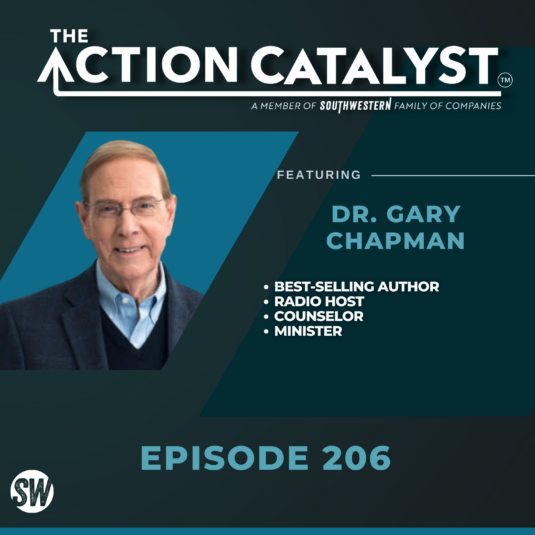
Best-selling author and counselor Dr. Gary Chapman, author of The Five Love Languages, explores how his foundational relationship framework helps couples, families, and leaders communicate love and appreciation more effectively, and why mismatched love languages often cause emotional disconnects. He also shares practical strategies for nurturing quality time, recognizing children’s emotional needs, and translating the languages into the workplace. Chapman also clarifies the circumstances that may cause someone’s language to shift, and which aspects remain stable over time.
About Dr. Chapman:
Dr. Gary Chapman has degrees from some of the most respected colleges and seminaries. He’s written some of the best-selling books of the past 2 decades and appeared on thousands of radio and television programs across the country. But Dr. Gary Chapman knows more than just a lot of scholarly theories and practical advice—he knows people. He knows how to relate to people, how to have fun and how to make people laugh.
Chapman is a well-known marriage counselor and director of marriage seminars, as well as a nationally syndicated radio host airing on more than 400 stations. The 5 Love Languages, one of Chapman’s most popular titles, topped various bestseller charts for years, including the New York Times best-seller list. Chapman has been directly involved in real-life family counseling for more than 40 years.
Chapman is a graduate of Moody Bible Institute and holds B.A. and M.A. degrees in anthropology from Wheaton College and Wake Forest University, respectively. He has received M.R.E. and Ph.D. degrees from Southwestern Baptist Theological Seminary and taken postgraduate work at the University of North Carolina and Duke University.
Learn more from Dr. Gary Chapman at 5lovelanguages.com and appreciationatwork.com.
The Action Catalyst is presented by the Southwestern Family of Companies. With each episode, the podcast features some of the nation’s top thought leaders and experts, sharing meaningful tips and advice. Learn more at TheActionCatalyst.com, subscribe below or wherever you listen to podcasts, and be sure to leave a rating and review!
LISTEN:
SUBSCRIBE TO OUR RSS FEED: https://feeds.captivate.fm/the-action-catalyst/
SUBSCRIBE ELSEWHERE: https://the-action-catalyst.captivate.fm/listen
__________________________________________________________________________
(Transcribed using A.I. / May include errors):
Host
Dr Gary Chapman, if you’re not familiar with his name, you’re probably familiar with his book, The Five Love Languages. Dr Chapman, thank you so much for the privilege of being here.
Dr Gary Chapman
Well, thank you. It’s good to be with you today.
Host
So just in case people aren’t familiar with The Five Love Languages, can you just give us a high level overview of what the five love languages are and kind of how you came up with them?
Dr Gary Chapman
Sure. That book for 25 years every year has sold more than the year before, which says it’s helping people. Yeah, the basic idea is that what makes one person feel loved doesn’t necessarily make another person feel loved. You can be sincerely loving someone, and they don’t get it emotionally. And I realized this in my counseling. I’ve been involved in marriage and family counseling now for 40 years, and I would have a couple sit down, and one of them would say, I just feel like they don’t love me, and the other would say, I don’t understand that I do this and this and this. Why wouldn’t you feel loved? I knew there was a pattern, but I had no idea what it was. So eventually, I sat down and read several years of notes that I made when I was casting people, and asked myself the question, when someone said in my office and said, I feel like my spouse doesn’t love me, what did they want? What were they complaining about? And their answers fell into five categories, and I later called them the five love languages, and started using that in my counseling. And sometimes couples would come back in three weeks and say, Gary, this is changing everything. And then I started using it in small groups, and the same thing happened. So probably five years later, I thought, you know, if I could put this concept in a book, write it in the language of the common person. Maybe I could help a lot of people I would never have time to see in my office. So that’s the history my love languages are words of affirmation, using words to affirm the other person. You look nice in that outfit. Really appreciate what you did. One of the things I like about you just using words to affirm the other person. Life and death are in the power of the tongue. Says an old Hebrew proverb, you can kill people or you can give them a life by the way you talk to them, a second love language. And these are in no particular order, acts of service, doing something for the other person that you know they would like for you to do in a marriage that would be such things as washing dishes, vacuuming floors, cooking meals, changing the baby’s diaper. Whoo, big act of service. But acts of service, you know, I’m sure you’ve heard the old saying, actions speak louder than words. For these people, if this is their love language, actions do speak louder than words. It’s not true for everyone, but it is true for these people. Number three is gifts. It’s universal to give gifts as an expression of love. My academic background, before I studied counseling and theology, was anthropology, cultural anthropology. I did an undergrad and a master’s degree. We’ve never discovered a culture where gift giving is not an expression of love. The gift says they were thinking about me. Look what they got for me. Number four would be quality time giving the person your undivided attention. I do not mean a couple sitting on the couch watching television. I’m talking about TV, off, computer, down, you’re looking at each other. You’re sharing with each other what you’re thinking and feeling. And this is true. All of these are true, not only in marriage, but in all relationships, and certainly in business relationships. Number five is physical touch. We’ve long known the emotional power of physical touch. That’s why we pick up babies and hold them and kiss them and cuddle them, long before the baby understands the meaning of the word love. The baby feels love by physical touch. So in marriage, we’re talking about such things as holding hands and kissing and embracing the whole sexual part of marriage, arm around the shoulder. Driving down the road, you put your hand on their leg. Now when we share this in a business setting. This is where the HR people say, Whoa, we don’t touch. At work, there are no cultures where humans do not touch. Now, there are appropriate touches and there are inappropriate touches, but humans are touchers. Okay? And so the basic concept is, out of the five love languages, each of us has a primary love language, the one that really speaks most deeply to us. It’s very similar to spoken language. Every one of us grows up speaking a language with a dialect, and that’s the one we understand best. Now, typically, we will speak most often our own love language. About 75% of the people will speak to others. Is their primary language, but about 25% will speak one language more predominantly, but they want to receive another of the languages, and I think that is because they were trained to speak one of these languages. Maybe a father taught his son always give the lady gifts. Don’t miss an anniversary or birthday. Give her gifts in between times. So he’s a gift giver. Doesn’t mean he wants gifts. That’s just what he was taught to do. Yeah? So that’s the way that plays out. That’s the misconnect, and that’s why a wife can say, I feel like he doesn’t love me. And he says, What do you mean? I wash dishes, I vacuum the floors on Thursday night, I wash the car every Saturday, I mow the grass on Saturday, I help you with a laundry What do you mean? Don’t love you. He’s speaking acts of service. But what she says is That’s true. You know you’re a hard working man, but we don’t ever talk. We don’t ever sit down and talk with each other. You’re always doing something. He’s speaking acts of service. What she wants is quality time. Couples can be sincere and miss each other, and I think 1000s of couples do.
Host
You talk about quality time? What are some of the things that you’ve seen couples do where one or both of them receive in that language, and what have they done to sort of protect that?
Dr Gary Chapman
Yeah, I think it can be more difficult, because all of us are busy, and in a super busy life, it’s more difficult to carve out time. In fact, I’ve had men say to me, for example, why does her language have to be quality time? But what I say is this, if quality time is her language, if you will carve out, it doesn’t have to be an hour, if you will carve out 10 minutes, 15 minutes a day, just to sit down and talk with her. Give her your undivided attention. See what’s on her heart, what she’s thinking, what she’s feeling, let her share with you and let her ask you questions. And if she knows that tomorrow she’ll get 15 minutes, she’s going to be okay. If you’re consistent, then she’s going to come to accept that. She’s going to come to realize, you know he’s he’s going to be there for me. Well, I’m going to have a chance to talk. So it doesn’t mean you have to carve out two and three hours at a time. Now, there may be times in which you want to take a weekend away, you know, and just have more time with each other, but I think if you realize the importance of it, then it’s a great investment of that 15 or 20 minutes.
Host
I love that. So should we focus as givers at being good in all five of the languages, or should we focus primarily on just, you know, the one that our our spouse receives? That’s the one I really need to focus on.
Dr Gary Chapman
Well, in a marriage relationship, I say give heavy doses of the primary love language. Sprinkle in the other four for extra credit. With children, you won’t know their love language until they’re about four, but you can, you can see their love language because if you observe their behavior, and my son’s love language is physical touch. When he was about three or four, when I came home in the afternoon, he had run to the door, grab my leg, climb all over me. He’s touching me because he wants to be touched. My daughter never did that. Say, Daddy, come to my room. I want to show you something. Quality Time was what she wanted, my undivided attention. So with children, you want to give them again heavy doses of the primary, but you want to also speak the other four, because we would like for them to learn how to give and receive love in all five languages that would be the healthiest adult, but many of us did not receive all five, so we came to adulthood and we had never received, for example, words of affirmation, and we find it difficult to verbalize words of affirmation to the other person. But the good news is, all of these languages can be learned as an adult, even if we didn’t receive them as a child. Now, the reason it’s important for us to be aware of all five and seek to learn how to speak all five is because we have more than one relationship. It’s not just the wife, it’s children, it’s it’s worker, it’s a people with whom we work. It’s friends, you know. And if we recognize this concept and know that everyone we encounter has one language that speaks more deeply to them than the other, then we’re going to be more effective in communicating that we love or we appreciate other people.
Host
So moving this into leadership, do these apply? Or obviously they apply… What is unique about how they apply? If anything, in the corporate… like you mentioned the physical touch aspect.
Dr Gary Chapman
Yeah. Well, first of all, there’s not a direct correlation between your love language and a family relationship and your appreciation language at work. Work relationships are different from family relationships. There’s somewhat a correlation. We found about 36% of the people their love language at home is their love language is their appreciation language at work, but that means for the others, they have a different appreciation language at work. Why it’s so important in work is research indicates that 70% of the people who have a job in this country say they feel little to no appreciation coming from the people. People with whom and for whom they work, that is super high. 64% of the people who leave a job and go to another job say they left primarily because they didn’t feel appreciated. We tend to think people leave for more money, but that’s not really true. They leave because they didn’t feel appreciated. So most managers, if you talk to them, they will say, Oh, I appreciate my people. Oh, I tell them all the time, I appreciate them. Well, you’re telling them, you’re using one of the languages, and you’re hitting about 40% of your people. That means 60% of your people, your words just roll off like water off a duck’s back. They don’t get it because that’s not their language. So you’re missing out on about 60% of the people who work for you, 40% is words of affirmation. I’m thinking it’s 35% that are acts of service, and 25% that’s quality time. And then there’s a smaller percentage that are gifts. And almost no one in the workplace has physical touch as their primary language. Very interesting.
Host
That’s helpful. The time here is almost out. Where would you want people to go to connect with you and to learn more about your work?
Dr Gary Chapman
Well, if they go to 5lovelanguages.com, the number five, 5lovelanguages.com they’ll see snippets of all of my books if they want specifically to gear in on the workplace, it would be appreciationatwork.com.
Host
Okay, so last little question here, can your love language change over time? And if so, what causes that?
Dr Gary Chapman
Yeah, that’s a good question and a common question that I get. I think, like many other personality traits, the love language tends to stay with us for a lifetime. Now, having said that, I think there are certain stages of life and certain circumstances in life that another love language may pop up for a while and seem to be more important than the primary for example, a mother who has two preschool children. Acts of service may not be her love language, but I can tell you, during those years, if he pitches in and helps her, it’s going to really communicate love to her. Or, let’s say, your spouse gets word that some family member has died. Physical Touch may not be their language, but I can tell you, if you hold them in your arms as they cry, and you cry with them, I can tell you that’s going to speak deeply to them. So the stages of life and circumstances sometimes cause another to, you know, to come higher. Another factor is, if you get enough of your number one and your number two is rather close to your number one, you may begin to say, you know, I don’t know. I think my love language is changing. I think, I think I want this, but if they take away number one, you’ll quickly say, Oh no, no, no, no, that’s still my love language.
Host
That’s interesting, fascinating, fascinating stuff. Dr Chapman, thank you for taking the time to do this. We appreciate you very much.
Dr Gary Chapman
Well, thank you. It was good chatting with you.
0 Comments