Time To Get Real, with Julie Wainwright – Episode 503 of The Action Catalyst Podcast
- Posted by Action Catalyst
- On May 19, 2026
- 0 Comments
- author, Business, CEO, data, entrepreneur, failure, fashion, fear, founder, fundraising, leadership, luxury, mindset, passion, success, tech, technology, unicorn
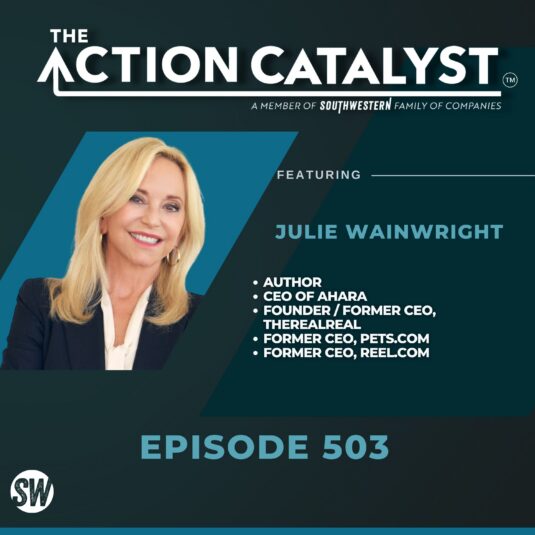
Entrepreneur Julie Wainwright, founder and former CEO of unicorn company TheRealReal, shares the candid story behind building a billion-dollar luxury resale company after being told at age 52 that she was “unemployable”, discusses overcoming public failure, fear, ageism, and gender bias in tech, how her experience at Pets.com shaped her resilience, and the disciplined, data-driven mindset she used to create and scale a disruptive e‑commerce business. Other topics include identifying unmet consumer pain points, balancing passion with objectivity, and practical advice for founders navigating fundraising.
About Julie:
Julie Wainwright is an entrepreneur and e-commerce pioneer who has been building and growing technology and consumer businesses for more than 20 years. Currently, she is the CEO and co-founder of Ahara, a precision nutrition company founded in 2022.
Prior to Ahara, Julie was founder of The RealReal. She grew The RealReal into the leading luxury consignment company with over $1 Billion in revenue and forever changed the way people buy and sell high-end luxury goods. In addition, Wainwright raised sizable venture capital funding, and brought the company public in 2019.
She has received several prestigious industry awards and accolades, including: Entrepreneur’s 50 Most Daring Entrepreneurs, Fast Company’s Most Creative People, CNBC’s Disruptor 50, Inc. Magazine’s 100 Female Founders List, Retail Innovator of the Year, and Business of Fashion’s BoF 500. In 2021, she was celebrated by Forbes in their inaugural 50 successful women over 50 and was on the cover along with Kamala Harris, Cathy Woods and Shonda Rhimes.
The Action Catalyst is presented by the Southwestern Family of Companies. With each episode, the podcast features some of the nation’s top thought leaders and experts, sharing meaningful tips and advice. Learn more at TheActionCatalyst.com, subscribe below or wherever you listen to podcasts, and be sure to leave a rating and review!
LISTEN:
SUBSCRIBE TO OUR RSS FEED: https://feeds.captivate.fm/the-action-catalyst/
SUBSCRIBE ELSEWHERE: https://the-action-catalyst.captivate.fm/listen
__________________________________________________________________________
(Transcribed using A.I. / May include errors):
Stephanie Maas
Okay, hi!
Julie Wainwright
Hi, Stephanie.
Stephanie Maas
How are you, Julie?
Julie Wainwright
I’m okay!
Stephanie Maas
Okay. So a couple of things. This is going to be a two fold question. Number one, anyone that is running a business wants to run a business, or has even an ounce of entrepreneurial spirit, for most of them, the dream is something you’ve already done. It’s building a billion dollar business. So I would love to hear from you about that, especially as a woman.
Julie Wainwright
Oh yeah, yes, I have built a billion dollar business now. The company, the real, real is heading toward 2 billion. Probably would have been a lot easier to get there if it wasn’t for covid. But here’s what happened to me. I At the age of 52 I had been an executive in tech, mostly working in business to consumer technology almost my entire career. I started my career at Clorox and brand management, but after that, I was only there three years, and then I went into technology and did a lot of different jobs, and ended up as a multiple time CEO, but at the age of 52 because I’d had one failure as the CEO, I was told pretty bluntly by a recruiter that I was unemployable. And you know, you hear about people getting rich in tech, well, women don’t get as rich in tech, and I’d had a divorce, so I whatever money I had, I had half that amount of money, and I’m healthy and felt vibrant and had a lot to give. And it was basically he was saying, you know, no one’s ever going to hire you again. So then I had to figure out, do I just leave town and do something else completely and change my life completely, or do I give it one shot at really starting my own business? And I decided to take that tech now, I’m pretty sure the reason I didn’t start a business before that as a I had opportunities coming toward me, but also I was really afraid of failing. It feels scary when you don’t have a safety net or aren’t getting the paycheck. The interesting thing is, once I had that big failure, it wiped out my fear, and it was an odd gift I couldn’t have. I wouldn’t have wanted to go through what I went through, because it was a public failure and covered by all the newspapers, but I didn’t even know it had wiped it out. But psychologically, when I came out on the other side, I was so much stronger, and the fear of failure totally went away. I didn’t care. I didn’t care what people thought. I knew what was inside of me. I knew I could go forward and I and especially with that failure, I kept thinking, Okay, if I’ve been through this, nothing’s going to be that bad again. So I got over that, and then I took a very analytical approach to starting my own business, and including I knew I wanted to go into E commerce. I knew I wanted to do something that was really hard for Amazon to do, because they are the Juggernaut, whether you think they are not. They are luxury was one of the ideas that I felt like they’ll never get into it and never do it. Well, however, I dismissed it. I said, Oh, I’m never going to create a luxury brand. So then I was shopping with a girlfriend, and she decides that she’s going to buy a little bit of consignment in the back of this beautiful store. It was a shoe store, full price. Shoe Store had an area called the vault in the back. That’s where she shopped. I couldn’t believe it. I shopped with her forever. I’ve never seen her walk into a consignment store and I said, you bought used things. She goes, who cares? They’re beautiful, you know, they’re in great condition. And I said, Well, would you ever walk into a consignment store? She said, Never. They’re gross. I don’t like sorting through all the stuff to get to the good stuff. I said, Well, what about eBay? She goes, I would never shop on it feels like too many fakes. I don’t want to deal with an individual. And then I said, Have you ever consigned she said, It’s too hard, and at that moment, I knew that was my business. This is how I get into the luxury market. Then, you know, you just start small and solve problems. Now I developed a set of premises. Demand would be unlimited. It really is a supply issue I had to solve getting great product on the site, because everyone’s going to want it. The brands are great. They’re meant to be reused multiple times. So that was my premise, that I had a supply problem, not a demand problem, and I created all these plans to get the supply coming in. So. So we get out there, and sure enough, within the first 20 minutes, everything sold everything, oddly enough, because I’d had the big failure with pets.com, the press was writing about me, like, Oh, she’s back. Let’s see what she’s doing here. So that ended up getting us some free press. And then the next thing I knew is that all my wonderful plans for generating supply weren’t working. So then it became, well, what else can we try? But everything is baby steps and testing. Am I solving the right problem? Do I understand what’s the most important thing I have to do today? Do I understand what’s the most important thing I need to spend my money on? I also have this theory that if you’re really going to start something and you think it’s a novel idea, chances are which the real real absolutely was and created a new category. Although consignment wasn’t novel, having luxury consignment was novel. And someone taking possession of the goods and authenticating it was novel, doing all the work for the consignor. If you have this idea, somebody else does too. Then it comes down to who executes it and who executes it well. So I’ve always thought that about businesses. When you get this idea, if you think it’s breakthrough, and maybe it is, but someone else is also getting that idea, and then you really have to execute as fast as you can and be superior. But I always knew it would succeed. There wasn’t one moment of doubt I had in my brain, you know, I was not second guessing. Is this a real business? Can I do it? I knew I could do it. I knew it was going to be a huge business. So that’s the whole story right there. That’s not the whole story, but that’s like the Genesis. So when anyone starts a business, I’m sure they’re like, this is going to work. It’s great. It’s your baby. You have all that passion. You have to have passion to get it going. You’re so excited about it. And then, you know, then you have to be completely dispassionate. How can I make this better? Am I doing this right? What you know, what’s happening? What do people say about the product? So you go from this pure like big vision to to look for areas where maybe you were wrong, and you have to have that true passion, true vision, but maybe my vision needs tweaking, or maybe it sucks, maybe I’m wrong. You know, it’s this weird thing. You have to hold them both very tightly, because if you don’t, you will fail.
Stephanie Maas
You had a passion, but you were completely objective.
Julie Wainwright
You have to be, yes.
Stephanie Maas
I mean, honestly, Julie, if our listeners get nothing but those nuggets, those alone, they so easily speak to your success.
Julie Wainwright
Look, here’s why I see people fall down all the time. And even people I talk to, we think we’ve got a great idea for a food truck. We really want to be in this business, and we’re going to they’re trying to raise the money. And I said, Well, have you rented a food truck and tested it? You can do it pretty cheaply. No, we don’t even want to do that. We know it’s going to work. I’m like, do you know you’re going to want to be in that food truck every day? Have you worked in a food truck? And the answer was no, no. And we, you know, we already know. And I’m like, you don’t know. Now, having said that, if that person would have come to me and said, I you know, I’ve been doing this. I ran a test. I know that these things sell really well. I know I can produce them for this. I rented this truck. I made more money, or I didn’t make money. Here’s what I’m doing. Then you’ve got someone you want to invest in, but you do see these people that actually do this, have these big visions and don’t take the small steps. So that’s number one, and I think it’s so critical, and it’s critical for them, because the other thing is, when you start a business, you don’t easily discard it. It is with you. You can’t have commit. You’ve got to commit, and if you commit, then you’ve got to figure it out and and it’s got to be aligned with your priorities. So this is the other thing. They were treating data, the implications of data as a it was personal. Data is not personal. You know, data gives you information to make you smarter, to make better decisions. There’s a lot of things that are weird about the tech people that you meet, and the tech bros are really weird. But one of the things that’s incredibly useful is using data to guide your decisions. Data when you’re actually creating something is critical. And as I said before, having that impersonal view of what you’ve done is critical, because someone else will do what you’re doing, if let’s just say you’ve got some hype and things are going well, but you’re not iterating, you’re not reading the signs, you’re not looking someone else will figure that out, and they’re going to be smarter than you, and you will be gone, period. It’s really as simple as that. You’ll be struggling, you’ll be gone. You’ll get pissed off and business. This isn’t personal, and yet it is. You know, you have to hold both. If it’s your baby, it is personal, but it’s not personal when you’re looking at results.
Stephanie Maas
Let’s do this. So translate this, all the things we’ve talked about, bring me to the book, Time To Get Real.
Julie Wainwright
Let me tell you why I wrote the book, because I so I wrote time to get real, because I haven’t read what I would consider an honest entrepreneurial journey since I read the book Shoe Dog, which is about Nike. And I think, and I love that book. I think it could have been even more raw. I love entrepreneurs. I love creating a business, but I think the story is bigger than that, which is what time to get real? Is what thought went into it, what I did right, what I did wrong, and what was going on in my personal life. Because there is absolutely no doubt that when you create a business and the real real, just to give you an idea, especially when it’s growing, it went from 10 million to 20 to 50 to 100 to 250 to 500 to 750 to a billion. Just, boom, boom, boom, the growth that actually impacts your life. In fact, it was my whole life. So what does that do to your personal life? Well, I write about the bumps. I write about the bad choices. I write about the good choices, I write about the learning, I write about the fun, and I give very specific examples. I hadn’t read a book like that before, and if I would have read it, I would have made different choices. I would have taken to heart if someone actually told the truth, I would have made different choices on some board members who were ended up being really bad actors, I would have made different, and probably would have hired better on some key hires that had to go, you know, I just think it’s one of those stories that needed to be told. And even then, after I wrote it, I thought, okay, I had a publisher. I’m done. I don’t need this to be published. Because it was so cathartic. And then I was out of the country, and this young Porter, the second day I was there, said to me, I know who you are, Miss Wainwright, and I really find your story inspiring, and I hope you write a book someday. And I started, literally, I started crying, and I said I was at that point for final edits and final legal review, or I could have just said, No, we’ve done it. I’m done I don’t want to do this, and that one person was my deciding factor. And oddly enough, I never saw him again. I was there for five more nights, never saw him again. So I felt like he dropped in to give me a message. But that’s why I wrote the book, because there’s information in the book along the way and celebrations that I haven’t read before, and practical and practical advice. It is very practical. It’s very pragmatic.
Stephanie Maas
Yes, but at the same time, I mean, what a gift to give to say, Hey, let me share with you the good, the bad and the ugly. Learn from me.
Julie Wainwright
Being an entrepreneur is lonely, and it’s not about being a woman. It’s about being an entrepreneur. It’s you know, you’re at top. I was responsible for setting the strategy, raising the money, emptying the trash, making the right hires, you know, making the decisions, although I’m really good at delegating, still at the end of the day, it’s my you know, is my neck on the line all the way. You know to know you’re not alone in this. And like I said, is really helpful to any entrepreneur. Luckily, I don’t suffer from depression, but certainly there’s been a lot of stories from entrepreneurs that really just give up, or they’re suffering with depression and self doubt. And I think if you know you’re not alone, that these things are hard, then you’re like, okay, they’re hard for everyone, but I still can do it. I think that’s really important for entrepreneurs, because it is hard. I had no safety net. I didn’t my dad had his own business. It was very successful. My mother died young because she had multiple sclerosis, but when she went into a home where and she was young, in her early 50s, because she couldn’t she needed 24 hour care. My dad basically just had a breakdown and sold his business and ended up having some tough economic times before he started another business. And then he did fine, but I had to bail him out. You know these things, you know these things are on our shoulders all the time, and there was no one there to bail me out, and that’s how most people are. Know what you know? Most people that start these businesses, it’s like, if you don’t do well, you don’t eat, you don’t, you don’t, you know, you can’t pay your rent or your mortgage, and that can be scary. I think the key is not to let it overwhelm. You and to know that you you’ve got everything inside. And even if this one fails, you’ve learned so much, you can go back again and try again. It’s really you know. But like I said, there wasn’t I was bailing out my family. I didn’t have someone to bail me out if it failed.
Stephanie Maas
And I think again, the book just the support that it puts out there. There’s a different generation of entrepreneur coming up, and they are, they want more, the support they want, the camaraderie they want. It’s I don’t know. I feel like I was raised in a little bit more of an environment that everybody was viewed as competition. So you don’t want to tell anybody what you’re doing. You don’t want to reach out and ask questions. I think we’re seeing that change, and this book is a perfect example of saying, Hey, I’m going to be vulnerable enough to share the mistakes I made. I’m going to invite you to join me in celebrating the wins, and just know you’re not alone.
Julie Wainwright
Well, and honestly, everyone would benefit from that. Now, look, women still have a really hard time raising money. You know, it’s less than 2% of all venture capital go to women, so and it got worse after covid. But here’s, here’s my point on this. So what? There’s still money there. And you know, recognize that if you need to raise venture capital then, which I did, because it was a tech solution. If your idea is good, you’re still going to get a and your business, you know, you need more of a real, developed concept. Now, I waited till we were $10 million in sales before I raised capital, because I knew it was going to be hard. But if you’ve already got a business that’s going you want to go out and raise venture capital, then you knock on a lot of doors every no is information. You just do it. You don’t let the numbers that you know 98 point think it’s like 98.8% goes to men now or something. It’s like, okay, that means 1% going to women. I might as well join in. You know what? Why not my idea, and I think the key is to treat every no as a learning experience, and a no can get you closer to a yes. Now there are some things that you know you may not get funded. I met with a young person who has an idea for a beauty product. She was solving a particular problem she had with her skin, claims to have a great product. She raised $150,000 which is a lot of money to get started. She didn’t bring her product to market. She chose to put money into an ad agency and packaging, and didn’t like get the product in the market to try it. Now, it’s hard for to raise capital, and maybe it’s a great product. And what I said to her, but you didn’t spend that money, right? So therefore, to go out and raise capital when you’ve already chosen a path on this comes back to know what problem you’re solving. This is a good example. She didn’t use that money wisely because she didn’t understand the problem she needed to solve was a market test. She thought it was a packaging she needed to get it into the market to test it, to get some validity, not just what she thinks, not that just worked on her skin, but get it in the market, which she could have done. And so that’s a hard lesson to learn. I gave her that feedback, and I’m sure she didn’t like me for me giving me that feedback, but it’s true, she didn’t use she didn’t make the right choices. Now, may I and then I suggested, if her products that great, she looked for a partner, a big partner to launch with. I don’t know where she is with it, but you know these things, hopefully she’s young, young entrepreneur. Hopefully that’ll help her. I didn’t write about other people’s business in the and the book. Time to get real. But you know, there’s lessons in there. It’s sometimes it’s hard to see it though. If it’s, you know, it’s even if it’s right in front of you, that’s why sometimes having people to just give you honest feedback is can be important.
Stephanie Maas
Oh, that’s awesome, and what a great example of how the know can lead to a learning opportunity. Julie, thank you so much. I really appreciate your willingness to share your story with us and our listeners. Thank you.
Julie Wainwright
Oh, it’s my pleasure. It really is. Thank you. I appreciate it.
0 Comments