
Shop Different, with Ron Johnson – Episode 508 of The Action Catalyst Podcast
- Posted by Action Catalyst
- On October 6, 2026
- 0 Comments
- Adam Outland, author, being authentic, Business, CEO, culture, customer experience, empowerment, entrepreneur, hiring, innovation, leadership, management, retail, success
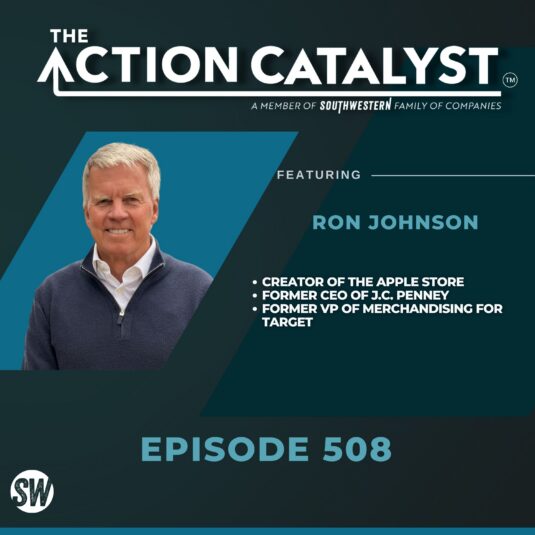
Ron Johnson, the visionary behind the Apple Store and the iconic Genius Bar, shares powerful lessons on leadership, customer experience, innovation, and company culture drawn from his leadership roles at Apple, Target, and J.C. Penney. Johnson explains how principles of unconditional support, authentic leadership, and empowering frontline employees helped transform retail by creating meaningful customer relationships rather than transactional experiences. He reveals the thinking behind the creation of the Apple Store and Genius Bar, discusses the importance of pushing decision-making to the lowest levels of an organization, and outlines a simple framework for building customer loyalty through launching, deepening, and restoring relationships.
About Ron:
Apple Store creator Ron Johnson is a sought-after speaker, board member, and author of Shop Different: How Retail Revealed Apple’s Genius. He also founded Enjoy, the first mobile retail store, and served as the CEO of J.C. Penney. He is best known for creating the Apple Stores as Apple’s Senior Vice President of Retail, working directly for Steve Jobs while serving as a member of Apple’s executive team. From developing a vision for the Apple Stores, to building a world-class retail team, to launching game-changing innovations like the Genius Bar, Johnson helped create the most respected and profitable retail stores in the world. He redefined the purpose of a brick-and-mortar store and helped Apple become America’s best retailer.
Prior to his time at Apple, Ron was highly regarded for the work he did with Michael Graves to bring good design to all as Vice President of Merchandising at Target; their collaboration set the stage for the brand’s hundreds of later design partnerships and cemented Target as America’s premier upscale discount retailer.
Learn more at RonJohnsonShopsDifferent.com.
The Action Catalyst is presented by the Southwestern Family of Companies. With each episode, the podcast features some of the nation’s top thought leaders and experts, sharing meaningful tips and advice. Learn more at TheActionCatalyst.com, subscribe below or wherever you listen to podcasts, and be sure to leave a rating and review!
LISTEN:
SUBSCRIBE TO OUR RSS FEED: https://feeds.captivate.fm/the-action-catalyst/
SUBSCRIBE ELSEWHERE: https://the-action-catalyst.captivate.fm/listen
__________________________________________________________________________
(Transcribed using A.I. / May include errors):
Adam Outland
Today’s guest is Ron Johnson, the creator of the Apple Store and the Genius Bar, and the former CEO of J.C. Penney, with time also spent as the Vice President of Merchandising for Target. Ron’s joining us from overseas today, and Ron, I should have just flown to France to do this interview.
Ron Johnson
Gosh, that would have been great. I’d love to have you here.
Adam Outland
Remind me, Ron, and our listeners too. Where where did you grow up?
Ron Johnson
I grew up in a suburb of Minneapolis called Edina, Minnesota. It was an unbelievably great place to grow up. You know, I grew up in a family where my parents loved all three of us unconditionally. My dad showed his love. You know, I played a lot of sports, and he never missed a game. He had a big job at General Mills. I would play 60 baseball games in the summer on our Legion team. He made every one of them, and you know, I had parents that were just involved in our lives and encouraged us to try new things and to do things, and and never said the word you can’t, they encouraged us, and that gives you a lot of self-esteem. And I think self-esteem is something that is deep in your core. You know, confidence you develop through experience and through working hard and practice, but knowing you’re loved provides the background that no matter what happens, you have a place to go, and it’s a huge asset. And I took that throughout my career to the employees at Apple. You know, love was our business strategy, and Steve wanted us to use a different name for it, so we called it enriching lives. But it’s an act of love. You’re securing the good of everybody in your path. It goes back to my first memory when I was four years old. I think my mom wanted me to get me in school so she didn’t have to deal with me all day long. She took me over to the little elementary school. It’s about two blocks from my house, and I remember it’s my first memory as a child sitting with the principal, and my mom was in the room, and the principal asked me, “Ron, what color is was George Washington’s white horse? And I thought about it, and I looked at my mom, and I said black. And we walked out, and I remember my mom put her hands on my shoulders and said, “Ronnie, no matter what happens, I will always love you. You know, I knew that I had answered that question wrong the moment I did it. That was unconditional love, and we we’ll fail every day. We don’t do as well the test as we like. We make a mistake with a friend where we don’t treat them right. We make an error on a big baseball game when it matters. I’ll never forget. I was in a high school state tournament, and I was on first base. Was the seventh inning, seventh game. We’re down one run to our arch rival, and the balls hit down the right field line. I got a single as on first, and I took off as I turned second. I looked back and this first baseman had run down the right field line and caught it, and I ran. I felt like forever to get back to first base, and I didn’t make it. And it was a double play. It turns out that player was Kenneth Herback, who went on to be the first baseman for the Twins. So I should have known he was a pretty good ball player. But regardless, it was a big screw up. But I remember after the game, my parents said, “Ron, what a great year you guys made it a long way in the playoffs. Even though I failed, they were looking at the positive, and I’ve been an optimist my whole life, and I think that goes back to my upbringing.
Adam Outland
In leadership and in management, I feel like sometimes where people get it wrong or where management or leadership doesn’t land is when the leader is having a critical conversation with a team member from a place of I’m not good enough as the manager, because you’re not performing right.
Ron Johnson
No, I learned that. That’s a lesson I had to learn after business school. I went to a retailer that was owned by Target Corp today called Mervin’s, and at about 28, I think was my age, I got a chance to manage a group of 25 people, a large group, and it was Halloween. I walked into the office of my manager, and she said it’s not working. I said, “What, my costume? She said, “No, your leadership style. And she said, “Everyone likes you, but you’re suffocating them because every time I would talk to them, I talk to them all day long. They tell me an idea, and I said.” Well, that’s a good one, but have you thought about this? And I never let them pursue their own ideas. I always had another thought, and you know, I learned a lesson through that. And your team at work is kind of like planting a garden. You know, every plant you put in a garden needs different treatment, right? And if your garden’s going to flourish, every plant’s got to work together and be beautiful, and it’s the same as work. So then I realized every employee needs help every day, but they need help in a different way. It’s not about what I want; it’s about enabling them to do the best that they can. So I would start every day. I’d think about who are my employees, what do they need today? And if I saw them, the question I asked wasn’t “What are you working on? It was “What can I do for today? What can I do to help? That’s all I asked. You know, early on, I tried to be who I was taught to be-a manager from Harvard Business School. You know, set high goals, hold people accountable, discipline-all that stuff, and that’s not me. I grew up in a culture of love, and so I’m going to love my employees. How do I help you soar? And we all have to figure out how to be authentic. And I found my best success when I just was myself.
Adam Outland
Authenticity is huge, and you know, obviously, when you’re yourself, it breeds trust, and you can’t really do anything as a leader if you don’t have trust.
Ron Johnson
I agree.
Adam Outland
If you don’t mind, the most noticeable external moment that defines I feel like a big part of your career is with Apple, and that’s that’s saying a lot considering you also had big experiences at Target, and JC Penney.
Ron Johnson
Yeah. Well, I felt like when I interviewed with Steve, and after three hours together, he said, “When can you come back? And I came back in two weeks, and I walked in. He said, “Ron, he goes, “I want to offer you the job, but the opportunity was to create the Apple Store, and I was lucky to get that chance. You know, the reason Steve wanted me to do that. You know, I had brought design to Target. I had spent my whole year career in retail, trying lots of things, and some things worked, and some things didn’t. But I kept trying to do things that were different, that would make a permanent change in the trajectory of the area I was responsible for, and that always involved taking risk, but trying to identify something that had never been done before. Now I had this idea: why copy when you can create? When you copy something, everyone sees it for what it is. It’s a copy, and that’s a good way to improve. And we should always watch what our competitors doing. And if they have a great idea, try to bring that to our company, our responsibility. But the most important things we do come from our imagination when we truly look deeply inside and do something that’s never been done before. And when I had this idea, you know, the question I asked was, why does good design have to be expensive? You know, I was running the home area at Target, and we had all these functional products. But if I went to these beautiful boutiques in New York or in London. There are these tea kettles that were like $150, and we’re selling $10 kettles. But those, you know, could make tea or hot water. But they were beautiful to look at. And why couldn’t we bring those to everybody? And I had done that, and that Steve saw that and said, “I’m going to talk to the guy doing design at Target, because Steve cared deeply about design, and he knew I had the ability to think different, and that’s why I got tapped. I’m not a huge believer in being overly cautious. In my experience, when I was at Target, almost all tests fail, and people said you ought to test something when you didn’t know if it would work. But when you’re to test something, people know it’s really no one’s committed. Why are you testing it? Because you’re not committed. You know, I went out to Apple. The board was kind of on the fence if Apple should open stores, so Steve got approved a four-store test, and when he interviewed me, said, “Ron, I’ve got approval for a four-star test. I said, “Well, good for you. I’m not coming to do a four-star test. You think I’m going to throw away my career at Target to come test opening stores, Steve? If you believe Apple’s biggest weakness is its point of sale, and if Apple is going to succeed as a company, it has to control the buying experience. You shouldn’t test that. You should go make it work. Now, the first stores might not be perfect, but we’ll improve on them. But you got to be all in on opening stores, or I’m not going to come. I think that’s the big difference. Is when you do, if you’re doing something that’s important, and you’re going to put a lot of energy into it, make sure you have the ability to adapt it. You can learn from it. You can do it, but don’t do it in a way that you can walk away. Because if you’re pursuing. Something strategic, you got to will it to success, and you got to make it happen. You don’t get to walk away if it’s not important. You shouldn’t waste time on it. You know, Steve was great about just doing a few things, but he knew they were important, and he was all in on those. Apple, when Steve came back to Apple, there were like lots of product lines, and he cut it back to four. He made a matrix of four products and said, “We’re gonna do four things great. When Steve ran Pixar those first years, when the movies like Toy Story were coming out, he would only let them do one movie a year because it had to be great. You got to do it the best you can, and you got to have the ability to adapt. But you shouldn’t be going in knowing you got a backdoor or a way out.
Adam Outland
What decision-making philosophies do you feel like really helped you when you had complete control of the steering wheel with these Apple stores and you were getting out of the gates? You know, there’s a lot of decisions to make. Some you had quite a bit of practice with with prior careers, but there were some that were new.
Ron Johnson
I think the best thing that we did at Apple is we pushed decision making down as low as we could. When I left, we had 60,000 employees, and every one of them knew someone well who knew me well. So there was one person degree of separation from any employee in me, and you might ask, well, how did you achieve that? Well, I did it very simply. I I interviewed every store leader before they started. We were opening at sometimes 50 stores a year, but I found well, if I just set aside, I tended to be in town on Thursdays, and I set aside 8o’clock in the morning Pacific time. I said, you know, any time you want to hire someone, just send them to California, and I’ll see them between eight and 9o’clock on Thursday morning. If it was two, I’d see eight and 9o’clock. But I met everybody, and so I knew that day mattered. And so my meeting those people, and I would just say to each one at the end, you know, I have the chance. I take the time to meet everyone before they run a store for Apple. I would like you to meet every employee before they join Apple in your store. In most of our teams, we started out we had 15 employees in the store. We grew to 50, but if I can meet 50 people a year. A store leader can meet 50 people a year. And the worst thing for employees, you walk into an environment and you don’t know if the leader likes you. You got to earn your stripes after you’ve been hired. If you interview with the store leader before you start and you get the job, you know that person supports you, right? So you come in with confidence. That’s that unconditional love. That’s what that interview does. And every employee at Apple knew, and one of them said, “You know, the best thing about Apple when you were there is I reported to my store manager. The store manager reported to the head of Europe. The head of Europe reported to you, and you report to Steve. So if I had an idea and I told my stair manager, all you had to do was tell one person and tell you, and Steve could know about it. And I really believe in you know pushing decision making downhill. So we empowered our employees in the store to do anything they thought was right for the customer. They could do anything. They were empowered. I remember the time a woman walked into our Soho store, an author and her Mac had died, and she didn’t have the money to buy a new computer and it couldn’t be fixed. And the person said, “Look, we got 50 computers in the store connecting the internet. Let’s get you a stool. You sit down at this one. This is yours until you finish your book. And she came in for 30 days straight and wrote a book in the Apple Store. Well, do you think a lot of people heard about that? Of course they did. But that was an employee doing the right thing for a customer who had a need. And I remember one store outside of Minneapolis at the Roseville Mall. I went to visit. They said, “Ron, could we try setting up everyone’s computer before they leave the store. I said, “Well, that takes a lot of time. You got to protect their data and all that stuff. And they said, “Well, we think we can do that. I said, “Go ahead, and they did it. Well, it took six years, but six years later, we rolled out a personal setup where everyone on every product had a chance to get it set up in the Apple Store before they left the store. You know, we had been happy just having a good buying experience, and we had very popular stores, but we did something more. But that’s because we empowered the employees to make decisions. So to me, that’s the primary lesson of the Apple Store. When people would come to the Genius Bar, they would come in really feeling badly that something wasn’t working. They didn’t know if there’s their responsibility. And our geniuses would just say, “Hey, thanks for coming. Whatever your problem is, I just want you know we’re going to get it fixed. You know, and if your computer’s not working, that’s on us.” What was broken wasn’t their computer. It was their trust in Apple, and we had to restore that trust. We had to restore that relationship, and it’s just how you think about assigning responsibility to people that makes jobs meaningful, because these people knew that they were trusted to do the right thing.
Adam Outland
In ever-growing large organizations, it’s so easy to get out of touch with the customer experience. What were practices that you deployed personally to know how that was evolving?
Ron Johnson
When we rolled out, we were one of the first to roll out Net Promoter Score, and I asked your customer, “Would you recommend the store to a friend? And we rolled it out. Like it seems like everyone has today, but the thing I loved about it was that the customer could write feedback, and they could write a note, and I told my team I want to receive every note that is negative, and I want to receive every positive note that’s more than 50 words, whatever it was. And so every morning, the first thing I do is I would just go through all the net promoter feedback. Might be 100 emails that I get, but I each one I’d respond to the employee. I had set up that the employee they referred to, their email was in you know a little thing that I had their email, and all I did was write notes, Jacob, awesome job! You really delighted this customer today. Thank you. You know, but when we did something that was negative, anything that was a six or less, I wrote to the customer and had it copy the store. So I knew the customer’s email. We knew what store they are from. It copied the store leader, and I wrote and I said, “Hey, I’m sorry we disappointed you. Our team is going to make it right, and I would send those notes out every morning, and our leaders would. The next thing they would do was try to take care of it, and I would get notes back that same day from customers saying, “I can’t believe I wrote you a note just to get this off my chest. You, the head of retail, wrote me back the same day, and your employee fixed it that day. I’ve never had an experience like that”. I visited stores all the time, but when I walked in a store, I didn’t walk in and ask for the store leader. The first person I’d meet, I would talk to. Hi, I’m Ron. Nice to meet you. How long have you worked at Apple? What can we do to make your your job better? The next person, hey, we just rolled out personal setup. How’s that working in your store? But I didn’t go to the you know come in with an entourage like with the district manager and meet the store manager and talk to them in the back room. I just meandered through the floor and everything was public. I talked to this employee, talked to that employee, and then the store manager finally come up and go, “Oh, Ron, I see you’re here. I said, “Yeah, I’ve had a great conversation. I’ve been talking to so and so”, and suddenly we’re all together talking on the floor with the employees. All these behaviors keep things small. The little things they actually scale. It’s so easy in a big world to think the little things don’t matter. They actually are more important.
Adam Outland
It can be so easy to what do you call it? Lose the message when you’re scaling because you lose track of your time because more and more demands layer in on what you are asked, required, or needed to do, and then all of a sudden you look at your schedule, and your schedule no longer reflects what it did when you were getting started. You know, it’s morphed into something else. How did you keep the guardrails on what was most important with your time, and what did you do to protect it?
Ron Johnson
Whatever was important for me, I just organized my weekly schedule around those activities. You know, Monday was yeah I had an ET meeting for Apple, but I met with my leadership team. That was a leadership day. Tuesday was a real estate and store design day, and so I’d spend the day doing real estate and store design. And I’d always go over to the real estate store design team’s office. I wouldn’t have them come to me, you know. Wednesday was with the marketing team and whatever we’re doing there. But I organized my day so everyone knew what I would be working on. I found a way to always do it on location where the the teams worked, so I could be present with the teams. But then what I did is I always kept a zero inbox. You know, even to this day, I I get to a zero inbox every day, and that gives me the freedom all day long to be present for people. I’m at the office interacting with people and trying to solve problems and help out. So those are some of the things. And if I got to a point where I had too many emails. I had to figure out how to delegate some of those that weren’t important. But I always kept an ability to be present at all times for people. But I used to do other things. I was kind of a crazy guy. I’d go do a quick exercise in the morning, then I lived near a cell. 711, and I, I like to have a Diet Coke in the morning. I never drank coffee, and and I figured if I drove to 711, I could say hi to the guy running the store who’s all alone in the middle of the night, and get to know him. And then one day there was merchandise all over the floor. I said, “How are you going to get this stocked by the top of all the customers come. He goes, “Well, I got two trucks today. I said, “All right, let me take one of them. And I sat there, and it took me about 20 minutes. And I filled in the 711 store. It’s not that hard, you know. That just put all the Coke bottles in by color, and I learned how to do the donuts. Well, I do that because, like I said, you know, your your goal in life is to love the people that come in your path, your family, your friends, your colleagues at work. Well, that gave me really good meaning and purpose and energy, and it made me feel good.
Adam Outland
Yeah, I think it’s you know we’ll get into this in a second, but I think it’s you know maybe maybe a positive implication of AI is its usefulness and taking care of things that can allow people to be present, if if used that way. So, come back just for one moment to Genius Bar, the the initial iteration. But what were you paying attention to that led to that creation?
Ron Johnson
Yeah. Well, the Genius Bar was created before we had a store, and the idea though was very simple: is that remember in 2000 we launched the retail stores? We were at the beginning of the analog to digital transition for all devices, and so like 90% of cameras were still film cameras in 2000. People would take your pictures with film, take it to the grocery store photo thing, get it developed, and then pick it up an hour or next day later. And so the biggest fear of technology was a, it was too complicated for me. And so, or what if it breaks? And most people had hid that. So stores like CompUSA at the time would put the customer service of the repair in a closed glass box behind a window, so no one saw it because they didn’t want to let people know they had a problem. Well, I said, well, if that’s one of the biggest fears to get someone over the hump to buy a computer, let’s celebrate service and let’s create a bar and let’s let’s create a place like I love going to a bar. The bartenders can make any drink on the planet. They’re really friendly. If I’m from out of town, I want to know what’s a good restaurant. They’ve got suggestions, and I said, imagine when someone had a problem with technology. They questioned his belly up to the bar, and instead of dispensing alcohol, we dispensed advice, and then that led to what? Well, these people have to be really smart. They got to know everything Apple creates. They got to answer any question for a pro for a consumer. These people have to be geniuses. Oh well, why don’t we call it the Genius Bar? And what that would do is by calling someone a Mac genius, they would know that they are going to be the smartest Apple person in their city. Well, people are going to show up for that job because who wouldn’t want to be the smartest Apple person in town? And when I told Steve about it, he loved the bar. He hated the name because Steve didn’t think we could find people who could talk to people, and no technology, he said. You should call it the Geek Bar. Best Buy had the same idea. They had acquired all the geeks. Yeah, you know. So Steve was not far from the truth, but we talked every night the first year, and I said, Steve, I want to try this one more time. You know, we’ve got to be able to recruit great people, and I think being called a genius, they’re going to come out of the woodwork, and we’re going to the smartest app of people in every city. It became probably the the most memorable feature of the store, but I think it’s because of what happened there. You know, when people come to the bar, they’ve got a real problem. Their computer doesn’t work. Something’s not, and they get that solved, and it’s life changing.
Adam Outland
You take all these lessons and you you meet with a a business owner in today’s environment that is trying to have a extraordinary customer experience the way you’ve been able to rebuild it time and time again. What set of questions might you explore with them to start the conversation about how to assess customer experience in that consumer touch point?
Ron Johnson
No, but it’s very simple to me. I would say to the person when you’re in the customer business, when you have customers, whether you’re a restaurant, a retail store, a hotel. You’re in the relationship business, and when you’re in the relationship business, there’s only three things a relationship can be in. Three states of relationships. You’re launching a new relationship. It’s the first time you meet someone. They buy their first product, the Apple Store. That’s a big moment to celebrate and do right. You’re deepening a relationship. That’s when someone comes back. They come in to buy another product. They come in for a training class. They come in for a one-to-one session. Now you’re deepening relationships. That’s a really good thing. Or you’re restoring a relationship because there’s a problem. Those are the three things you do. So I would say, well, you’re now in the customer service business. Tell me how you launch relationships. Tell me how you deepen relationships, and tell me how you restore relationships when you fail. Very simple framework. Who’s responsible for this, and how do you do it? And that’s true for every business. But when you look at a customer through the eye of this is a relationship. You’re going to treat it long term. You’re going to treat it with a great deal of importance than if you look at it that this is a transaction. And most business is transactional. And if I had that framework, I would think differently about everything I do than if I was just trying to be an operator and execute transactions.
Adam Outland
One might even say that’s applicable to life.
Ron Johnson
It totally is.
Adam Outland
You know, you’ve lived a an extraordinary and successful life. But if you had to go back in time to visit with yourself as a 21 year old, and that that young man just needed just a little bit of advice. What kind of advice would you be providing to that younger you?
Ron Johnson
I would tell them, don’t be in a hurry. You got a lot of time, and figure out what you can do that will turn you on for a lifetime. Because all of the really successful people do something that they’re going to love for a lifetime. I like our pro athlete. You look at Steph Curry; he loved playing basketball, and when he was young, he loved just practicing his driven. Look at Messi. You see these images of Messi when he was a young kid in the Barcelona program, a 10-year-old playing with a 24-year-old, but he could do things with the ball that I played soccer at Stanford. I could never do. And you look at him today, and he’s 39 years old. He’s had like 11 goals in the World Cup. Some incredible thing, you know. The point is, he loves it for a lifetime. Well, that’s also true with work. You should find a work you can do for a lifetime. So I always tell people, what industry do you love? I loved retail. I loved going to stores, so I decided to be a retailer, and I enjoyed every minute of my retail career. I wouldn’t be putting out donuts at 711 if I didn’t enjoy doing that. As silly as it is, there’s something really gratifying about creating a beautiful display in a store and looking back and saying that’s perfect, you know. And at least for me, there is. And everyone has something in their life that they love. And then I’d say, don’t be in a hurry. Yeah, I look at my career. I left Harvard Business School. I took a job for 1/3 of the price in unloaded trucks. Well, at age 40, I was creating the Apple store. That was pretty young. At age 31, I was a divisional merchandise leader at Target, which was a big job, but I started at 26 unloading trucks. So this idea that you have to be successful out of the blocks is not true. You got to find something you love, and if you do something you love and it’s for a lifetime, don’t skip the most important step, which is to learn it from the ground up. Do the little details. Understand what everyone’s job is, so when you get into a leadership position, you can have understanding and empathy for what people have to do.
Adam Outland
Hey, this has been an awesome interview, Ron. I really appreciate all your anecdote stories, and so I appreciate that.
Ron Johnson
That’s great. Maybe 7-11 won’t have to hire as many employees now, and it’ll be out there slugging donuts.
0 Comments