Everything Clicks, with Shamir Duverseau
- Posted by Action Catalyst
- On September 15, 2026
- 0 Comments
- AI, Business, customer experience, digital, IT, marketing, sales conversion, success, tech, technology
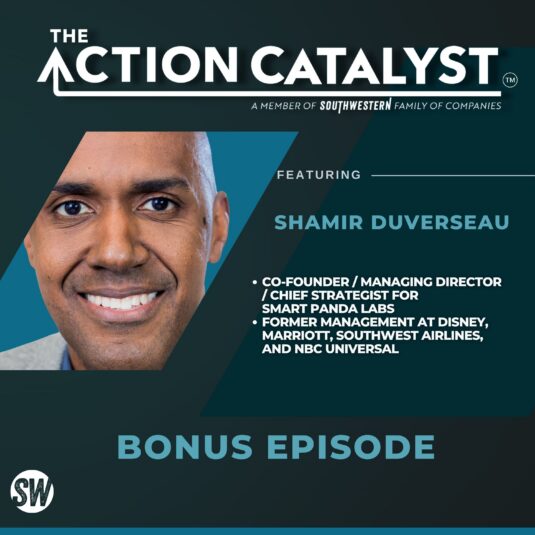
Shamir Duverseau, co-founder of Smart Panda Labs and former marketing leader for brands including Disney, Marriott, Southwest Airlines, and NBC Universal, discusses how organizations can dramatically improve digital marketing performance by focusing on the often-overlooked post-click experience. Duverseau explains that while many companies invest heavily in advertising and customer acquisition, conversions are won or lost after consumers arrive on a website, where poor user experience, organizational silos, and misalignment between marketing, IT, product, and data teams create friction that drives potential customers away. He explores the “Bermuda Triangle” challenge of cross-functional collaboration, the growing impact of AI on customer experience, and why achieving an “Amazon-level experience” requires strategic communication, technical integration, and continuous optimization, along with insights on customer journey optimization, conversion rate improvement, digital transformation, marketing technology, and user experience strategy.
About Shamir:
For 25+ years, Shamir Duverseau has led digital strategy for Southwest Airlines, Disney, NBC Universal, and Marriott. He watched companies burn millions on advertising while their MarTech ran at 20% capacity and customer journeys had no owner. So he built the solution. Through Smart Panda Labs, Shamir has spent 15 years helping organizations fix the post-click experience—optimizing the digital journey to increase conversions and LTV without increasing ad spend. His mission: help B2C enterprise marketers turn traffic into customers, prove ROI to leadership, and feel confident their tech is actually working.
Learn more at SmartPandaLabs.com.
The Action Catalyst is presented by the Southwestern Family of Companies. With each episode, the podcast features some of the nation’s top thought leaders and experts, sharing meaningful tips and advice. Learn more at TheActionCatalyst.com, subscribe below or wherever you listen to podcasts, and be sure to leave a rating and review!
LISTEN:
SUBSCRIBE TO OUR RSS FEED: https://feeds.captivate.fm/the-action-catalyst/
SUBSCRIBE ELSEWHERE: https://the-action-catalyst.captivate.fm/listen
__________________________________________________________________________
(Transcribed using A.I. / May include errors):
Host
Today we are joined by Shamir Duverseau. He’s the co-founder, managing director, and chief strategist for Smart Panda Labs, bridging the gap between marketing goals and technical execution. He brings 25 years spent prior in marketing for names like Disney, Marriott, Southwest Airlines, and NBC Universal. So, Shamir, welcome.
Shamir Duverseau
Thank you so much for having me. Excited to be here.
Host
That’s quite a resume of well-known companies that you’ve helped across your career. So, first of all, before we get into what happened after those companies, what are some of the common threads that you found working with those sort of heavy hitters in terms of how they approached their marketing, either for better or for worse?
Shamir Duverseau
Yeah, it’s funny. When I started with those companies, you know, obviously being new to the world of marketing, being new to the world of you know having a real job, you’re kind of a bit of a deer in the headlights at that in that situation. But what was exciting about it was the chance to work with some really really powerful brands, right, and get really excited about the things that you see. You know, you see the flashy commercials on TV, and you get excited by names like Southwestern Airlines and Disney, and and so forth. So these are things that you know I grew up with. A lot of people grew up with, so they were well known names. And I think as you get into them, you realize two kind of very important things, and and two things that really affected me and brought me to where I am today. One is first of all the power of brand and how that really influences people, but also the fact that these are still organizations made up of you know of people and people do quirky, weird things a lot of times and make very unusual decisions at times. You know how they got there, why someone’s thinking that, and I think that really gave me a a really powerful focus on people and the importance of making sure that it’s easy to talk about things like stock prices and profit margins and you know trying to hit marketing goals and all that kind of fun stuff. But when it all comes down to it, it comes down to people. It’s the people that you’re working with at the organizations, and then it’s the people that you’re trying to serve, you know, the end customer, the consumers in those organizations, and just the importance of keeping focused on that. I think was probably the biggest lesson I’ve learned, and and how to navigate that was really the lesson that I kind of learned that eventually really highlighted the the problems that I saw in those organizations that brought me to where I am today.
Host
You know, people, individuals. That’s a super scalable skill to master. That doesn’t matter if you’re a tiny, tiny organization or if you’re one of these huge names.
Shamir Duverseau
Absolutely, absolutely. It’s funny you work with an organization that has, you know, whatever 10,000 employees, 20,000 employees. You’re, you know, multiple places and situations that people live in and are going through, but when it all comes down to it, I mean, we’re all trying to do the same thing. These are people who are trying to support their families. These are people who are trying to maybe you know move forward in their careers. They’re trying to get a promotion, or they’re trying to get a bonus, or they’re just trying to get home at a decent hour so they can spend time with the kids. It’s all the same stuff, no matter what what position they are, no matter what organization they are. It’s all the same fundamental goals and and focus and vision that they all have. And once you kind of understand that, and you kind of you know allow that that empathy to come through, it becomes a lot easier to deal with the different people across the organization.
Host
You learned a lot of very valuable skills from working in that world, but it’s a world that you did choose to walk away from completely. Why?
Shamir Duverseau
So it’s a bit of a story. What happened was, as I was working at my last kind of corporate job at Marriott, it was a good, nice environment, good boss, great team. But what it came down to was just not having the the flexibility and the latitude to do the things that I wanted to do, and that was both on the corporate side and on the personal side. So, on the corporate side, a lot of the the politics that exist and the the bureaucracy that exists in a large organization became very frustrating. Just not being able to move forward with initiatives the way that I wanted to, and kind of address the problems that I saw in the organization, and frankly, had seen multiple organizations leading up to that point, and then from a personal standpoint, just not having the latitude to prioritize the other things in my life that were super important to me, the other pursuits that I that I wanted to make sure to focus my time on, my family, the volunteer work that I that I like to do, not being able to have the latitude to be able to control my schedule enough to be able to do that led those things to kind of collide at a certain point, and for me to sit down and say, “This isn’t where I want to be going. You know, what do I want to do, and and how do I want to go about doing it? And that led me to to reassess and say, “Okay, first of all.” What’s the problem I see from a corporate side that needs to be solved here? And ultimately, that that problem just came down to a lack of communication across some key teams. Marketing and IT just typically had poor communication; just didn’t get along, didn’t understand each other. Expectations were were poorly set up. A lack of translation; they just were speaking two different languages, and that just caused a lot of tension, frustration, and really prevented a number of organizations from moving forward, especially at a time when digital was becoming more and more critical in terms of establishing what that digital customer experience looked like. And then I said for myself, well, if I can create an organization that helps to solve that problem and move things forward, and at the same time, because I’m creating the organization, if I could take control of my schedule and my life and how I want to go about solving that problem, well, maybe here I can kill two birds with one stone, and and that ultimately kind of led the decision to for me to gather some people that I had worked with previously over the years and literally pull them into a room and and say, “Hey, here’s what I’m thinking. Best case scenario: this thing takes off, and we get to you know kind of quit our day job, and and we can do this, and this becomes something that kind of lasts. Worst case scenario: maybe we get a little side money. Someone can buy a new new pair of shoes, whatever they want, and you know we’ll walk away with the side money and call it a day. So we decided to kind of take the risk and kind of start it very slowly on the side and see if it would grow.
Host
So you know, you say the answer for companies isn’t buying more ads. It’s what happens after you click the ads. That’s when the conversions are actually won or lost. So what is the post-click problem?
Shamir Duverseau
Yeah, it’s a great question. The way I kind of describe it to people is a scenario that probably most of us, and not all of us, have experienced. So, imagine yourself-you’re driving home, perhaps from work or you know from school, wherever the case may be-and you decide, you know what? I need this room by the grocery store. I’ve got to pick up milk. You know, we’re like we’re fresh out. You know, I got to pick up some milk for the kids. You know, they got to complain if they don’t have any for for their cereal the next morning. So you swing by the grocery store, you run inside. You know, fortunately, it’s one you’ve been to before. So you you kind of navigate the the aisles. You go to the milk. Okay, great, found the one I want. You go down to the checkout. There’s five checkout lines open, and they’re all like 20 people long, and you just say to yourself, “Man, I don’t want. I can’t do this. So you say, “Well, I’ll go to I’ll go to self checkout. Well, those are broken. All right, so you you can’t go to self checkout, and it’s just like you know what I like. I do not have time for this. I can’t I can’t stand there. So you run back to the corner, you throw the milk back in the free in the in the cooler, and you say, “You know what? I’ll just I’ll just I’ll figure this out. Some other point, and the reason I use that story to describe the post click experience is because effectively that’s what happens to people online. You’ve gotten people to come to your store, you’ve gotten people to come to your website, perhaps they’ve even gotten to the point where they found the product they want, but at some point they hit some barrier that says this isn’t worth my time and effort to get past this barrier. I’m going to bail on this process, and at that point you’re hoping they come back, but the data suggests otherwise. That oftentimes people don’t come back, and of course, the higher consideration that your sale is, the more and more so that those barriers and those points of friction and the lack of communication causes them that frustration and causes them to bail in the process. So that post quick experience is exactly that. It’s what happens. It’s the problem that’s experienced after the ad, where perhaps you think, okay, I’ve gotten them. Great, my job’s done. Instead of saying, hey, people need help here. They need help to find what they need to look for. They need help to be able to check out. They need help to be able to make the decision that you want them to make on the website. Perhaps to take some number of visits to the website, maybe some email communications in the process. And the post-click experience problem is the fact that organizations don’t spend near as much time and effort and energy on that part of the experience as they tend to spend on the advertising component and getting in front of people and trying to drive consumers to their web properties, and that’s a mismatch because if you think about it, you’re spending a few seconds interacting with an ad, a few seconds interacting with a search result, but then you’re on several minutes, maybe over the course of time, maybe several hours, maybe multiple touches, interacting with the the website and trying to search and trying to shop and trying to compare and trying to figure out what you’re trying to to buy, depending on the nature of the purchase. So logic would dictate where should you spend the lion’s share of your time and energy and resources. Well, it should be where the people are spending the lion’s share of their time, energy, and resources-that’s the postal experience. The problem is that’s not what’s happening. The metas of the world, the Googles of the world-they’re very good at saying, “No, no, no, no, no. We’re going to help you solve your problem. Spend more money here with us on our platform, and if you drive more people, that’s your that’s going to be solving your problem.
Host
There are three pretty straightforward ways for companies to increase that conversion without increasing their ad spend. Can we kind of break those down one by one?
Shamir Duverseau
Sure. So you know, obviously, there’s things you can do purely from a usability standpoint, just to say, how do we make this experience better? How do we make it cleaner? How do we make it more organized? So again, let’s go back to our grocery store analogy. How do we organize the shelves in the grocery store? How do we organize the aisles? How do we make sure there’s clear signage? How do we make sure people can very clearly look at the signs and say, okay, that this is where the milk is, this is where the cereal is, this is where the meat is. So I can quickly go there, find the product I want, right? How do we organize the checkout lines to make sure they’re they’re well staffed, right? How do we make sure that self checkout is actually working, right? How do we make it easy to use? So in the same same sense on a website, how do we structure and organize the website that makes it easy to navigate, easy to find, easy to surface information that’s important to the person? If they’re shopping for clothing, how do we make it easy to find size comparisons so people kind of understand what what does this brand mean by small, medium, and large. If people are searching for electronics, you know how do we have the the specifications that the kind of people look for, right? Is it easy to find reviews and see what other people have said about this particular product? Is is the checkout process easy? How much information are we asking for, right? So all those things kind of really affect that just the user experience, how people are actually clicking and interacting with the website experience. Now, relatively speaking, that’s maybe the easiest one to kind of deal with. The other ones become a bit more of kind of organizational issues of what’s happening, right? So, in order to be able to really impact that experience, well, marketing has to work with IT, has to work with the product team, has to work with the data team to make all those things happen in any kind of large organization. So now you’ve got an issue where people have to be able to communicate and collaborate in order to build the end experience that the customer is actually going to interact with, so a lot of that becomes a bit of translation, a bit of a bit of being an arbitrator between those different different departments, and helping everyone to keep focused on what it is that everyone wants to accomplish in their own team, and say, well, how does that roll up to the bigger goals of the organization? And as we alluded to earlier, you’re dealing with people, and you know when you go to maybe someone in IT and you’re kind of spilling out what you need from a project, what they may be hearing is, this is going to take me all night. You know, I was supposed to go to my kid’s baseball game tonight, you know. So the importance of being able to work with people in order to collaborate to make these different departments be able to align and work together, or it may be an issue of just technologies that exist in your organization and not being able to leverage those technologies and use them in a way where you’re truly getting value out of them. So having a really expensive toolbox and and just basically just saying every time I’m just going to use the hammer. You know that’s not going to get you very far either. So that those three problems or a combination of those three tends to be what leads to that post click experience problem.
Host
The second problem you address there, as far as the departments working together and the individuals, is this what you refer to as the Bermuda Triangle issue?
Shamir Duverseau
That’s exactly it. Yeah, it’s it’s just it’s a space where you know it doesn’t have to be a problem if people can can effectively communicate and collaborate, but it ends up being a problem oftentimes because culturally the organization doesn’t set it up necessarily for those organizations to be able to work well and communicate well together, maybe the skill sets of people in their organization don’t allow them to be able to have a good understanding of the area of expertise that they’re they’re dealing with. So those kinds of issues end up coming up, and they end up causing a lot of tension in our organization, and very much slow things down and don’t allow them to impact ultimately that post click experience the way that an organization would want to.
Host
Do you think it’s a problem of collaboration, or is it potentially a problem of, you know, when the different stakeholders are brought into the process? Right, like IT thinks this something needs to originate with them. Product thinks something needs to originate with them. You know, marketing thinks they need to be involved before IT so they can help originate an idea for something IT is going to build, but IT thinks they need to be involved. You think it’s a a workflow issue in a lot of cases?
Shamir Duverseau
Absolutely, absolutely right, and that and that’s that’s kind of the nature of the collaboration problem, right? Where it’s someone feels like they they own exclusively a certain piece of that process, and are reticent to to bring into other group until they feel it’s appropriate to kind of bring them in the loop on it. So perhaps marketing has this idea. This is what they want to do. They feel like they flushed it out. Then they go out to IT and say, “All right, I want this is what I want you to do. This is what I want you to execute. Well, now you’re treating IT as an order. Taker as opposed to a business partner, instead of saying, “Hey, you know, we’ve seen this issue in the research. How do we best address this? Let’s bring these players to the table and let’s bring IT to the table. Hey, IT, this is what we’re thinking. You know, what do you see on your side? What are the pros and cons? What are the long-term impacts? Let’s jointly kind of come up with that solution and what that solution might be, so that everyone feels like they’re invested in it, and that now when we’re all moving forward and we’re moving through the process, it’s not blind or siloed to any one particular group or team, but everyone’s kind of seeing what we’re thinking, what we’re feeling, what we’re prioritizing, and we’re able to do that and figure those things out together, and that way, that that process is going to move significantly more smoothly.
Host
We’re talking about IT. I’m pretty much now obligated to ask you what role AI is playing in all of this, or how AI has changed your position on all of this from what it might have been even a year ago.
Shamir Duverseau
Yeah, to be honest with you, the introduction of AI has made this 10 times more important than it was before. Because the problem is, AI can make certain elements seemingly so much easier, or at the very minimum, realistically, seemingly faster than it was before. It just becomes a way to accelerate you, giving getting yourself painted into a corner and creating a problem for yourself more quickly than perhaps you would have before, because you think you know what you’re doing. You know you think AI knows what it’s doing, and you’re not realizing the structure and the the parameters you need to put around AI. How you need to educate the AI in the proper way. Is it looking at the the proper data sets? Is it set up to talk to the proper systems in the proper way in order for it to deliver at scale and at speed the things that it’s able to do, right? And that takes a level of collaboration of marketing saying this is how we want to use this tool, and IT saying okay, well you know these are the systems needs to interact with. Here’s how needs to be able to read this information and these data points to be able to execute on that vision of what you want to deliver to the customer and that ultimate experience, but if those things aren’t done ahead of time and set up, you’re either running into a situation where either a you’re not able to leverage AI because the company just isn’t structured in such a way that AI knows what to look at and what to read and what what information to use to make appropriate decisions, or B, someone is able to kind of run off on their own and do their own thing, not understanding that they’re operating in a silo and they haven’t communicated with the right group, and you know, IT or the data team comes back and says, “Hey, you know, you’re looking at this data set. That’s not accurate. You need you need the AI to be looking at this data set in order to make the kind of decisioning that you wanted to make, so that’s that’s mostly what we’ve seen is those groups perhaps not working together upfront and understanding how they want to leverage AI to understand what roles each respective team plays so that they can be set up for success moving forward.
Host
Obviously, we want the customers to have a good post-click experience. We want it to be as seamless as smooth as possible. Surely there are some scenarios where we don’t want things to run too quickly. We we want a level of friction to a degree in certain scenarios. What are some exceptions to this rule, or or what might be some scenarios where providing a good post click experience might mean throwing up some barriers anyway?
Shamir Duverseau
Yeah, that’s a great that’s a great point. You know, it’s funny because I mean we we throw the word around friction very loosely, and it’s certainly an appropriate term to use. But really, what what you want to do is you want to help people make the best decision, and at times that means removing friction. At other times that might mean adding friction in order to help them make the best decision, so you may have run into a situation yourself. You know, it just maybe you’re on a website and you’re trying to make a modification to an account that you created. And a lot of times, when you go to delete an account, perhaps to remove it, you’ll hit delete, and a pop-up will come up and say, “Are you sure you want to do this? It might even ask you to type in the word “delete” or type in the word “confirm” in order to do that, right? So that’s thoughtful friction. Like you, you’re throwing up a barrier because you’re you’re trying not to do some. You’re trying to help the customer not do something that they’re going to regret that they didn’t mean doing, right? So you’re helping them to make the best decision. Are you sure this is what you want to do? Are Are you sure this is the path you intended to go down? And if so, great. You know, type in these seven letters or whatever the case is, and you know, rock and roll and have fun. But if not, oh wait, that that’s not. I wasn’t trying to delete the account. I was just trying to switch plans, or I wasn’t trying to delete the account. I was just trying to delete my you know personal information that was stored here, or something to that, you know, to something that effect, right? So, friction is ultimately a tool, and sometimes you want to remove it, and sometimes you want to increase it to an appropriate degree. But as long as you come at from the context of saying people are trying to make a decision, how do I help them to make the best decision for them? Then you’re going to use that tool of friction. In the appropriate way, as well as a number of other tools in your toolbox.
Host
You talk about something called Amazon level experience.
Shamir Duverseau
Yeah. So you know what often happens is when companies have these conversations and they’re talking about the experience that they want to deliver to people, they use something like Amazon has kind of the the gold standard, right? You know, everyone’s familiar with it. Everyone’s comfortable with it. We know how well Amazon’s doing from an e-commerce standpoint. We’ve seen the Amazon experience of how quickly and easy it is to to go through and and make a purchase. I mean, you and I both probably made purchases on Amazon in in 30 seconds flat, just because it’s just it’s just that simple, right? So oftentimes it’s like, yeah, I want to do what they’re doing, right? I want to, I want to be able to make it as smooth as Amazon. I want to be able to have people buy things with one click, or I want to be able to have the kind of recommendations that Amazon has to say people like this had this, or surf up reviews the way that Amazon does. Whatever the case is, often though organizations don’t appreciate the 25 things that need to happen in order to deliver that kind of experience, so they can very clearly see the endpoint, which is great, and we’re happy for that. But they don’t see the the 25 steps that need to happen in order to do that, and who has to be involved in executing those 25 steps across the organization, across the enterprise. So navigating that experience, internal organizational experience, in order to deliver that Amazon experience is the key. And understanding it’s not a light switch; it’s a journey to get there. And you’ve got to be able to envision what are those 25 things, what order do they need to happen, how do we need to kind of measure and kind of pivot along the way, in order to ultimately reach that end goal, and understanding too, I say end goal, but it’s ultimately not an end. It’s it’s something that once you kind of reach a certain point in that experience, you’re continuing to learn, you’re continuing to to iterate and make those kind of changes and keep moving forward, which again is exactly what what Amazon or the Amazons of the world are able to do so. Organizations have that goal, which is great. It’s just a matter of understanding what needs to happen, how technologies need to be used, how different groups need to be able to be aligned in order to be able to reach that.
Host
As we kind of wrap up here, I want to give you a minute to kind of brag on Smart Panda Labs. What does Smart Panda Labs see as its specialty in the marketplace, and how can listeners learn more about the lab? Learn more about yourself?
Shamir Duverseau
No, appreciate that. So, Smart Panda Labs, we we consider ourselves to be a technical marketing agency. So, our whole existence is predicated on being at the space where marketing and IT and product all intersect, and we come at it specifically from a marketing standpoint. But in a sense, we we view ourselves as kind of being that ambassador, that diplomat in the organization that says, “Hey, look, we we speak their language and we can translate marketing. What are you trying to accomplish? What are you trying to do? Great, let us help you talk to IT. We can frame it in the way IT wants it framed. We understand how they’re thinking, what questions they’re going to be asking, how to collaborate with them, how to communicate with them in a way that allows you to be able to accomplish and achieve your end goals, and whatever gaps that exist, we’re able to fill them from a strategy standpoint, or from a design standpoint, or development or analysis to make sure that those gaps are filled and things can ultimately end up running smoothly. So yeah, if people are interested, please check us out at smartpandalabs.com, or simply if you’re interested in just learning more about how we think and and how we look at things, please follow me on on LinkedIn, follow me on Instagram, hear what we’re talking about, hear what we’re trying to evangelize, the story we’re trying to tell about the importance of the post-cook experience, and how people need to be able to invest in that to really grow.
Host
You’re helping people navigate the Bermuda Triangle.
Shamir Duverseau
That’s it.
Host
Shamir, thank you so much for making some time for us today. We really appreciated it.
Shamir Duverseau
Appreciate it. Thank you so much. Thank you so much for having me. The show is great. Appreciate what you guys are doing with the show. So so happy I could be a part of it.
0 Comments