The Way of the Spiritual Entrepreneur, with Pauline Nguyen
- Posted by Action Catalyst
- On October 20, 2026
- 0 Comments
- author, breathwork, burnout, Business, calm, CEO, emotional intelligence, entrepreneur, leadership, mindset, overwhelm, stress, success, Workplace Culture
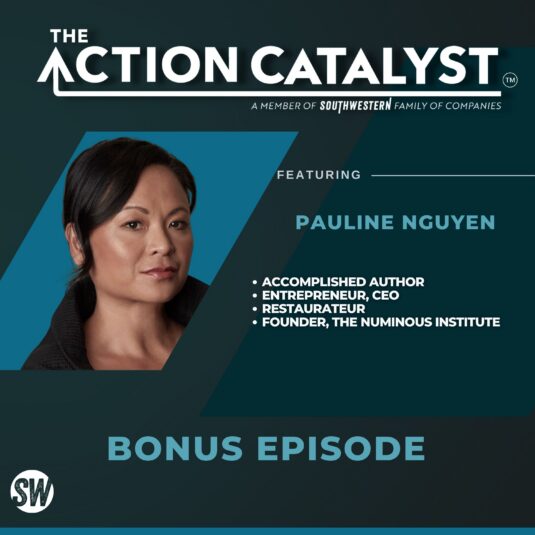
Pauline Nguyen, acclaimed entrepreneur, author, speaker, and founder of the world-renowned Red Lantern restaurant, shares powerful insights on emotional mastery, conscious leadership, and sustainable high performance. Drawing from her extraordinary personal journey as a Vietnamese refugee and successful business owner, Nguyen explains why many high-achieving leaders excel externally while struggling internally with stress, burnout, and emotional overwhelm. She introduces her framework for emotional literacy, emotional intelligence, and emotional maturity, along with her SSS Method (Semantic, Somatic, and Soulmatic transformation), which helps leaders regulate their nervous systems, build resilience, increase self-awareness, and lead with greater authenticity and influence, and explores leadership development, mindset, emotional regulation, breathwork, workplace culture, employee retention, and personal growth, offering actionable strategies for entrepreneurs, executives, and business professionals seeking stronger leadership, improved performance, and a more fulfilling life and career.
Click here for a special gift from Pauline to podcast listeners!
About Pauline:
Pauline Nguyen is one of Australia’s most decorated entrepreneurs. As owner of Red Lantern – the most awarded Vietnamese restaurant in the world – she earned the Telstra Business Award and, in 2026 was named Global Transformational Leader of the Year. She has also been named one of “200 Women Who Will Change the Way You See The World.” At three years old, Pauline escaped Vietnam by boat – nine days at sea, a year in a Thai refugee camp, and a beginning that would have broken most. She chose, instead to become the beneficiary of everything that happened to her. Her memoir, Secrets of the Red Lantern, won international acclaim; her latest, The Way of the Spiritual Entrepreneur, continues to move readers worldwide. Combining the latest neuroscience with spirituality, travelling the world as an International Keynote Speaker and Executive Coach, she guides CEOs and founders into Conscious Leadership – rewiring their story from victim consciousness to creator consciousness, and learning to live life by design, not by default.
Learn more at Pauline-Nguyen.com.
The Action Catalyst is presented by the Southwestern Family of Companies. With each episode, the podcast features some of the nation’s top thought leaders and experts, sharing meaningful tips and advice. Learn more at TheActionCatalyst.com, subscribe below or wherever you listen to podcasts, and be sure to leave a rating and review!
LISTEN:
SUBSCRIBE TO OUR RSS FEED: https://feeds.captivate.fm/the-action-catalyst/
SUBSCRIBE ELSEWHERE: https://the-action-catalyst.captivate.fm/listen
__________________________________________________________________________
(Transcribed using A.I. / May include errors):
Host
Pauline Nguyen is an accomplished author, entrepreneur, and CEO with an incredible backstory and even more incredible track record of getting results, and we’re excited to dive in deep with her today. So, Pauline, welcome.
Pauline Nguyen
Thank you so much for having me. I’ve listened to so many of your episodes, and I really think what you’re building is so special, and I want to acknowledge you for that. I just think you guys are just really genuinely good guys. I’ve listened to so many of your episodes, and I just think you’re just genuinely good people.
Host
Well, great. I hope not to ruin that with today’s interview.
Pauline Nguyen
Don’t be scared. I know that having a podcast that has been so long standing is not is. It takes a lot of work. It takes a village, and and what you’re creating has real impact. So I’m honored to be here. Thank you.
Host
Okay, well, great. So we’re all done then. That was the best interview we’ve ever had.
Pauline Nguyen
See you later. Bye.
Host
So to kind of dive in here, you teach emotional mastery to high performers. So the kind of people who are crushing it on the outside and screaming on the inside, we know that we have at least a few of those in our audience. Give us your definition of emotional mastery, and then tell us where does that incongruency start? Why is it that the most capable leaders are often the ones that are quietly falling apart?
Pauline Nguyen
Okay, I work with so many leaders, and so when you’re a leader of an organization, the responsibilities are immense. The pressure is immense. There’s complex, high-stakes challenges every single day, and so it’s your job. It’s what we get paid for to master the outer world to look good on paper at least, right? But as you say, the truth is the high-performing leaders-they’re struggling on the inside. They’re-they’re burning out. They’re-they’re losing their authenticity, and so they struggle to maintain their values, their core, their essence. They struggled to maintain their health, their intimate relationships, their personal life. I believe we don’t have business problems; we have personal problems that reflect in our business. And especially with the high performers, the elite leaders, they’ve been taught discipline, discipline your habits, discipline your your body. But the most disciplined people I know are usually the closest to burning out, and they can’t see it coming because discipline is the thing that they trust the most. It’s the one muscle that never failed them. The discipline becomes a habit until the day comes and they can’t reach that thing that’s actually running them, because nobody ever taught them to discipline their state. Nobody ever taught them to multiply the capacity, and so capacity isn’t a time problem. Capacity is a state problem. Capacity is the maximum amount someone or something can hold without crumbling, and so I help them to master their inner game so that they can maintain their values and thrive from the inside out and lead an extraordinary quality of life, and I have a a method that takes time, but it doesn’t take too long. But that’s definitely not where I started. It’s been an an incredible, intense journey to get here.
Host
We’re gonna get to the journey and to the method, but I want to do just a little bit more table setting before we do. Your latest book is called The Way of the spiritual entrepreneur, and we’re going to dive into a lot of what’s in that book. But what does spirituality in general mean to you, and where does yours come from?
Pauline Nguyen
For me, when I say spirituality, I mean the physics of your nervous system. I mean the biochemistry of fear. I mean. Somatic intelligence. Your body has been running since before you had language for it. That’s what spirituality means to me. It’s never meant anything else, and so spirituality has been given such a bad rap because of the love and lighters, the tarot card readers. I’ve got nothing against that. I just think that it’s time to take spirituality out of the cloud and put it back into our bodies where it belongs. To be in spirit is to be inspired to do your best work. Some of the most spiritual people I know live their lives in spirit and inspired. To be a spiritual entrepreneur is to think beyond yourself, to think beyond how can I evolve, push humanity forward, and to do it in states of joy. That’s what spirituality means for me. If we have capacity and we’re doing the hard work, confrontation, confrontation is in service of harmony. We have to when we’re talking about emotional mastery. What is the wisdom of the emotions? If you’re feeling anger, that’s a clear sign that your boundaries have been crossed. What are you going to do about it? We are leaders, but what is the message? What is the wisdom of the emotion that you’re feeling, and so we always start with emotional literacy instead of saying how are you feeling to it? Good, fine, stressed, overwhelmed. Have more vocabulary for it, and then we go into emotional intelligence. Where now am I feeling it in my body? Let’s breathe into there, and the emotional intelligence part is: How do I know that? Is it an identity issue that it’s touching? Is it a position issue? Is it triggering a past trauma? That’s having the intelligence once you’ve got the literacy, and then we have to understand that we have to have emotional maturity. The emotional maturity is what is the wisdom behind this emotion? To really go do the interior work when we feel sadness. What’s the wisdom of sadness? Sadness is something needs to end. Now, what are you going to do about it? Something needs to end. Perhaps we haven’t grieved the loss of this job, or the loss of that person leaving, or something in our lives that we haven’t given the time and the respect to. And so, you know, what’s the wisdom of fear? The wisdom of fear is, hey, you’ve not done that before. It’s okay, or it’s we better avoid that. We better stop that. So rather than react or reenact from that emotional state because you haven’t paused, use the wisdom. Understand the wisdom of it. So it’s emotional literacy first, and then emotional intelligence, and then having the maturity to understand the wisdom. Now, how can I release that from my body versus holding on to it? And science tells us time and time again it takes 90 seconds, 90 seconds to release the emotion from our body. Do we do we know how to do that? Do we need to go for a run? Do we need to jump in the ocean? Do we need to move our body? Do we need to scream in a pillow? But how many of us hold on to it for days and months and years and sometimes decades as well? So that’s what emotional mastery is for me. Emotional literacy, emotional intelligence, emotional maturity together creates emotional mastery.
Host
Well, that how to let go of it is what I want to get to next. So when we get to that, how you know you explain that what a lot of people write off as woo woo are things that for the right group is absolutely a tactical strategy. So Navy SEALs call it tactical breath work. You’d say Olympic athletes call it state regulation. This is the same idea for business leaders. We just don’t have a name for it yet, and a lot of these tactics specifically seem to be geared around how to perform and stay calm in high-pressure situations. So, can you give us some of those examples? You say it only takes 90 seconds. Could you give us kind of like a real-world example for how that might apply to someone in a business environment.
Pauline Nguyen
Sure. Would you like me to demonstrate it here?
Host
Sure. This isn’t a high pressure situation for me.
Pauline Nguyen
No, of course not. But it it can you can take a snapshot of how you feel now, and then take a snapshot of how you might feel later. I guarantee you, you’ll feel differently later. It only takes five minutes for the listeners. Do you have five minutes before you go into that boardroom meeting? Do you have five minutes before you’re going to have that difficult conversation with your spouse, with your staff? Do you have. Five minutes, and so what we’re doing is let’s just do it rather than we me carrying on. You need the proof first, right? And then if you want the science, I can tell you about the science later. But some people don’t want the science; they just want it to happen now. So, so why don’t you take a snapshot of how you feel now? Close your eyes, relax your jaw, relax your face. Now, when I ask you to breathe, just breathe into your belly for a few rounds, and breathe slowly on my count. Breathing into your diaphragm, inhale for 321, with a full belly. Hold for 321, Slow exhale for the count of 654321, Empty belly hold for 321, Inhale for 321, Full belly, hold for 321, Exhale for 654321, Empty belly hold for 321, Inhale for 321, Full belly. Hold for 321, Exhale for 654321, Hold for 321, You can, with your eyes closed, keep breathing now at your own pace, in your own time, can you recognize the exact emotion that is arising within you now? Is it calm, peacefulness, love? And so there’s so many little tactics like that. And when we can identify the emotion, it has less of a hold on us, right? Two more minutes. Two more minutes. Close your eyes, and then when I ask that question, some people-it’s oh-it’s irritation, it’s anxiety, it’s confusion, whatever it is. Simply recognize the exact emotion that is arising within you now. When you give something a name, it has less of a hold over you. And now observe the direction of the moment of your thinking. What’s the direction? Is it entangled in the past? Is it projected in the future? Or is it here in the present with me right now, and now I want you to visualize, sense, or feel a little flame at your eyebrow center. Visualize, sense, or feel that little flame flicking away at your eyebrow center, and now with your intention and attention, can you move that flame like you are walking backwards into a cave? Move that flame to the middle of your brain, and all you need to do now is hold your attention on this flame in the middle of your brain, dancing there, casting shadows in your mind’s eye, just for a few moments there, dancing away. Ah! And now, whenever you are ready, you can place a gentle smile on your face and open your eyes.
Host
Ah, that is a very, very calming exercise and quick.
Pauline Nguyen
It’s five minutes. Five minutes.
Host
Yeah, and anybody can do that. You mentioned a method earlier that I wanted to get around to fleshing out some of the specifics of. I believe for you this is the SSS method.
Pauline Nguyen
Yes, the triple S method. I created it after decades of my own personal healing. It’s mindset, mindset, mindset, mindset, mindset. We love mindset, but it can’t just be mindset. It also must be mindset, heart set. How much do you love? How quickly do you forgive? How kind will you be? And then, of course, health set. We we have to we have to sustain our health, and soul set, our spirit, and so the triple S method addresses the different levels of change in the mind, the body, the soul, and the spirit. The spirit is to be in spirit and inspired to do our best work, right? And so the first S is semantic. The second S is somatic. The third S is somatic, semantic of the word, where we rewire your thought patterns and your beliefs, how you’ve always done you, how you can do yourself very differently. We start to install new language patterns to create new neural pathways, and then the somatic of the body. It can’t just be talk therapy. It can’t just be talk therapy. Can’t reach what the body holds. The nervous system remembers what the body forgets. So we have to get into the body because the pattern isn’t in your head. It’s in your physiology, which is why reading about it never fixes it unless you integrate it into your body and then soulmatic of the spirit, what does that mean? To reconnect with your intuition, to reconnect with your purpose, to access your heart brain coherence, and so it’s pure science and spirituality designed to activate your potential. And so I have all. I love playing with words. I’m a I’m a I’m a wordsmith. So SSS semantic somatic soulmatic for stillness structure and sovereignty for spiritual growth, strategic clarity, and self mastery.
Host
Now, what I’m hearing a section of our audience saying is ultimately, obviously, all of this serves to guide leaders to a place of what you refer to as conscious leadership. Define for us first, if you will, what conscious leadership is, but also who is the commercial benefit of this? Because obviously, it’s going to make leaders feel better in their own skin, right? But I think a lot of people might be asking, “That’s great. What’s the impact on their bottom line?”
Pauline Nguyen
Sure. So I came to this country as a boat person. My family escaped the Vietnam War. We spent nine days out at sea, a year in a refugee camp. My father survived the war, but he brought it home with him. I grew up reading his moods in order to stay safe. I became hyper vigilant. I ran a nervous system that was based on fear. I know what fear smells like. He suffered terribly from PTSD. We grew up in a very violent household, physically violent, emotionally, spiritually, mentally violent-that was my training long before my business. And so, commercially, how many of us have those sorts of stories? Our body is the boardroom. The nervous system of the leader is the nervous system of the organization, because we all have a story, right? We all have a story. Yes, we are aware, but how aware are we that we are aware or not aware, right? I spent 25 years building the most awarded Vietnamese restaurant in the world called Red Lantern. We have an 11% staff turnover rate in an industry which has 60 to 80% staff turnover that saved us millions and millions of dollars on recruitment on training. We didn’t create staff loyalty, staff engagement. We created staff devotion when the nervous system of the leader is reflected, and with the staff and the the culture, we created customer devotion. We closed the restaurant after 25 years last December. We gave the public three months’ notice. It’s a famous restaurant, fully booked every single night for the three months in a hospitality business. When we announce that we’re going to close the doors in three months, it’s so natural for the staff to flee, right? Why wouldn’t they go find a job very, very quickly? Not one single staff member left. They stayed until the very end, and so we’re talking influence now. We’re talking magnetism. We’re talking customer loyalty, customer devotion, staff retention. That’s energy that you can’t see, but you can certainly feel it. You know when you’re with a leader or with someone, and you walk away going, there was something about them that was magnetic, or something about them that was repellent. You can influence before you can even open your mouth, and you just don’t know why. You feel so calm when you’re with them, or so inspired when you’re with them. So they’re real ninja tricks, right? If we understood how powerful we really are.
Host
Yeah, I am definitely feeling that right now, 100%. Pauline, you’re a founder. You’re an entrepreneur. You’re a restaurateur. You’re an author. There’s probably a million different ways people could reach out to you and discover almost a entirely different Pauline each way.
Pauline Nguyen
Can I just say that I I just think you guys are such genuinely good people. I’ve I’ve created something to give to your audience. I love that you continually to show up for your audience. So I’d love to gift your audience something if if that’s okay. If you’re an entrepreneur, an executive, and you’ve mastered. Your profession, but inside you still feel like you’re winging it. You’re at the imposter syndrome, but you actually want unshakable power. You want undeniable influence, and to be magnetic. You know, you you might be the person everyone goes to, the one who can solve any business problem in 30 minutes, because that’s your job, but you still can’t fix your own stuff. You haven’t mastered your inner game. You’re successful on paper, but you’re you’re quietly wondering. You know, what if I get found out? It’s for those who are feeling like you’ve built an expensive prison that you can’t escape, and you give your family and your spouse your leftovers while the strangers get your best energy, and so I want to gift your listeners what I’ve called, especially for your listeners, the sovereign leader system. What is sovereignty? Sovereignty is there is no power outside of ourselves. We build our own power, our own influence, our own magnetism, and I’ve put this in two pieces. First is a guided reset that you can drop into before any high pressure moment. The first is called calm courage, inner peace, outer abundance. The second is called deep healing for the mind and body. They’re 20 minutes and 30 minutes each. You will love them. So many people love them all around the world, and so it clears what your mind’s holding, brings you back to calm, gives you decisive power. It is not woo woo. It is science. It’s not magic. The second is I want to give your listeners the framework. It’s the map I’ve used for over 400 leaders, so that they can find that pattern that’s quietly running the game and then change it. And it’s it’s not a watered down freebie. So if you’re a founder or leader who’s absolutely mastered the outer game and you now want to master your inner game, this is for you. So you can go onto my Instagram page at Pauline N Speaks. If you DM me the word action, I’ll send it to you straight away. But don’t tell anyone. It’s our secret.
Host
Oh yeah, don’t don’t tell anybody. No, that’s absolutely perfect. That would be perfect. Yes. Well, Pauline, this has been an incredible conversation. Thank you so much.
Pauline Nguyen
It’s my absolute pleasure.
0 Comments