
Victory of Victimhood, with Preston Smiles – Episode 179 of The Action Catalyst Podcast
- Posted by Action Catalyst
- On February 1, 2017
- 0 Comments
- author, awareness, bridge, coaching, emotional intelligence, entrepreneurship, leadership, mindset, motivation, overcome adversity, personal development, personal growth, resilience, responsibility, self-help, speaker, success
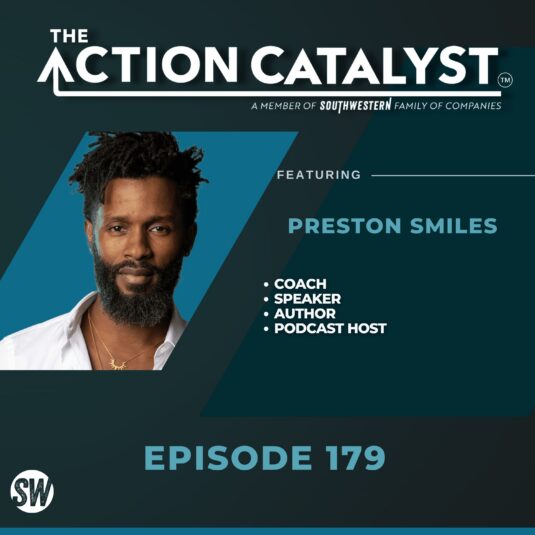
Preston Smiles, personal development leader, author, and speaker, shares powerful insights on personal growth, emotional intelligence, and conscious leadership. Smiles explores how self-awareness, radical responsibility, and authentic communication are essential for creating success in both personal and professional life. He emphasizes the importance of healing limiting beliefs, embracing vulnerability, and shifting mindset patterns to unlock greater fulfillment, relationships, and performance. The conversation highlights practical strategies for overcoming adversity, building resilience, and living with intention, while blending spirituality, entrepreneurship, and mindset coaching.
About Preston:
Personal Development’s breakthrough power couple, Preston Smiles and Alexi Panos, have supported thousands of people who have dramatically changed their lives by participating in the various programs and workshops they teach all over the world, including their groundbreaking 12-week online training program The Bridge Method, and the popular workshop The Bridge Experience. As agents of change, passion and possibility, they both founded their own movements that inspire and empower people worldwide, including Preston’s Love Mob and Alexi’s non-profit E.P.I.C. Their trainings are action-oriented and address all learning styles while engaging the mind, body and soul, and they are committed to leading others and inspiring people to step fully into their unique gifts.
Learn more at PrestonSmiles.com.
The Action Catalyst is presented by the Southwestern Family of Companies. With each episode, the podcast features some of the nation’s top thought leaders and experts, sharing meaningful tips and advice. Learn more at TheActionCatalyst.com, subscribe below or wherever you listen to podcasts, and be sure to leave a rating and review!
LISTEN:
SUBSCRIBE TO OUR RSS FEED: https://feeds.captivate.fm/the-action-catalyst/
SUBSCRIBE ELSEWHERE: https://the-action-catalyst.captivate.fm/listen
__________________________________________________________________________
(Transcribed using A.I. / May include errors):
Host
Preston Smiles and Alexi Panos, they do business together, and they have a book that they wrote together, which is called Now or Never: Your Epic Life in Five Steps, The Bridge from Where You Are to Where You Want to Be. We got Preston here on the show. Preston, welcome, and thank you for being here.
Preston Smiles
Thank you for having me. I really appreciate it, man.
Host
So, you and Alexi are, you know, kind of founders of this, this bridge method, you call it. What is bridge all about, and why do you kind of use that? You use that language, I’ve noticed a lot, is kind of like bridge to bridge. So, can you talk about that concept a bit?
Preston Smiles
Yeah, I mean, it’s, it’s, it has multiple meanings, one, you know, starting with both of us individually, we both sit in a very particular part of how the human experience is going, so for instance, for me, I could be at a conference speaking, and I could also be speaking at a festival, or, you know, at a junior high school, and so we both find that our particular makeup and how we stand in the world and our sort of understanding of the human experience is a bridge and so it’s a living bridge and so we wanted to create a living bridge in the bridge method and all that we put out, so the bridge method is in itself a 12 week online training program that teaches people how to navigate this world, and then the bridge method is also the name of our company, it’s an umbrella for the bridge experience, which is an experiential workshop that also has positive psychology, NLP, Gestalt. work, it’s we sort of somatics, esoteric wisdom, we sort of combine everything, we find that our work is like a bridge, it literally is dancing and swirling with all of the wisdom that is out there in a way in which a layman or a regular person like ourselves, could actually use it, and so it’s, it’s about synthesizing, it’s about, you know, translating these very technical clinical terms and ways parts of psychology into practical everyday steps.
Host
Right? What is the reason why people don’t cross the bridge, so to speak?
Preston Smiles
Well, one, everything our society right now is pointing to that we need something outside of ourselves to have an experience of joy or happiness, and so already you know from a very early age we’ve been taught and conditioned to believe that we need the car, the money, the degree, the partner by our side, the season football tickets, whatever it may be, we need these things, the next bag, you know, the next program to complete us, and so just starting at square one, that in itself is what holds so many people back from seeing, right. So one of the things I say all the time, it’s not a matter of becoming, it’s a matter of revealing, revealing what’s already here, revealing the creativity, revealing the love, revealing the flow that’s already here. And so a lot of coaching clients come to us and they want to become, and we bring them back to that. We remind them that it’s not your job to make it happen, it is your job to welcome it. And so it’s less about the doing and more about the being, and we’ve got it confused in our society. We have it do have, and then be, you know, I’ll do something, and then I’ll have something, and then I’ll be happy once I have these things, and for us it’s the other way around. It’s be, do, have. How do you let go of that sort of materialism that I think that we, we do get programmed with that? It’s just kind of the nature of advertising, and you always have a choice, and that, and that’s the bridge to empowerment, because without choice, you know, without awareness, there is no choice, and so it always comes down to awareness. In our workshops, one of the first things we say is you can’t intervene in a world that you truly cannot see, and all of us are worlds, so you can’t change. You can’t see, so awareness has to be the first step. You can’t shift a pattern or a habit that you have no awareness that it’s happening. And so we go into this process of bringing an awareness to conscious and unconscious agreements. We go into an awareness about understanding the difference between being a victim and operating from victim consciousness, which is an entire different thing. We remind people that how you do anything is how you do everything. So, if you’re cheating on your taxes, more than likely you’ll be cheating in other areas of your life. If you’re always late with your kids, more than likely you’re late to a lot of other things as well. And so, when we catch the patterns and we catch the unconscious agreements that we’re operating from the shoulds, the of courses, and start to take another look at that. We can then take ownership of our lives, and then we have something in the book we talk about CTS, which are conditioned tendencies, and the condition tendencies come up or show up when we are in high-stress situations where we feel overwhelmed, and those are fight, flight, freeze, and appease. These are the reptilian brain that shows up, which we all have. And if you don’t have an awareness of your conditioned tendency, it will, it will run you. You won’t run it. So, have you ever noticed when all hell is breaking loose that you know, maybe someone tries to start neutralizing the situation, or you know, start cooking, you know, there’s a very interesting thing that shows up, where, and it’s more of a modern one, but where we start to try and make sure everybody’s happy and neutralize it, so fight, clearly you know what that is. Flight, clearly you know what that is. Freeze, we just stop. There’s no movement. And then appease is where there’s movement, but all of the movement is around trying to neutralize the whole thing. It’s just about awareness. It’s not about changing anything per se, but just bringing an awareness to it, because if you know that that’s what comes up. So, for instance, my condition tendency is fight and Alexis condition tendency is fight.
Host
Oh awesome.
Preston Smiles
So yeah, so if something comes up in our relationship, both of us have, you know, have an understanding that that’s probably where we’re going to go first, if you know that that’s your condition tendency, then you can get out in front of it, you start to experience, you know, shortness of breath, or you know, heaviness in the chest. Then you go, “Oh, here it comes. I’m about to, I’m about to go into it. Let me breathe into this. Let me remove myself from the situation and give myself more choices. There’s an interesting part in our book, as well. It’s still in chapter one, about something we call it the diminishers, and the diminishers work for your ego. They are literally like they clock in, and whenever something great is about to happen, or whenever we’re about to break through, the diminishers pop in, and they make sure that we sabotage it in some way. And so the diminishers are procrastination, perfectionism, over analyzing, not asking for help, criticizing the know-it-all, self-doubt. I got this. All of these are ways in which we sabotage when we’re about to break through, and so back to awareness. If you, if you have an awareness that right when something’s about to happen, you, you dive into perfectionism, and you know, make sure that you actually never do anything, because you’re analyzing it so much, and you’re trying to get it so right that you sit there getting ready to get ready while everyone and everything has passed you by, then you can do something about that. My number one diminisher is I got this, so I’ll jump in prematurely without all the information. So, for me having that understanding, I do the exact opposite. Oh, okay, we’re about to do this. Perfect. Let me, let me study a little more. Let me get more market research. Let me dive in, you know, an extra two hours on this material, because my condition tendency, my diminisher is I got this. The ego’s number one job is to protect us. And here’s the thing, most of these come from generations before us. Most of them are passed down, as much as we want to pretend like we are not like our mom and dad. You spend 18 years with somebody, you’re going to pick up some of their habits, and they picked up someone else’s habits, and they picked up someone else’s habits. So, there’s lots of psychology and studies around most people have some type of trauma between the age of one and seven. From those traumas, if they are not properly moved into, we begin to create in our language or terminology diminishers that start to run our lives, so self doubt, you know. Let’s say you’re six years old and you’re singing in the back of the car, and your dad or mom just got fired, and they’re having a hard day, and they turn around and say, “Shut up, little kids are better seen than. Hurt, and then they apologize, maybe two hours later, but the damage has already been done, and now that little girl walks around 20 years later, still operating from self-doubt, not believing that she has a beautiful voice, and not sharing that voice. And so, for us, this is this back to it. You can’t intervene in a world you truly cannot see. This is a way to see the world, your world, the one that has been, you’ve painted, the one you’ve co-created with the creator, or whatever you would like to call it, and it gives you an opportunity to paint what you would like to experience.
Host
So, what’s next? Okay, so I’m aware. So, then what’s next?
Preston Smiles
So, the next step is to be radically responsible, so for us, radically responsible being radically responsible is the bridge to getting unstuck, because the moment we take 100% responsibility, we have, we get our, we gain our power back, you know, as long as there’s a finger pointed out at someone or something that has done something to us, then they have our power and not us, and so we dive deep into really owning how we’ve shown up, you know. We break down the difference between being a victim versus living from victim consciousness, you know. And you know that we’re not saying that people are not victims, terrible things happen, they absolutely do. But what you choose after that, and what you choose for 20 years, telling the same story about how you were wronged when you were 17, that’s a whole nother ball game, that’s called victim consciousness. And so we have people go through a process where they look at their lives and ask themselves, How did I create, allow, or perpetuate this situation, and that can be very confronting, especially for people who would like to remain in victim consciousness, and we totally get it. You know, I’ve been there many times over. This is not a, you know, a silver magic bullet that once you do it, you never go back. This is something that is a practice, and so, you know, it’s a process, definitely a process, and I’m not saying this is an overnight thing, but starting with sitting in that question, How did I create, allow, or perpetuate this situation? You know, let’s take the example of, let’s say it’s a boss, you know, let’s take a work situation, and your boss, you know, every once in a while, just says something that is just kind of out of pocket, looking at it from 100% responsibility, one has to ask themselves, Where did I miss speaking up for myself? How have I allowed this? Yeah, he did it in, let’s say, 2012 but then, or she did it in 2012 but then I didn’t say anything about it, I let it slide, and then all of a sudden I’m being, you know, you know, asked to do things that are outside of my job title, I’m being asked to stay longer than everybody else, but not being compensated for it. How did I, let’s say, create this scenario? Oh, well, the first time that they asked me to do that, I never said anything, and then the second time I never said anything, and so, oh, it’s interesting. I, not only did I create it, or did I, was I the space for it, but I allowed it over and over again. And how am I perpetuating? Oh, I’m perpetuating it because even though I keep saying yes, and I keep doing it, I go home and I complain about it, and we believe that what you resist persists. So, the moment you’re in resistance to something, you grant it life, you bring, you bring it into reality. So, this is not about bypassing, this is not about ignoring what is. This is about recognizing what is, and then choosing to put our focus on what we would like to experience. And so, a lot of people meditate on the problem, and this is a conversation about meditating on the promise or on the solution, and what you permit, you promote, what you permit, you promote, and so sitting in this in the question over and over again, like for instance, short story, I at 25 found out that I had a heart condition, and I found out that some of it came from stress, and same of it came from the, you know, 20 years of eating terrible fast food, and you know, soda, and drinking alcohol, and all of these things. And at first, I went into victim consciousness. How could this happen? My parents, they didn’t tell me. No one told me. The government, the society, and I was blaming everyone but myself. I was pointing the finger at everyone everywhere outside of myself. And so all of those people, my parents, the government, society, all had my power. But it wasn’t until I took a look and asked myself, How did I create this? How did I allow this? And how am I perpetuating it? And I sat in that question, and I recognized that, yeah, I could have researched, I could have done a lot of other things than just take what was handed to me, and so it was a lot more powerful for me to recognize that it was me that created this situation, and that. If I created it, then I could also create something different.
Host
Preston, we are out of time. I do have another question for you. Action Catalyst Podcast, so the whole, you know, point of this is is to drive action as much as possible in people’s lives. What if somebody’s listening to us, what is the first thing that they should take action on?
Preston Smiles
Just noticing where else that happens, because usually it happens, it’s not just one place, and so bringing an awareness to where else in my life this is showing up will be a key indicator on how it’s them and not everyone else, and like I said, the moment you get in that conversation, yes, you could get down on yourself, but you could also get really pumped about it, and go, wow, okay, so it’s me, and if it’s me, and I created them that powerful, that created this scenario all over my life, then I can create something different.
Host
Well, Preston Smiles. I wish you all the best, my friend.
Preston Smiles
Thank you, sir.
0 Comments