
How to Make It in Hollywood (and Anywhere), with DeVon Franklin – Episode 214 of The Action Catalyst Podcast
- Posted by Action Catalyst
- On October 4, 2017
- 0 Comments
- author, Business, CEO, DeVon Franklin, faith, fear, Hollywood, leadership, patience, Podcast, producer, resilience, Self-Discipline, speaker, spirituality, success
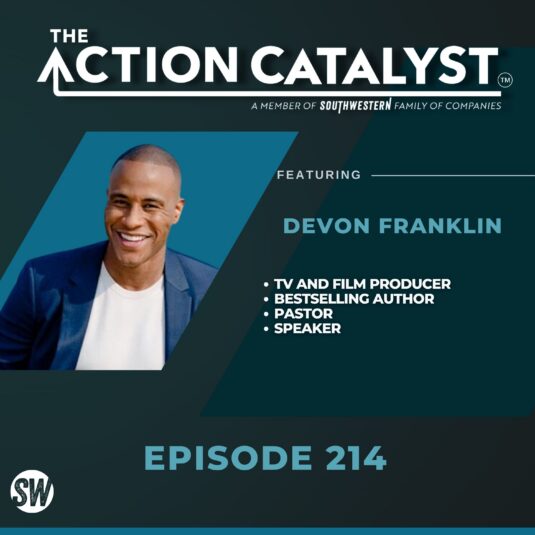
DeVon Franklin—Hollywood producer, New York Times bestselling author, and leadership expert—shares powerful lessons on purpose, faith, and high-performance success in business and life. Franklin explores how aligning personal values with professional ambition creates sustainable success, emphasizing discipline, patience, and consistency as critical drivers of long-term growth. He highlights the importance of overcoming fear, maintaining integrity under pressure, and trusting timing in career advancement, while offering practical insights on leadership, decision-making, and resilience.
About DeVon:
DeVon Franklin is an award-winning film producer, New York Times best-selling author, and motivational speaker, and he is committed to uplifting the masses through entertainment.
DeVon has quickly become a force in the media as well as a leading authority on inspiration, spiritual wellness, and personal development.
Variety Magazine named him one of the “Top 10 Producers to Watch,” Ebony Magazine has distinguished him as one of the “Top 100 Influential African-Americans in America,” and Oprah has called him “a bonafide dynamo…a different kind of spiritual teacher for our times.”
DeVon serves as President/CEO of Franklin Entertainment, a dynamic multimedia entertainment company. DeVon produced the hit inspirational film BREAKTHROUGH starring Chrissy Metz for Disney/Fox, the hit Sony Pictures Animation animated film THE STAR and the hit Sony Pictures film MIRACLES FROM HEAVEN. Along with his work as a producer, he is also the author of multiple best-selling books including THE TRUTH ABOUT MEN, THE SUCCESS COMMANDMENTS, THE WAIT (co-written with his wife actress Meagan Good) and PRODUCED BY FAITH.
He sits on the Board of Governors for the Academy of Motion Pictures Arts & Sciences and he lives in Los Angeles with his wife, Meagan.
Learn more at DeVonFranklin.com.
The Action Catalyst is presented by the Southwestern Family of Companies. With each episode, the podcast features some of the nation’s top thought leaders and experts, sharing meaningful tips and advice. Learn more at TheActionCatalyst.com, subscribe below or wherever you listen to podcasts, and be sure to leave a rating and review!
LISTEN:
SUBSCRIBE TO OUR RSS FEED: https://feeds.captivate.fm/the-action-catalyst/
SUBSCRIBE ELSEWHERE: https://the-action-catalyst.captivate.fm/listen
__________________________________________________________________________
(Transcribed using A.I. / May include errors):
Host
If you haven’t met DeVon Franklin or heard of him, his story is incredible. He’s a Hollywood producer, a minister, New York Times bestselling author. Will Smith said this about him. He said, in the 20 years I’ve known Devon, he’s lived his life in the same way that he makes his movies, with commitment, humility, and a work ethic that demands respect. Devon, welcome to the show, man. Thanks for being here.
DeVon Franklin
Oh, man, thank you so much for having me. Honored to be here.
Host
Yeah, one of the very first things I saw when I started watching some of your videos and things, you said your discipline contributes to your destiny, so how did you come up with that, and like, you know, give us a little context for that.
DeVon Franklin
Yeah, you know, I really, really believe that. I mean, I came up with it because I’ve had to live it, and you know, I’ve been in Ali, with, you know, worked my way up from unpaid intern to now being a producer and running my own company, and it is the discipline that has created the path for me to be successful, and I think that the discipline is required for anyone endeavoring to live in their dreams and achieve their purpose, because sometimes you know we overlook it, and I believe so many times people aren’t reaching the level of satisfaction they want in their life, not because it hasn’t been ordained for them, but because there may be an area of their life which they need to employ more discipline. I mean, you know, starting as an intern, you know, I started getting coffee and running errands and picking up lunch orders and copying scripts, and and doing the filing and doing the faxing. There was nothing glamorous about it, and it really required discipline. I mean, the thing I wanted at 18 years old was my own production company, and I had come from the Bay Area to Los Angeles to go to USC and pursue the dream of Hollywood, and ultimately having my own company. And it took 18 years before I actually was able to achieve that goal, and that required a tremendous amount of discipline, not only personally but professionally, because I believe what you do personally shows up professionally, and that just require a lot of sacrifice. It required a lot of focus, and every day committing to that day, doing the work, showing up, doing my best to be of service, and trusting that eventually, over time, the very things that I were was working towards would happen, and they did happen.
Host
You were talking about taking care of people’s assistants. Can you just share a little bit about how you feel like that contributed to that journey?
DeVon Franklin
Yeah, you know, my philosophy, I mean, first of all, I didn’t start a movie set, I think that’s the, that’s the thing that you know, some people look at Hollywood, like, oh, you know, again, glamorous, no, not at all. I started in the office, and I was working as an assistant, I mean, as an intern at the company that managed Will Smith, and you know, looking after those assistants, I mean, that was my daily job, was, you know, I went to the assistants, I asked them, you know, what work do you need done? And I would go around each assistant, I would get their filing, I would do their filing, I do their faxing, I would go and get their coffee orders, I would go and grab their lunch, and I just made myself indisposable to them because they were the ones that were really the gatekeepers, they were the ones that were in the flow of information, they had access to the town, they had access to the principles, and so I, you know, befriended all of them, and to this day, two of my closest friends I met when I was an intern, and they were assistant, and you know, we still hang out and are a big part of each other’s lives, and so we sometimes misjudge who’s important and who’s not, and based upon who we don’t think is important, we may, we may adjust our behavior, but I believe that that’s not what we should do. We treat everybody equally and be of service to as many people as we possibly can, and that has served me well, because some of those assistants went on to, you know, run production companies and work at networks, work at studios, and so people remember how you treated them on the way up. People remember how you treated them when they didn’t think that you may need them, and so I think anyone out there, you know, listening, it’s like, please let’s not modify our behavior, let’s treat everyone with respect, let’s try and meet everyone’s needs. Me and I have no doubt that that’ll be a main asset to your career, you know, having been in Hollywood, you know, there’s a lot of things in the secular world and environment that people of faith can learn from, and there’s a lot of things in the spiritual world that people in the secular environment can learn from. I have actually found that they complement one another quite well. One of the things that I have found, especially people of faith, there has been this fear of even feeling like the, you had the permission to go after secular success, and no, you can go do it, and you should go do it, and here’s why you should go do it, and here’s how you can do it in a way that will enhance your faith, not require a compromise of your faith, not only is it possible, it’s, yeah, it’s doable, it’s done, it’s happening, and I think what happens is we think, oh, you know, Hollywood has greater temptation, and we kind of look at Hollywood at the expense of looking where we are. I don’t believe that. I believe that no matter where we work, depending on our ambition, we are tempted based upon what we want, so if you’re in a career and you want to move up, then you’re tempted to figure out how to do that, and sometimes it can come – you can make, you may make that choice at the expense of what you believe, at the expense of who you truly are, at the expense of your personality, and so I don’t think that the temptations are any greater in Hollywood than in any one particular industry.
Host
You know, I think there’s a part of coming from the spiritual angle, you think, oh, I have to be sort of soft, I have to be, you know, like I just be kind and humble and graceful, right? But you talk specifically about negotiation, so can you give us a little bit on that?
DeVon Franklin
Yes, definitely. I mean, you know, I see so many people, you know under negotiate because they don’t first identify their value. One of the things that relates to negotiating and understanding your worth is just first and foremost coming to a realization that you are worthy, that you create worth, that you create value, and that you deserve to be compensated for that, and that may seem super simple, but there are so many people that I’ve come across that I’ve, you know, coached, and that I’ve given advice to, where that was the one thing they were overlooking. So, as a result of not really coming to a place of saying, you know, what, I am valuable, I do create value for my organization, I am war, I am creating work, and I deserve to be compensated for that, because they weren’t doing that, they were downplaying then the negotiation, and they were lowering what they feel like they should be compensated for. So, to get what you negotiate, not with your work, you first have to have to come to the recognition, yes, I am valuable, and this is what I, this is what I create. The second thing that then has to be done is to not assume that where you work is going to take care of you. The organization, the company, is interested in the company. They have the company’s best interest at heart, number one. And as a result of that, they’re always going to look out for the company. Now, in a negotiation, the company can get a win, and you can get a win, but you must know that you have to be an advocate for the value you create in order to get the win for yourself, and the other part that’s important that I talk about is you have to define what compensation is. I believe that compensation is more than just money, you know. Compensation can be lifestyle, compensation can be, hey, you know, I want to get home by 6o’clock to take care of the kids. Okay, can I factor that in to how I do my job? And companies can get really creative when it comes to compensation, and when they want to keep you, and the other part, when it comes to negotiating, is you have to face your fears head on. So often people are afraid, oh, I’m afraid, but what if I ask for this and they say no, or they get mad? No employer is going to get mad at you for having a high view of the work you create. They may not see it the same way, and that’s okay, but don’t be afraid to ask for what you believe you’re worth, and then advocate in order to achieve that, and having been on the short end of having had a negotiation when I was an executive, and I did not advocate for myself, and I accepted something less than the value, and I had to live with that for years. I said, okay, never again, never again. And when it came time to renegotiate, I certainly made sure that I got what I believed I was worth and got the compensation I was looking for. Now, what happens is, when it comes to negotiating for ourselves and it comes to advocating for what we want, being an advocate for yourself is not arrogant. Telling a company. Hey, here’s what I’m worth. Here’s what I create. That’s not arrogant. There is nothing in that that lacks humility. When we begin to eat our own praise, when we begin to say, oh, it’s because of me that this, this, and this, and this, then it’s like, okay, that borders on arrogance. But when it comes to being an effective negotiator and advocate for the value you create, that is, I believe, exactly what God wants us to do, because when we are in business, when we are operating in our purpose, we do deserve, and we do have the right to be to say, you know what, this is what I want, this is what I believe God is asking me to ask for, and I am going to be an advocate for myself, because if I’m not an advocate for myself, who else is going. Be an advocate for me, and I do believe that faith without works is dead. That means faith with works is a lie. And too often, when it comes to negotiating, we just say, “Oh, God will take care of you. Well, maybe God, the way He wants to take care of us, is He’s given us the ability to be effective negotiators. He’s given us the ability to advocate for what He’s already called us to go for. We have not, because we ask not. Life and death in the power of the tongue. So I do believe that effectively negotiating is not against humility. We negotiate understanding God is in control, and He has given us the ability to advocate for what we believe we are worth.
Host
You talk about your prayers alone aren’t enough, and there’s a little more to it than that. So, what’s your philosophy there?
DeVon Franklin
Yeah, I believe that too often we pray, and we don’t do prayers alone aren’t enough. And I do believe that we should be praying and preparing. You gotta pray, and then we get up and we prepare for what we just prayed for, because too often we pray, and I believe that prayer sometimes we use it to mask our fear, because a lot of times we are afraid to actually go after what we believe God has put in our heart. So, as a result, we say, oh, I’m praying on it, I’m praying on it. Okay, that’s fine, pray on it, but you got to also go do, you got to take steps of faith that align with what you just prayed. If somebody says they’re, you know, if you invite someone over your house and they RSVP, and they say, ‘Oh, yeah, I’m coming. So, what do we do? We clean up our house. Why? Because we expect the person to arrive. We have to treat our prayers the same way. We expect God to answer. So, as a, as an, as an act of expectation, we get ready, and this preparation thing is so important, because I do see so many people of faith that have the prayer part down, but their preparation is not where it needs to be, and if God were to answer our prayers when we are unprepared, we would squander the blessing when it arrives. So I do believe firmly that that this, and again, this is a mixture of the spiritual and the practical. So, I pray, and then I get up, I go to work, I get there on time, you know. I do, I’m of service, I meet the need of my colleagues and my boss, whether I like them or not. My feelings about who I work for should not determine the quality of my service or my preparation.
Host
I think that’s a powerful concept, and when you, when you talk about your differences, your destiny, can you kind of like tie all that together for us? Like, what does that, what does that mean exactly? And then, and then also, how do I know what my difference is?
DeVon Franklin
How do I, I mean, look in the mirror, you know, the difference is actually the easy part, because none of us are the same, even if you’re twins, you’re not the same. There’s something different about you. So, I think the difference part is actually the easier part. I think sometimes embracing the difference is the hardest part. You know, having grown up as a middle child, and you know, of three boys, and have never really felt like I completely fit in, you know, and also, you know, some people in the spiritual world say I’m too secular, some people in the secular world say I’m too spiritual. So it took a lot of courage for me just to say, you know, I have to own who I am, I have to own what makes me different, and believe that that is going to be enough. And having navigated my career owning that difference, it is easy. It’s not easy. It’s hard, because it’s painful, you know. Because a lot of the time you’re alone, you know, you’re charting a course that others have not gone down before. And we all have a need to want to be accepted, and sometimes we have to sacrifice that need for acceptance, because acceptance, in some instances, would require us to forfeit what makes us different just to fit in, and having had those moments, and having seen the benefit of owning difference, I do believe that all of us are created to make an impact in the world, and I do believe that that impact is directly related to our difference, what makes us think different, how we look different, how we create different, you know, all of our purposes, you know, are different to a degree. Our passions are different, talents are different, and that’s what makes the world the incredible place that it is. And I think that’s the highest testament to God of honoring that difference and honing that difference as a way to say, God, I love how you created me, and I don’t want to change who I am, and I want to harness the full power of who I was created to be, and I do believe our difference takes us to our destiny, because we all were uniquely suited to do something in the world, and it’s our difference that will help us get there, not exchanging what makes us different, what makes us common, you know that that is a sure way to never operate in the fullness of our of what we were created to do, and so this idea of different, it, we have to identify it, we have to hone it, we have to embrace it, we have to hold on to it, and again, not easy, but absolutely worthwhile, because in the end it will pay off when you look at the people who have made the greatest impact in the earth. They are the ones who have owned their difference, even at the expense of people talking about them, people saying they’re crazy. They owned it, and as a result, the world is better for it.
Host
Devon Franklin, my friend. Thank you.
DeVon Franklin
Thank you so much. Really appreciate it.
0 Comments