
Building Your Personal Brand, with Chris Dessi – Episode 167 of The Action Catalyst Podcast
- Posted by Action Catalyst
- On November 9, 2016
- 0 Comments
- author, Business, company culture, entrepreneur, leadership, marketing, personal brand, social media, success
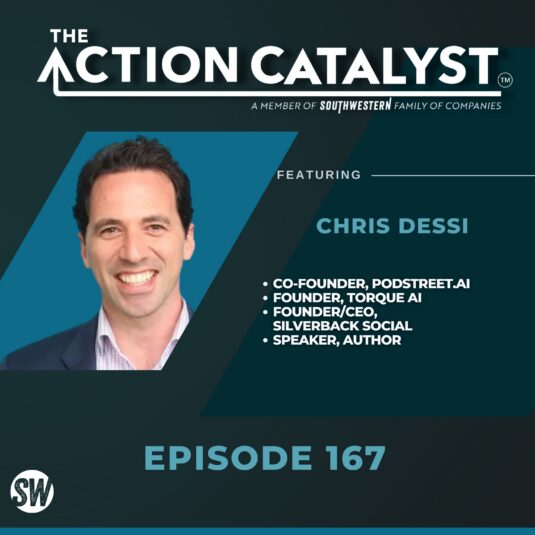
Chris Dessi, CEO of Silverback Social, author of “Remarkable You”, TEDx speaker, and Inc. columnist, shares practical strategies for building a powerful personal brand that accelerates career growth, increases professional visibility, and strengthens organizational impact. Drawing from his own journey from sales executive to entrepreneur, Dessi explains how content creation, blogging, social media marketing, and thought leadership can help professionals establish authority in their industry while remaining aligned with their company’s brand. He also discusses the intersection of personal branding and corporate culture, the role of authenticity in digital marketing, and why vulnerability is a critical leadership skill for entrepreneurs and executives.
About Chris:
Chris Dessi is not a consultant who studied AI. He’s an operator who built Silverback Social from the ground up and sold it. Before that, he was part of the leadership team at Buddy Media — which Salesforce acquired for $1 billion. He knows what it costs to make payroll when you’re not sure it’s going to clear, and what it feels like to lose a key client on a Friday and face your team on Monday.
He founded Torque AI because he was exhausted watching smart companies stall out on AI adoption — not from lack of tools, but from lack of a real system. Torque is the 93-day implementation partner for executive teams who are done debating and ready to build.
He also produces and hosts AI Summit NYC and is a Founding Partner of the NY AI Alliance. He holds an Executive Certificate from MIT Sloan, MS from NYU, and BA from Loyola, and keynotes in 17 countries.
Learn more at ChristopherDessi.com.
The Action Catalyst is presented by the Southwestern Family of Companies. With each episode, the podcast features some of the nation’s top thought leaders and experts, sharing meaningful tips and advice. Learn more at TheActionCatalyst.com, subscribe below or wherever you listen to podcasts, and be sure to leave a rating and review!
LISTEN:
SUBSCRIBE TO OUR RSS FEED: https://feeds.captivate.fm/the-action-catalyst/
SUBSCRIBE ELSEWHERE: https://the-action-catalyst.captivate.fm/listen
__________________________________________________________________________
(Transcribed using A.I. / May include errors):
Host
Chris Dessi is the CEO of a company called Silverback Social. He’s a columnist for Inc. He’s a TEDx speaker, and he’s the author of a couple books. And I’m excited. So, Chris, welcome to the show.
Chris Dessi
Thanks so much for having me. Honored to be here.
Host
So, can you kind of give us the definition of exactly what is personal branding?
Chris Dessi
Sure. You know, I think for a lot of different people, it means different things. But for me and for my journey, what it meant was the idea of stepping out into the sort of proverbial world and saying, “I’m an expert at what I do, and being able to be discoverable to the people in my vertical as said expert, and the reason why that became my definition is because I was a director of sales at an ad network, and I started this personal branding journey simply because I was ambitious. I was a director of sales that wanted to be a vice president of sales, and I loved my boss. I didn’t want to take his job. He was the VP, and I realized that the only people that knew how good I was at my job were my clients and my boss, and that was a problem. This became a limiting factor in my career, my well-being, and in my life, I was newlywed. My wife was newly pregnant, and I wanted to buy a home for her in a bucolic suburb of New York. We were living in a tiny studio apartment, so I needed to take action. I needed to do something drastic and do something definitive. And for me, at that time, the first step in personal brand building was creating a blog.
Host
There is this explosion of personal branding, right? And and now everybody is an expert. Social has given us that power, but I think the conflict is coming that protecting the brand of a company is really critical. Do you think that it’s possible for people to have a personal brand and still work inside of a larger company brand?
Chris Dessi
I do, and I think the the executives that we work with at larger enterprise entities do come to us with like you know wringing hands with that concern, saying I’d like to build my personal brand, but I also work for an organization that has a definitive brand zeitgeist, if you will, that I don’t want to deviate from. I am on the you know X Y X brand train. I don’t want to get off the X Y X brand train. I’d like to just say that I am an expert alongside or within my brand, and I think that that’s where people get confused. It’s almost like when people initially flinch about social media that really don’t understand social media. The reason why they flinch is because they think of the Facebook icon, they think of the Twitter icon, they think of Snapchat, they think of the Kardashians, they think of you know the first reaction I’ll get from executives that don’t want to do it is who cares what I had for lunch, and I need to take a step back and say, listen, I understand your concerns, but I have an undergraduate degree in psychology. I have a master’s degree in direct marketing. What we’re going to be doing when it comes to personal brand building has nothing to do with posting pictures about your lunch, unless in fact, you know, unless of course you run a food services company, and that’s definitively appropriate. You know, the personal brand building is going to be about content generation. It’s going to be about video content. It’s going to be about custom, unique content for each social platform that’s going to be paced out over an appropriate time period. That’s going to be associated with a content calendar. That’s going to have a definitive ROI and a track back to performance-based optics that are going to be associated with key performance indicators for your organization. This is not going to be willy nilly. There’s going to be a strategy here, and there’s going to be a definitive focus on achieving something. Now, the pushback when somebody says you can’t have that within an organization, if those, if the strategy and if those different notches up the belt as you climb that ladder are definitively in line within the organization. What happens is it amplifies everything. It is definitively compound interest, right? We’re talking earlier where I said he had a quote that I thought was fantastic, where he talked about automated marketing is to marketing what compound interest is to finance, and I think similarly when it comes to personal brand building, when executives within an organization are building their personal brand, if done properly and if done synergistically with the strategy and the vision and the values of an organization, can only amplify it and buoy everything that’s happening. So when one executive has five social profiles that are all articulating that executive’s expertise, but back. Linking to the organization, what do you have? You have powerful backlinks that Google is saying, “Wow, this is not a this is not a bot. This is something that’s appropriate. This is being updated weekly and or even daily. So this content is of value. I am going to then reference that organization higher than every other organization. All of that is good if it’s done properly.
Host
Yeah, it’s interesting you say that because what I feel like we have right now is we have this sort of divergence where you got people like, okay, I’m I’m drinking the Kool-Aid of the company, I’m like fully like on the ship, and then you have this the sort of like rebels going, you know, the heck with corporate America. I’m starting my own blog and I’m going to have my own thing and and I you know I’m going to do that.
Chris Dessi
So so so I I didn’t mean to cut you off. I’m sorry. I’m going I’m going to go the I’m going to go the opposite direction. I’m going to look at it from different optic. Okay, I’m going to say that that’s fantastic because if in fact within your organization there are people that are on the tertiary edges of leaving your organization anyway, and by building a personal brand, they’re going to jump ship. Good riddance, get rid of them. Build that culture so that everybody is in lockstep and and and and allowing for that. If in fact that’s your culture, if your culture is your Tony Shay and you’re out at Zappos and everybody is unique, I don’t know if you’ve been to Vegas and you’ve toured their their factory, but I’ve been lucky enough to do it. And every person, every individual at Zappos is definitively an individual. And I I bet Tony Shay would be like, yeah, man, build your personal brand, be the renegade, you know, go be the outlier and do that. If if it’s if those people that are building their personal brand are are sort of articulating themselves as outliers in your organization, then you’re just expediting a process that might take two, 510, years. That’s going to cost your company money by keeping them underneath the roof of your organization. So, are there any other things that you think, like in terms of reasons why companies are afraid of personal branding and maybe why they shouldn’t be? I think they’re afraid of personal branding because they don’t want to be outshone by their executives, and I-I mean, I feel at this point that organizations are figuring out that social media is not the bane of our existence; that it can be exceptionally powerful. And frankly, for some organizations, it doesn’t work. For some organizations, it’s not appropriate, and for some organizations, people building a personal brand can be a detriment. I’ve worked extensively with financial organizations writing their social media and privacy policy so that you know it limits that activity, and they don’t want their executive speaking because what their executives say could potentially sway markets, and that could be a very, a very powerful and bad thing. So they don’t want to do that. But really, what happens is when the organizations understand that they can deal with content marketing, and what I mean by content marketing, if people don’t understand, I’m just blog content, LinkedIn blogging, corporate blogging, allowing for the executives to have a voice. You can curate that content. You can have an internal HR, PR, social media, digital executive be the curator of interviews of executives, and you could feature and profile those executives to build their personal brand profile. But perhaps it’s not them generating that content on a regular basis that is definitively curated from the organization that’s in lockstep with a definitive marketing plan. We do that for many larger organizations that have you know very strict parameters, we just say okay, give us your top 10 executives, and we will interview them, and we will create a structure and an outline for the blog posts, and then we will backfill that with certain content, and then we use that as the content marketing strategy moving forward. The content marketing strategy and the personal brand building can all be interwoven and all connected in order to deal with a beautiful marketing strategy, overarching marketing strategy.
Host
Yeah, isn’t there a risk of having your executives be branded? I mean, that’s a very legitimate concern, right? Is that the CEO, like if you’re Tony Shay, you become branded and then you leave Zappos? Is that something that? What’s your opinion on that?
Chris Dessi
Yeah, you should be concerned about it, but it’s just the way it is. I’ve lost executives at Silverback because I’ve buoyed them and they’ve done an exceptional job and they’ve left. And guess what? They left on great terms. And I gave them a big hug and I was like, “Wow, congratulations! You got to that other organization. And they essentially used their you know what they were learning at Silverback and and where they’re being featured at Silverback as a stepping stone for them, and I think that that’s great. And I think it’s our job as heads of organizations, right? Like you’ve got a few 100 employees or people that are that are working in lockstep with Southwestern to make sure that we’re giving them the the tools, the infrastructure, and the the systems in place so that they don’t leave, and it is something that we need to be concerned about as modern business owners. But I think it’s a good thing. I think it makes our organizations better. It makes us more attentive to the people. It makes us less likely to feel like those people are cogs in a machine. That they’re actually human beings that have needs, wants, feelings, desires. And vision and aspirations, and they are, you know, they want to do more than what they’ve just been given on their plate. That they want to stretch their goals. I think that these are all great things. And if all it is is an organization has to take a closer look at its own corporate culture and own corporate identity, well, then that’s just the way it is. And too bad, you know. Keep doing that. And I got to tell you, the smartest large organizations, and I’ve been very lucky to deal with a few of them, like a handful of them. I, you know, I produce an event, and at the event, it’s a it’s a brick and mortar live event, and we curate speakers to come to the event, and largely we try to get speakers from the client side. We don’t want anybody pitching agency stuff. We want people from Mastercard, from General Electric, from IBM that are talking about their experiences. Now, what happens when you put those people on a stage? Those people that are going to be on a stage are going to have a Twitter following, and that Twitter following is going to be largely influenced by what those people say on stage. And those people are going to have to cultivate that Twitter following. And guess what? Then they’re going to have a public-facing Facebook page. Then guess what? They’re going to have their own personal blog, and they’re going to write about their own opinions, even though they work for an IBM or a GE or a Mastercard. And those people, frankly, become the most interesting, the most compelling people. All of those people become the people that I use as my sort of north star of marketing understanding and marketing ideas, and who would have known, you know, 20 years ago that I would have access to a high high-ranking executive at General General Electric, where I could just, you know, log into a Twitter feed and see where she’s speaking at the next conference to hear what her thoughts are about about whatever is happening that day. I think that that’s a wonderful thing for GE, and that’s the best thing for GE, and they should continue to do that.
Host
So, the book again is called “Remarkable You: Build a Personal Brand and Take Charge of Your Career”. Can you just talk to us a little bit about what are some of the core things that people can be doing to to really build their own personal brand, whether that’s part of a company or it’s on their own?
Chris Dessi
I mean, listen. I could go through the steps for the core things. I’m going to back up. So the reason why I wrote the book, maybe that’s where we’ll start. The reason why I wrote the book is I’m lucky enough to speak to audiences every once in a while about social media and digital marketing, right? And I would get off stage, and people would say, “Wow, that sounds really interesting, but I don’t know where to start. I have nothing to say, and I’m not really sure what to do. So I went about trying to create this sort of insulated process where nobody had any excuses anymore. So I was kind of coming at it as part motivational, part kind of smacking people in the back of the head, and part saying, “Hey, you wouldn’t be at this position in this organization if you didn’t already understand what you’re doing really well. Like you wouldn’t be upper management if you weren’t really good at something and didn’t have something to say about your industry. So let me tell you my story, and I just talked about my being, you know, motivated to continually climb up the corporate ladder, and then I was able to say, okay, great. So here’s step one: get introspective. Step two: start a blog, first name last name.com because of SEO capabilities and the the ability of sort of squatting on your name. So after 20 minutes, when you’ve launched the blog, then we can continue to talk. After you’ve become introspective, think about some of the things that you’re good at. Think about some of the things that you’re passionate about, and start writing content from there. Now, that’s just the the the at the core of the book. The other tertiary things become all right. How do I go about writing a compelling headline? Well, you might want to use CoSchedule’s headline analyzer. How do I go about becoming a better writer? Well, you might want to install the Hemingway app so that you become a better writer because it’s called the Hemingway app because instead of writing at 12th grade a 12th grade reading level, we really want to write at a fourth grade reading level. We’ve all been lied to, right? We want to write you know Hemingway because he wrote Old Man in the Sea at apparently a fourth grade reading level. So these are the different tools that I use in order to curate that curate and generate that content, and those are the recommendations. And then once you start doing that, it’s almost like taking baby steps to creating this this definitive vision of what you are as a personal brand. So if you envision yourself as a vice president of sales and you’re a sales manager right now, what are the steps that you need to take? Well, you need to prove that you’re good at prospecting. So we’re going to generate content about prospecting. What are the ways that you go about prospecting, and then that becomes your content calendar for the content that you start to create, and then you go from there because it’s all about taking that first step. So that’s really, you know, without going through here’s step number one, step number two. That’s the general energy behind the book, and it is small. I did that on purpose. I wanted to make it a quick, you know, general read to just get people thinking and say, “Hey, I am remarkable. There is something about me that’s remarkable, and and to be able to go out and share that with the world because we’ve all got something appropriate to share with the world.
Host
Something that’s very powerful, the word is vulnerability. Can you just like talk to us a little bit about why does that matter to you, and why is that important, and how does that apply to personal branding?
Chris Dessi
Sure, I think it applies to personal branding because it applies to life. But I think you nailed on something earlier where you’re kind of like, you know, everybody can can be an expert, and I think it probably born from that is that you know guys like you and I who’ve kind of put in our our probably our 20,000 30,000 hours instead of 10,000 hours. Really, kind of you know been out there and and and done the work. You you get a little frustrated when you get other guys coming in and saying you know oh I’ve done I’m this I’m that and you’re kind of whatever. So I decided to go the opposite route. Instead of pounding my chest and being boastful, I went pure raw, and I said, “Okay, I’m an entrepreneur, but I wasn’t a born entrepreneur. I became an entrepreneur because I got fired. And when I got fired, I couldn’t speak. When I got fired, I was probably having a panic attack when it happened because I was so surprised. And when it happened, I was terrified because I had a wife and a mortgage and kids and you know one little girl and another beautiful baby girl on the way, and when I started writing about that, and I started talking about my truth and what I was really going through, and not to be you know a Debbie Downer or depressive, but just to be like, listen, this is the real stuff. This is really what goes on. It’s not all models and bottles. It’s not you know being an entrepreneur. It can be a grind. It can be brutal on your family. When I started doing that, I saw this really beautiful backlash of warmth and affection and acceptance from other entrepreneurs that were like, “Yeah, man, you know, rock on, keep keep spitting truth, you know, that type of a thing. And when I was given the opportunity to deliver, it was a TEDx talk, not a TED talk, to be clear. TEDx are locally curated events, so this is not like I was invited to the TED stage. But when I was given that opportunity, they approached me to talk about social media because that’s what I’m known for: digital marketing and personal branding. And I sat with my wife, and I really got introspective about it. And I said, you know, I do. I’m lucky that I do a lot of public speaking, that I’ve done a lot of television appearances, and I’ve written some books, but I’ve got two little girls that are eight and five, and I think I think I might be wrong, but I think the TEDx talk might be around for a while. So, what is the message that I want to communicate to my daughters? And I and I went about like really kind of trying to figure out what that was, and I can’t. I landed on vulnerability because I really feel that whether it be in business, whether it be in personal relationships, whether it be in romantic relationships, that the moment that we remove our masks and allow for our true selves to be out there, beautiful things can happen. And I think that it’s the concern that I do have as a guy that’s in social media and digital marketing is that sometimes we put up these very well constructed, almost too well constructed facades of bombast about our success and about how wonderful our lives are. When it might not necessarily always be that way, and that we would find truer, deeper, more meaningful, and more beautiful relationships. If we would all just take a step back and allow ourselves to be more vulnerable, and that’s what the talk is about. I’m very, very proud of it. I tell a few different stories. I talk about my daughters. I talk about my friend Sean Lugano that was murdered on September 11th. I talk about my father who passed away from ALS, Lou Gehrig’s disease, and frankly, it’s the sort of maraschino cherry on my career that I am feel very fulfilled in my heart that I that I did it and I did it the right way.
Host
Well, Chris Dessi, Chris, appreciate you being a beacon for vulnerability and an ambassador of vulnerability in the world, and for sharing some of that here.
Chris Dessi
Thanks.
0 Comments