
Are You Fully Charged, with Tom Rath – Episode 185 of The Action Catalyst Podcast
- Posted by Action Catalyst
- On March 15, 2017
- 0 Comments
- author, Business, cancer, CEO, energy, entrepreneur, fully charged, happiness, health, meaning, motivation, performance, productivity, sleep, success
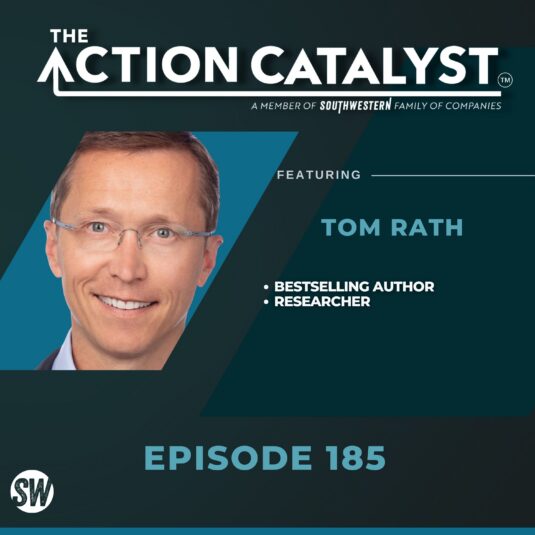
Bestselling author and researcher Tom Rath shares insights from his book “Are You Fully Charged?” on how to improve performance, well‑being, and engagement at work and in life. Rath explains that meaning—not happiness—is the key to fulfillment, emphasizing that focusing on helping others, leveraging strengths, and connecting daily work to a larger purpose leads to higher productivity and better outcomes. He explores how personal energy, including sleep, movement, and health, directly impacts cognitive performance, leadership effectiveness, and workplace success, while warning against the dangers of distraction, especially from smartphones, which reduce attention and relationship quality. The episode also highlights how emotions and behaviors spread through social networks, influencing teams and organizations, and why leaders must prioritize well‑being and purpose to build stronger cultures.
About Tom:
Tom is an author and researcher who studies how careers impact health and wellbeing. He has written 12 books that have sold more than 10 million copies and made hundreds of appearances on global bestseller lists.
Tom’s first book, How Full Is Your Bucket?, was an instant #1 New York Times bestseller. His book StrengthFinder 2.0 was listed as Amazon‘s top-selling non-fiction book of all time. Tom’s other bestsellers include Strengths Based Leadership, Wellbeing, Eat Move Sleep, and Are You Fully Charged?
Tom is currently co-founder and CEO of CareerSight. He previously led Gallup‘s workplaces business and served as a Senior Scientist. Tom was also a Vice-Chair of the VHL cancer research organization. He is a graduate of the University of Michigan and the University of Pennsylvania, where he has also been a guest lecturer.
Learn more at TomRath.org.
The Action Catalyst is presented by the Southwestern Family of Companies. With each episode, the podcast features some of the nation’s top thought leaders and experts, sharing meaningful tips and advice. Learn more at TheActionCatalyst.com, subscribe below or wherever you listen to podcasts, and be sure to leave a rating and review!
LISTEN:
SUBSCRIBE TO OUR RSS FEED: https://feeds.captivate.fm/the-action-catalyst/
SUBSCRIBE ELSEWHERE: https://the-action-catalyst.captivate.fm/listen
__________________________________________________________________________
(Transcribed using A.I. / May include errors):
Host
Tom Rath is pretty much in a world all of his own, and if you don’t know, Tom used to be a senior scientist and advisor to Gallup, which is where a lot of his work started. One of the world’s leading thinkers, I think. And so, Tom, welcome to the show.
Tom Rath
Thanks so much. It’s great to be talking with you today.
Host
Why, why do you think so many people are struggling to find the meaning in their work today?
Tom Rath
You know, it’s a great question. That top of mind for me is the fact that one, I put a little bit of the burden of that on each of us as individual workers, where you know we get more focused on happiness and kind of separating out work from family instead of thinking about a more integrated mission and picture. So that’s on the individual side of it. On the corporate side of it, you know, it’s easy to get conditioned to where you’re looking at responding to quarterly demands, near-term demands, and companies don’t get as focused on the contribution they’re making to the lives of employees. I mean, I think if you were to really step back for a moment and say, why are people part of organizations? We all, I mean, two entrepreneurs get together in the first place because they think if they join heads that they can do more together than they otherwise could apart, and that assumption, in my opinion, should kind of be baked into every intention and conversation as organizations grow larger and larger, but yet it’s hard to yank ourselves back to say, yeah, I mean, let’s say you’re a company that is in food service, for example, if you have people who are preparing food each day and they never get to see the face of a satisfied customer who’s eating the food they’re preparing, they don’t make food that’s anywhere near as high quality statistically, when people study this, and the customers aren’t as happy, because they don’t, they don’t receive the higher quality food, and so we’ve got to find little ways just throughout the day to connect what we’re doing with why we’re doing it, if for no other reason, because if we do so, then we do better work, it’s higher quality, and we get more done.
Host
You talk about how, how meaning is one of the keys, one of these, one of the three keys to being fully charged. But what’s the difference between pursuing meaning and pursuing happiness?
Tom Rath
You know, it’s a more important distinction than I would have realized even a few years ago, where you know it seems like there’s this pursuit of happiness that literally the phrase is not baked into the Constitution, and here in the United States, at least, and people spend a lot of time pursuing their own happiness, and many times when people focus in isolation on their own happiness, it actually takes things in the wrong direction, where you get so focused on that it decreases your well-being and the well-being of your family or friends or coworkers and network around you, whereas you know, even if I had a friend who was really struggling and he was having a hard time right now, the first thing I would recommend he do is something directed towards picking up the spirits of another human being, because that’s really the best way to pull yourself up in parallel, is to focus more of your time and energies on the things that you can do for other people, so that’s I think there’s an important distinction there, where meaning is something that you get from doing anything, any efforts for another person, and in theory, that also picks up someone else’s spirits, and it starts to spiral upward and energize the network all around you.
Host
So, staying here on the topic of meaning, you kind of break that one down into strengths, interests, and needs. So, can you talk about why needs matters, and what you, what you mean by that?
Tom Rath
Yeah, you know, it’s there are really some basic needs from a physical and mental well-being standpoint that we just, for example, it can be even be something as simple as if my intent is good as it can be to is to serve other people or to do one specific thing that helps a group of people, I need adequate energy to wake up each morning and be as good as I possibly can for others. So, you know, I’ve spent a lot of time working with both leaders on one end of the continuum and another end of the continuum, hospice nurses who are helping people at one of the most critical times of need in life, and the one thing those two groups, nurses and leaders, really have in common is they’re too quick to put everyone else’s physical needs. When you think about something like sleeping or moving around throughout the day ahead of their own, and as a product they can’t be of as much service to someone at three or 4o’clock in the afternoon because they only got four hours sleep and. You know, you see, you see this in military groups I’ve worked with as well, where there’s this kind of ethic of I’m going to put everybody, everyone else’s needs in front of my own, and that leads to you’re the one staying up until 2am you’re the first one on email at 6am and the challenge is when, especially when leaders do that, that sends the message that that’s the cultural expectation to everyone around them, and not only are they less effective at three in the afternoon, but they have teams who feel like they need to model that type of behavior, and it causes all kinds of problems. There’s a balance there. It’s a good way to think about it, where you need to put your own, I mean, kind of the tried but true example of putting your own oxygen mask on first when you’re on airplane, where you need to make sure you’re meeting your own basic needs and showing others that you value that, and then you can be of even more service to other people in terms of building good relationships, doing meaningful things for people, and it’s just fascinating to me how Nicholas Christakis is the one who’s done a lot of the research on social networks, and he talks about the way he was working as an internist in Chicago back in the late 80s, I believe, and he got a phone call from a guy who was talking about how upset he was because his best friend was really upset, and it turned out that he was calling Christakis because his best friend was the spouse of a woman whose mother was dying, and he was treating as a physician, and he talked about the way four degrees out, so this gentleman he was speaking with, it was his friend, and then it was the daughter of the woman, and the woman who was the one that was sick, but what he realized in that moment was that these, whether you’re talking about something traumatic like that, or you’re talking about positive emotions, or you’re talking about obesity, they spread all the way out to three or four degrees in social networks, and so if, if one friend of yours all of a sudden becomes depressed, becomes obese, becomes a lot happier that reverberates out pretty quickly, and you can measure statistically the influence out to three degrees.
Host
That’s amazing.
Tom Rath
It’s remarkable. Yeah, we don’t, we kind of take for granted these little interactions with people each day, where I’m sure if I say, if I say the term that’s kind of people been researching lately, secondhand stress, there’s probably one person in all of our lives that comes to mind where we know what the scientists are talking about, in terms of if we find ourselves around that person more often, and they continually stress us out, that stress carries over to our spouses, to our children, to our coworkers pretty quickly, and we got to think about that consciously, so that we can, if nothing else, protect the people we care about.
Host
You talk about iPhones, and you cited this study about the impact that iPhones have. Can you talk us through just a little bit of a recap of what that research said?
Tom Rath
Yeah, and you know, it’s probably one of the, of all the pieces of science that I’ve studied in the last three to five years, that’s the one that’s influenced my own behavior, especially as a parent, personally more than anything else. And the study I was looking at originally showed how the phones have become such a metaphor for where our attention is that if I take my phone out of my pocket, and whether it’s at the dinner table with my wife and kids, or whether it’s in a meeting, I take the phone out my pocket, and even if the thing is powered off, it’s not vibrating, it’s not flashing, it’s not buzzing, like every all of them do. That sends a signal to other people at the table that the phone comes before them, and in most cases, what they’re saying and what they’re talking about, and what they care about, and but that phone comes first, and as a result, just putting the phone that’s powered off on the table in experiments degrades the quality of the conversation for everyone around the table, and so, as I read that, I have been so much more conscious about him. Some of these phones are too big to put in your pocket at times nowadays, but I make sure the phone’s stored away and not visible anytime I’m asking my kids how their day was at school, or I’m talking to someone I’m mentoring about what’s important to them, I make sure the phone’s nowhere near. I don’t want it to send the wrong messages about where my attention is and what I’m listening to, because you know, the more I’ve studied this research, you see it play out in all of our lives each day, I think one of the single most valuable things that, especially a leader or manager, teacher, a parent, can do in the next 10 years might just be asking another person a question, ensuring you keep your mouth closed and genuinely listening to that person’s response. I think, boy, that’s going to have a lot more value as each year goes by.
Host
Okay, so I wanted to talk a little bit just about the energy, because that does come into it. It’s the third kind of key here. And my first question was, just, do you think that most companies are they really concerned with people’s energy performance? Is it that they are, or is it more like they should be, and they’re not yet?
Tom Rath
They should be and they’re not yet. At this simple answer, because you know companies, the way things are set up in the United States, at least in particular, the companies are responsible in most cases for people’s healthcare, at least with large employers, and as a product of that, companies are having all these remedial conversations with employees about how they, they send them through things they call health risk assessments, and have people report back on what are the disease burden areas you need to work on. For example, it’s an important conversation between people and employers, but yet it’s going through this health prevention door, where you couldn’t pick labels that were more likely to scare off employees from that conversation if you got a team of branding experts in the room, seriously, and so it all evolved with the right intentions, everything else, but I think the conversations managers and leaders need to be having with the people they lead and care about is how do we make sure you have enough energy for good performance, and so you have good well-being, and this job sustainable for you, and that’s unfortunately because of all these health-specific topics and insurers and the way things are set up. A lot of managers and leaders are scared to have that conversation, but I would argue that you can’t be fully effective as a leader unless you’re thinking about that, and you see the growth of the person and the development of the person as an end in itself, and they’re just not. If you live, you’re looking at your employees as one more cost to reduce from a healthcare standpoint, a payroll standpoint, it’s the odds of your genuinely investing their development are really low.
Host
So what about sleep?
Tom Rath
Yeah, you know, it’s a good, is a good topic, because most people don’t realize, I think, that you know, if you don’t get seven or eight hours of good quality sleep, you, in many cases, have cognitive impairment that’s equivalent to having a six pack of beer before you show up at work, and it’s, it’s bad for your performance on the job. It’s bad for the quality when people measure quality of work. When you don’t have enough sleep, you don’t remember what you learned the day before, and you’re obviously a poor student that next day, and you have fewer creative ideas. So, the sleep is probably the most underestimated business critical element. I don’t think people are talking about enough. The more I read on this topic, again, back to how you change some things personally, we’ve really made sleep into a family value, and something that I talk about with my kids and with my colleagues, to say, how do we arrange our schedules so that sleep’s something that’s highly valued and rewarded, and I quit sending my kids to bed when they weren’t behaving. The more I started to read about this, because think about the message that sends, where sleep’s a punishment, not something that’s held up as an ideal in a household. And so we’ve got to think about, and I think a lot of us grew up in households, I’m sure that where the last thing you ever do is admit that you needed a whole eight hours of sleep, because it was kind of a badge of honor to say I only need four, and I can still be effective. Maybe for one or 2% of people, they can get away with four or five, six hours and still be okay, but for 98% of us, that’s not going to cut it if we want to be our best.
Host
Talk about sitting, because this was another – this one was another surprise to me, and just I don’t think most people think about this one.
Tom Rath
Yeah, we’ve just got to re-engineer. I mean, we kind of engineered our work lives, at least, so that we can get everything done without having to get out of our chair. You click a button, then Amazon delivers it. You want a printer right next to your desk, and everything else. We need to do the exact opposite and figure out how do we build little breaks in throughout the day that force us to get up to move around, ideally every 20 minutes at a minimum, every hour, because it turns out that even if you follow all the recommendations nationally and you exercise five days a week and you do it for 30 minutes, that does not offset going to work and sitting on your rear for eight or 10 hours each day that causes more health problems and leads to poor performance and productivity and well-being than if you, I mean, I think most Americans, frankly, should worry more about breaking up the eight hours of sitting, and then think about, do you need to exercise for 30 minutes and get the intense cardiovascular activity, because the sitting is a bigger problem based on the work that I’ve studied, and it’s as simple as just, I mean, whether you sit and stand to work every now and then, or set a timer and reminder to get up every 20 minutes, you know, when I spend time speaking to audiences, I’ve realized that I have to do something to get them up and moving around every 15 or 20 minutes, or I could almost guarantee they’re not learning, no matter how compelling content or a person is.
Host
Tom, where do you want people to go to connect with you and learn more and get are you fully charged?
Tom Rath
Yeah, tomrath.org is the most simple place to find all the resources and a lot of studies and references I’ve been talking about.
Host
So, this last little question here, I hope you don’t mind, is. A little bit of a personal question, but cancer is something that you personally have been battling for a number of years, and if there’s somebody out there who maybe is going through some real, real health issue, some type of health crisis, what would you say to them, and how much do these things that we’re talking about here apply and really matter in the face of a major sort of like life and health crises.
Tom Rath
Yeah, you know, the thing I’ve learned through bad battling cancer and my kidneys and spine pancreas all over, for I’ve got a condition that kind of shuts off a powerful tumor suppressor. So I’ve been battling cancer in all these areas for well over 20 years now, and the thing that I’ve learned is there is no cure all yet when you’re facing whether it’s heart disease or cancer, diabetes, but the one thing we do all have in our power is we can make a lot better choices starting today, and those little choices accumulate quickly, and they can dramatically improve our odds of living a longer life and better health. So, there are a ton of things you can do right now to chip away at having better odds, no matter how dire of a condition or challenge you’re facing. And better yet, if you’re healthy today, you can get ahead of those things, so that your odds are so much lower you don’t have to worry about it 1020, 30 years down the road, which is an even better idea.
Host
Well, Tom, my friend, I just want to say thank you. We just appreciate your time, and we wish you all the best.
Tom Rath
Thank you so much. It’s been a fun discussion and an honor speaking with you.
0 Comments