Assess for Success, with Dr. Tony Alessandra – Episode 504 of The Action Catalyst Podcast
- Posted by Action Catalyst
- On June 2, 2026
- 0 Comments
- assessments, author, Business, communication, growth, leadership, performance, psychology, sales, speaker, success
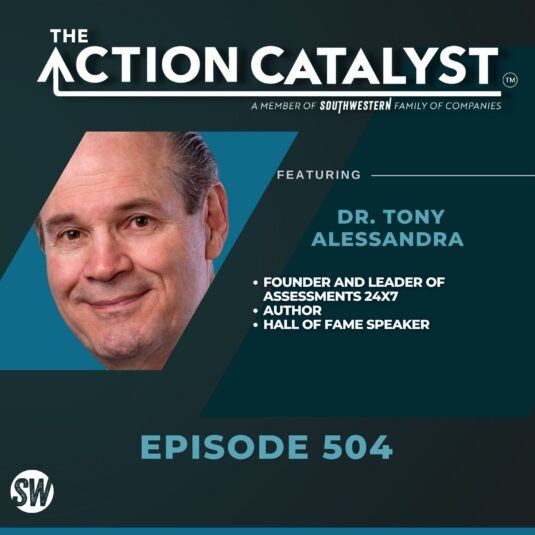
Dr. Tony Alessandra, founder of Assessments 24×7 and a pioneering authority in personality assessments, sales psychology, and leadership development, shares insights from more than five decades in the assessment and training industry. In this conversation, Alessandra recounts his journey from door‑to‑door sales and academic leadership to creating widely used assessments that help individuals and organizations improve communication, adaptability, and performance. He explains how modern assessments drive personal growth, better hiring decisions, stronger leadership, and more effective teamwork, and also explores his creation of the “Platinum Rule”, lessons learned from failure, the importance of listening and adaptability, and why simplicity, practicality, and focus are essential for long‑term business success.
About Dr. Alessandra:
Dr. Tony Alessandra has a street-wise, college-smart perspective on business, having been raised in the housing projects of NYC to eventually realizing success as a graduate professor of marketing, Internet entrepreneur, business author, and hall-of-fame keynote speaker. He earned a BBA from Notre Dame, an MBA from the Univ. of Connecticut and his PhD in marketing in 1976 from Georgia State University.
Tony is Founder & Chairman of Assessments 24×7 LLC, a company that offers a variety of online assessments, including the widely used DISC profile, the Emotional Intelligence 360 assessment, Motivators (Values/PIAV) assessment, and several 360º effectiveness assessments.
He is also a prolific author with 32 books translated into over 50 foreign language editions, including the best-selling The NEW Art of Managing People; Charisma; The Platinum Rule®; Collaborative Selling; and Communicating at Work.
He is featured in over 100 audio/video programs and films, including DISC Relationship Strategies; The Dynamics of Effective Listening; and Gaining the EDGE in Competitive Selling.
Dr. Alessandra was inducted into the:
- National Speakers Association “Speakers Hall of Fame” in 1985
- Legends of the Speaking Profession in 2009
- Speakers.com Top 5 Sales/ Marketing/ Customer Service Speakers 5 times
- Inaugural class of the Top Sales World Sales Hall of Fame in 2010
- Top 50 Sales & Marketing Influencers in 2012
- #1 World’s Top Communication Guru in 2012
Recognized by Meetings & Conventions Magazine as “one of America’s most electrifying speakers,” Tony’s polished style, powerful message, and proven ability as a consummate business strategist consistently earn rave reviews and loyal clients.
Learn more at Assessments24x7.com and Alessandra.com.
The Action Catalyst is presented by the Southwestern Family of Companies. With each episode, the podcast features some of the nation’s top thought leaders and experts, sharing meaningful tips and advice. Learn more at TheActionCatalyst.com, subscribe below or wherever you listen to podcasts, and be sure to leave a rating and review!
LISTEN:
SUBSCRIBE TO OUR RSS FEED: https://feeds.captivate.fm/the-action-catalyst/
SUBSCRIBE ELSEWHERE: https://the-action-catalyst.captivate.fm/listen
__________________________________________________________________________
(Transcribed using A.I. / May include errors):
Adam Outland
Today’s guest is Dr Tony Alessandra, the founder and leader of Assessments 24×7, a global leader in assessment technology operating for over 25 years. Thank you for being here. Do you prefer Tony or Dr Alessandra for the interview? What’s your…..
Dr Tony Alessandra
Tony, Tony.
Adam Outland
Okay, yeah.
Dr Tony Alessandra
New York City, first born Sicilian, so….
Adam Outland
Tony it is. Well, thanks for making time. This is wonderful.
Dr Tony Alessandra
Oh, my pleasure. And correct me if I’m wrong. So how I think I know Southwestern is you were, or still are in the book business. Remember that people used to go around and sell books? So back in 1980 It was either 83 or 84 I had somebody in my office. Her name was Holli, and one summer she went out there and just nailed it, okay, and she came back, and one of my buddies said, You need to look at Holli as a salesperson. She is really, you know? I mean, she really is good. And so I made her a salesperson. She eventually became my director of marketing, as when I was a speaker, full time speaker, and then in 2000 I spun her off into her own business called speakers office.com, and she then she managed me. Jim Cathcart, today, she manages people like Brene Brown and Lisa Ford and, oh yeah, she, she has really built that business.
Adam Outland
Well we have, we have so much, I think, just like that heritage in common in that way, because part of your history, while it wasn’t selling encyclopedias or educational books, door to door, you were, you were knocking on doors.
Dr Tony Alessandra
Yeah, so when I was a senior in high school, you know, we I took the SATs and applied to many, many different colleges. And one of the colleges I applied to was University of Notre Dame, definitely not expecting to get accepted into it. One day I come home from high school, my mother is on the front lawn waiving a letter, and it was my acceptance into Notre Dame. And so I said to my mother, you know, there’s no way we can afford this. My mother said, you know, your father and I have saved enough money for you to at least attend your freshman year, and something will work out. And so I went my freshman year, I came back for the summer, and I was in. I got a construction job. One week into the construction job, the contractor came up to me, put his arm around me, and said, Tony, become a doctor. That was his way of firing me. That night, I went to a party. I met this guy who was on the football team with me. He was a junior. I was a senior, but now he just graduated, and he said, Why not come to work for my uncle? And I said, doing what he said, selling cookware door to door. And the company was called saladmaster. I got the job in nine weeks left in that summer, sold more than enough. I mean, in my commissions, I paid my entire to tuition, room, board, spending money travel, and I did that for three consecutive summers. Paid for all of my college. My parents never had to lay out another penny. And I did find out, while I was selling this cookware, there was another very successful salesperson, selling saladmaster in Texas. Do you know who it was?
Adam Outland
No.
Dr Tony Alessandra
Zig Ziglar. So when I eventually became a speaker, and you know, would tell that story, and I did a tour with Zig in Australia, and we had some good stories to tell about. Him selling in Texas, me, selling in New Jersey. It really was a great experience. It’s interesting. When I first went into Notre Dame, I actually wanted to be a major in mathematics, and when I sat down and the counselor said, you know, I’m looking at all your records and I’m looking at your SATs and whatever. And quite frankly, as good as you are in mathematics, you know, because in the SATs, I was a 99 plus plus percentile. And he said, I really don’t think this is a major for you. He said, I really think business would be a major for you. And I eventually majored in marketing. So, you know, the marketing major, my selling experience, it all kind of fit hand in glove, although I will tell you to this day, my mind is very numbers oriented. I can do mathematics in my mind, very, very, very quickly. But when you get into the higher levels of math, you know, a lot of the math is then put into words, you know, and that my strength was just cranking out the numbers, seeing numbers. So I’m glad.
Adam Outland
Sales skills and numbers. If you got those two things, I think you’re on a good path. So then you but you decided to continue your education.
Dr Tony Alessandra
I did. I did. When I graduated Notre Dame, it was 1969 this was right in the middle of the Vietnam War. I was actually called in to do my physical, and because of a knee accident I had in college as a rugby player, I was going to go and get my master’s degree anyway. So I went to the University of Connecticut, got an MBA, again, with the specialty in marketing, then got a job teaching at Susquehanna University in Pennsylvania. I enjoyed it. After a couple of years, I decided to go out to California, and I taught for a year there at Cal State Fullerton. And and I said, You know what? I’m going to go get my PhD. I looked around at various programs. I will tell you that early in my teenage life, there were a couple of books that had a major mental impact on me. One was called psycho cybernetics, by Maxwell Maltz, and the other was the magic of thinking big, by Dr David Schwartz. And so as I was looking around at various programs, I found that at Georgia State University, he was a professor in the marketing department. So I called over there, and I said, Dr Schwartz, I read your book. Blah, blah, blah, blah, blah, I want to come in and get my PhD. Would you be my dissertation chairman. He agreed. I went to Georgia State, and businesses would call into the university and say, I have a I have a business problem. They directed to the School of Business department, they would say, I have a sales problem. And they directed the calls to me that led me into sales consulting, sales training and speaking. But in 74 late 74 I’m invited to this program where I was introduced to a concept called Social Styles, a four style model, love at first sight. I said, this is what I want to do. I love it. I went to the University of San Diego, taught for a couple of years, and my career really, really started taking off. And in 1985 was inducted into the National Speakers Association Hall of Fame. Eventually, I created something called the platinum rule. Platinum Rule is due unto others, as they would have you do unto them. And eventually, in 96 I put the assessment online, got about 10,000 people a month taking it, and it took me about three plus years to get that blinding flash of obvious this could be a business.
Adam Outland
There’s a real interest in this space of assessments that you’ve spent, you know, good chunk of your life in at this point. And people love assessing and things about themselves, and it holds up a little mirror for you to ask a lot of good questions about your strengths and propensities and what you do and what you don’t do. And I think that’s been really, really rewarding. In fact, I had my girlfriend my junior year of college at University of Maryland, before I decided I wanted to date her. Go ahead and take the Myers Briggs, and then, at least according to Myers Briggs, for whatever this is worth, it was like the perfect union on paper. And I was like, All right, well, that seals the deal. So assessments, I’ve been through so many and so, you know, culture index, all these things. What have you found since you’ve seen firsthand this, probably this progression in assessments over time, like, what? What’s the landscape like today? What have you seen it evolve into over time? What’s been the most successful or ones that are would just love for you to speak about the space, I guess.
Dr Tony Alessandra
Yeah. So there’s no question that when I first started in assessments, and I’ve been in the assessment business now for 51 years. So I’ve seen a lot, and I know many of the people in the assessment industry, competitors, for instance, the CEO of Myers Briggs, is a friend of mine. I see assessments as sort of like an MRI of the mind. It really gets inside the person from a personal a psychological point of view. I’ve seen assessments help people. Number one, personal growth, individual personal growth. Number two, the ability to be a better communicator, because now if you know that people are different for. You, you then learn, hey, let me adjust the way I’m dealing with this person. I can’t be my way or the highway. You know, it’s got to be my way. No, it’s adaptability, and that’s what assessments help you do. You know, some of the best selling books, men are from Mars, Women are from Venus. This is all about the concept of communication, connecting with people. So I see assessments really helping people in terms of personal growth. I see assessments going beyond what it used to be, which was one and done. Somebody takes the assessment, they they look it over, and they file it away, and that’s that’s that, you know, that was interesting. Today, we’re seeing companies where you take the assessments, and it’s either from a coaching perspective, how you can be a better coach as you’re dealing with different customers of yours internally, how to be a better leader, how to build better teamwork, how to make teams work more effectively, so that one plus one plus one plus one equals five or six or seven and not just four. You learn how to become a better a leader of people. You know, how can, how can people, how can companies, use the assessment long term? I mean, people are using these assessments from a hiring perspective, you know, using what’s called a benchmark, you know, matching a candidate to a benchmark. You know, a benchmark being an ideal potential, ideal employee. But for instance, we’re in the world of AI now, artificial intelligence, and we’ve actually put into our platform, AI, where, for instance, let’s just say, within your company, Adam, just everybody has an assessment, okay? And so you can actually say, You know what, I’m not getting the kind of productivity I want from let’s make believe I’m one of your employees, and I’m not doing as much as I you think I should be doing. So you can now ask with our AI, you know, I’m not getting as much productivity out of Tony. I think he he could do a lot more, but I’m just not seeing it. What are some of the things I can do to help him increase his productivity. What are some of the things I should avoid? And our AI will tell you exactly how to deal with me. But in our system, we have three basic assessments, disc motivators and emotional intelligence. And if a company has all three and their employees have all three it’s pulling from an integrated point of view, where you land on all three of these. And it’s giving you advice, not just from disc, but disc and motivators, disc and emotional intelligence, etc. There’s so much that can be done in the assessment world. It just it’s incredible how advanced assessments have become.
Adam Outland
Yeah, that’s really interesting. So what made you decide these assessments in particular? I mean, you’ve got all these different ones that are out there. What was the procedure of choosing the ones that you decided to represent?
Dr Tony Alessandra
Well first of all, you know, I started with, you know, back in 1974 I was exposed to social styles, a four style model. So I started studying four style models. And there’s, there’s a handful of them. And really, even though Myers Briggs has 16 patterns, you actually can convert them into, you know, put it that into four so that that four keeps coming up. So I went from the social styles to the platinum rule, which we called the director, thinker, relator and socializer. Initially we only had the platinum rule, and we lucked out that our first customer was Dr Ken Blanchard, but Ken didn’t want to use the platinum rule. He wanted to use disc so we got the algorithm. We built the DISC assessment for him, and he also got us the University of Phoenix. So those were our two biggest clients right up front. But listen, whenever I see a really good assessment, I want it on our platform. Because our platform, we are a SAS company. For those of you who don’t know what SAS is, it’s software as a service. We are an assessment technology company. So many other assessments that are even competitors to us, or assessments that have nothing to do with a four style model, are on our platform because the platform is state of the art. The only input that I had from the very beginning was listen to our customers. And I remember early on we had more than one, but this one customer. Who would always be calling us saying, you know, I wish it did this. But you know what, if you change that, and initially you could look at that customer and say, that customer is a pain. They’re always complaining. I said, This customer is an unpaid beta tester for us. They’re telling us all the ways to make it better for our other customers, not just them, but our other customers. So along the way, we listened to what our customers were saying. Always constant improvement.
Adam Outland
Yeah, constant iterations, innovation. I love it. What were some of the one way door decisions that you feel like you’ve had to make in building your business, you assessed and looked at it, you knew that if you stepped through, it was going to be really hard to go back?
Dr Tony Alessandra
Yeah, well, there’s a couple of things that I’ve learned and drive me in business. One is, you know when, when you are new, you or your company are new in business, you almost say yes to every opportunity that comes your way, because you don’t know what, what’s going to work, what’s not going to work. So sometimes we go through those doors. We said yes to go through those doors when we shouldn’t have, but hey, I’m looking for every opportunity. Now, once you are established personally or in business, the real trick, the difficult decision, is, when do you say no to an opportunity that does not enhance your goals and objectives, that pulls you off your focus? So? So that’s a key thing. Another thing is mistakes. Believe me, sometimes people look at my career, and they say, my gosh, look at how many successes you’ve had in your career. They don’t see all the failures. There’s been many more failures than successes. So I’m up at bat a lot. Any batter in baseball that goes one one hit for every three at bats will typically go into the Baseball Hall of Fame. So two mistakes and one success. But I look at mistakes as stepping stones, as learning experiences to success. I don’t believe in coming down hard on somebody that makes a mistake, unless it’s a mistake that is consistent over and over and we’ve talked about it. Experience comes from what we’ve done. Wisdom comes from what we’ve done badly. I learned from my mistakes. I mean, if I go through one of these one way doors that I shouldn’t have gone through, I learn how to not go through a one way door later, even if it looks like it’s a great opportunity. A lot of these doors are, what do they call it, wolves in sheep’s clothing? I shouldn’t have done it. And I will tell you my wife, she has a kind of a sixth sense, and maybe a lot of wives are like this. And when I go to her and say, hey, hey, I got this opportunity with this person. And she’ll say, I don’t know. I’d stay away from either that person or that opportunity. And sometimes I don’t listen to her, but almost every time, she’s right, I should not have done that.
Adam Outland
Sounds like you gave your wife the DISC assessment early on too.
Dr Tony Alessandra
Oh yes, yes. Well, you know, I will tell you, I believe I’m a firm believer in marriage counseling. And I know a lot of clergy do marriage counseling. They do marriage counseling, and I think that the DISC assessment in particular is a great tool for clergy to use in marriage counseling, because it sort of opens your eyes to how you are, how your potential spouse might be, and that, hey, my behavior is ingrained and it’s me. It’s not a reaction or whatever to you. It just helps you understand where the other person is coming from, my wife knows that sort of my initial response to things is no. I’ve been said, I’ve been called, that I idle in no. So my wife knows that when she asks me something, my initial response is going to be no, right? So instead of arguing with me and trying to persuade me, she knows my style. She said, No problem. You know, every single time, no problem, Tony, why don’t you sleep on it? And if you feel the same way tomorrow, that’s fine. And probably 80 plus percent of the time I sleep on it, and it becomes a yes the next day. And there was, there was no argument.
Adam Outland
See, and it’s, it’s similar. My wife would be a fighter style. So I usually, if I really want sushi, I’ll say, You know what, we have to go get birders tonight, like, that’s what I and then she’ll go, absolutely not we want sushi. And then I get what I want.
Dr Tony Alessandra
That’s interesting, because one of my kids, I learned a very similar lesson. We learned to say, Look, we have three options tonight, or a couple of options. We can go here, here or here, but all three are acceptable to me. They choose one, and now they’re going, Hey, I chose it, you know, but…
Adam Outland
Hey, that is actually the technique. We have a two year old that’s modeled right after my wife and choices are the path to least resistance. Yes, I love that. So it you know, one of my final questions, I think, just in for you, would be self reflective. I think if you have taken your own tests over time, where have you moderated yourself the most?
Dr Tony Alessandra
Yeah, yeah. So first of all, one of the hardest things for me as a very dominant, decisive director has been to learn to listen, to learn when to slow down, because I’m full charge ahead typically. But hey, let’s just back off a second. Tell me where you’re coming from. You know, one of the when, when I wrote my first book, which was called non manipulative selling, one of the sayings in there was prescription before diagnosis is malpractice. And this was for sales people. You know, some sales people, they go in, they know what they want to sell. They don’t really listen. They don’t find out what the situation is, you know. So you know prescription, find out where, where they’re at, what, what’s working, what’s not working, problems, potential opportunities, before you ever present anything. I’ve learned to sort of slow down a bit when, when required, I’ve learned to listen better. I’ve learned that mistakes are again, as I said before, stepping stones to improvement. And so I look at it that way. You know, there’s an interesting example I heard, and I forget who it was. It may have even been Ken Blanchard. The difference between positiveness and negativity. Okay, when we have a baby, you have a two year old, right?
Adam Outland
Yeah.
Dr Tony Alessandra
When a two year old, or even younger, is first, you know, starts crawling or first, starts trying to take their first steps and falls, we are so encouraging. Great, great. You know, we’re giving them all this positive feedback, you know, as they’re trying new things, as they are growing until they become a teenager, and then we start criticizing what they’re doing, as opposed to what we did when they were a child. So, you know, it’s important to understand, certainly, there is a time for positiveness and a time for negativity, but I try to be positive even when people make mistakes, rather than maybe they expect, I’m going to come down hard on it, because I am a high D, and a lot of people know that, but I don’t I say, Okay, let’s look at this. What could have been done differently. Let them come up with some of the solutions. When somebody comes up with the solution, rather than me telling them what they should have done when it comes from them, they are now more committed to make it happen, rather than me inflicting a decision on them. So there’s a lot of things I’ve learned because of the assessments, and especially the DISC assessment, but all assessments tell me something about me and about other people.
Adam Outland
You know, when I was in our little Montessori School, I also have three and a half year old, and we had this little discussion with a teacher about child rearing and from reading books on self talk and the magic of thinking big all these books, I said, you know, gosh, I gotta affirm my son. I’m gonna affirm him so much. And you know, this conversation, she goes, you know, just be a little careful about affirmation. I said, What are you What are you talking about? Affirmation is the best thing you can do, right? She said, Well, what it can create is a dynamic where they do things simply because of it, instead of for their own self exploration. And then I just had this, you know, flash of my entire life before my eyes, of doing things for for the affirmation of others versus the exploration for myself. So I know there’s so much baked into our psyche the way we’re born, but there is a lot in our life, the nurture part of it that helps us develop certain aspects of ourselves as well. So I, you know, a lot of these assessments, a lot of these conversations with Montessori teachers, kind of help you understand how you have such an outsized influence on people based on what you do. So I really appreciate everything that you’ve shared and what you’ve created and what you’ve done. And then my last one for you would be this, you know, given your life experience, everything you’ve built and what you’ve done, you know their little Sicilian boy in New York that was excited to go to Notre Dame. What advice would you impart to him as an 18 year old, before he went to college?
Dr Tony Alessandra
I would have told him to take academics more seriously because I goofed around a lot until I got into my PhD program. I would have told myself. To make sure that I got a broad education, not just a focus in a particular area. You know, Philosophy, Logic really broaden. You know, Shakespeare, education should be, at least, you know, all the way through elementary High School. Certainly, college should be to broaden your mind, broaden your perspective, as opposed to just make you a good person at this, this, this or this. It should make you well rounded. To me, that’s where the The New York Times crossword puzzle comes in for any, any crossword puzzle. It’s just that the New York Times is kind of tough, the best education I have ever gotten. I’m serious about this is not going through college and getting a PhD, it’s doing the New York Times crossword puzzle every day. My knowledge base, my depth and breadth of knowledge from doing a crossword puzzle has been significant. You know, not only just challenging your mind, but how much interesting and not so interesting information I have now in my mind. So really, really good. The three key words that I use over and over again today, which I wish I had those words before simplicity, practicality and focus I wish as a younger I had a better focus on things. I always was interested in simplicity and practicality. I would tell my teachers. I would raise my hand and say, I don’t understand what you just said. Could you simplify it for me? Could you say it a different way? And then once they did that, and I finally got it, and I would say, Okay, I got it. I got it. How do I put it into practice? How do I make it practical? But those are the three things, simplicity, practicality and focus. The other The last thing I will tell you, I would have told myself to read more, to read more self help books, and by the way, that I read a lot of self help books as a kid, but to read more self help books, more business books, and read more. This is where I was not so good at. Read more novels, but just read, read a lot more.
Adam Outland
Love it. Reading, simplicity. You’ve had a lifelong career of self analysis and growth and helping other people do the same. So thanks for joining us today on The Action Catalyst, Tony.
Dr Tony Alessandra
Adam, I really appreciate being invited as a guest. Thank you so much.
0 Comments